
Two cups can both say “16 oz” and still behave completely differently on your filling line. The gap usually sits in two numbers buyers rarely check before placing an order: rim diameter and actual working capacity.
This guide explains how party cup sizes are really built, why 90 mm and 98 mm rims dominate the market, and where nominal capacity drifts away from what your customers actually pour. It is written for distributors, foodservice suppliers, and private-label buyers who need to compare quotes on something more reliable than ounce labels.
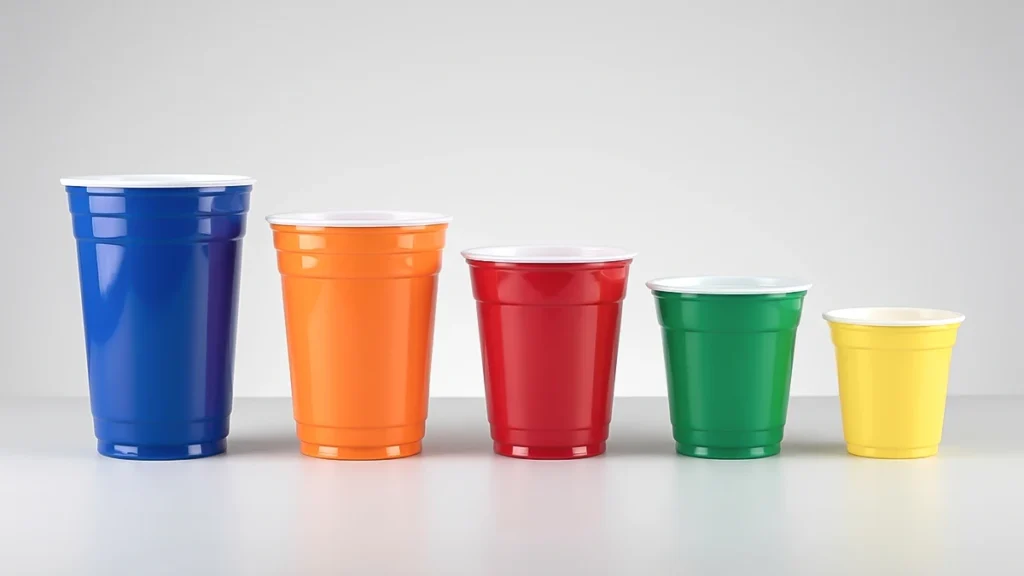
Why 90 mm and 98 mm Became the Working Standards
Rim diameter is the single most consequential dimension on a disposable cup. It decides which lid fits, which dispenser works, how the cup nests in a stack, and how many cases fit on a pallet.
The market settled on two rim families because tooling, lids, carriers, and filling equipment all converged around them. A 90 mm rim is the classic cold-drink format: compact, economical, and well suited to 9 to 16 oz servings. A 98 mm rim carries more volume and gives a wider mouth for ice, fruit, and toppings.
Once a converter invests in a mold family, lids, cartons, and pallet patterns follow that diameter for years. That is why buyers see so few options between the two, and why a “custom” 95 mm cup often costs noticeably more than a standard 98 mm one.
The practical difference on a filling line
A 98 mm cup takes a wider fill nozzle and moves more product per cycle, but the larger footprint reduces cases per pallet. A 90 mm cup packs tighter and nests deeper, which lowers freight cost per unit.
For beverage programs running high volumes of 12 to 16 oz, 90 mm usually wins on landed cost. For 20 oz and above, or anything with ice and toppings, 98 mm tends to be the only workable choice.
Nominal Capacity vs Actual Capacity
The ounce printed on a cup is a marketing figure, not a fill instruction. Three different capacities exist on the same product, and only one of them matters to your customer.
- Brim capacity — the volume when liquid sits level with the rim. This is the biggest number and the one most often quoted.
- Fill-line capacity — the volume at the designed fill line, leaving headspace for movement during transport.
- Working capacity — what a real serving looks like once ice, foam, or a lid with a dome is involved.
A cup marketed as 16 oz typically holds close to 470–500 ml at the brim. Once you leave headspace and add ice, the drink a customer receives is smaller than the label implies. That gap is normal, and it is also the most common source of complaints from operators who feel short-changed.
| Nominal size | Common rim | Brim capacity (typical) | Practical working fill | Lid family |
|---|---|---|---|---|
| 9 oz | 90 mm | ~280 ml | ~250 ml | 90 mm flat |
| 12 oz | 90 mm | ~360 ml | ~320 ml | 90 mm flat or straw-slot |
| 16 oz | 90 mm or 98 mm | ~470–500 ml | ~420–450 ml | 90 mm or 98 mm |
| 20 oz | 98 mm | ~590–600 ml | ~520–540 ml | 98 mm dome or straw-slot |
| 24 oz | 98 mm | ~700 ml | ~610–640 ml | 98 mm dome |
Treat these as typical industry ranges rather than fixed specifications. Wall thickness, taper, and base design shift the numbers by a few percent between suppliers, so always confirm against the capacity test on the supplier’s own spec sheet before you print a size claim on packaging.
How to verify capacity before you commit
Ask for a brim-capacity test on the exact mold you will be buying, not on a catalogue page. A reliable check uses water at room temperature, a graduated cylinder, and three samples from different cavities.
If your supplier cannot provide that, request samples and measure in-house. It takes an afternoon and prevents a season of consumer complaints.
How Cup Shape Changes What You Actually Pour
Two cups with identical rims and identical nominal ounces can still differ by a visible margin, because geometry decides how usable the interior space really is.
A straight-wall cup uses its volume efficiently and stacks short, but feels larger in the hand. A tapered cup is easier to grip and de-nest, yet the lower taper eats into usable volume near the base. Tall, slim formats look premium in a bar setting; short, wide formats read as generous portions and suit food applications better.
Square and specialty formats
Square and oval cups hold more volume in the same rim footprint, which helps with shelf presence and portion perception. The trade-off shows up in lids and tooling: square lids cost more, seal differently, and are far less interchangeable across suppliers.
Stemless wine cups, dessert cups, and parfait formats sit in a separate tooling family altogether. If your range includes these, budget for dedicated lids rather than assuming a 98 mm flat lid will cover them.
The Rim Diameter Is Really a Lid Decision
Buyers often select a cup first and then look for a lid. Running the decision the other way saves money, because lid availability and cost frequently outweigh small differences in cup price.
Lids are matched to the rim bead, not to the ounce label. A 90 mm lid will not seat on a 98 mm cup, and mixing the two in one warehouse creates packing errors that only surface at the customer’s counter.
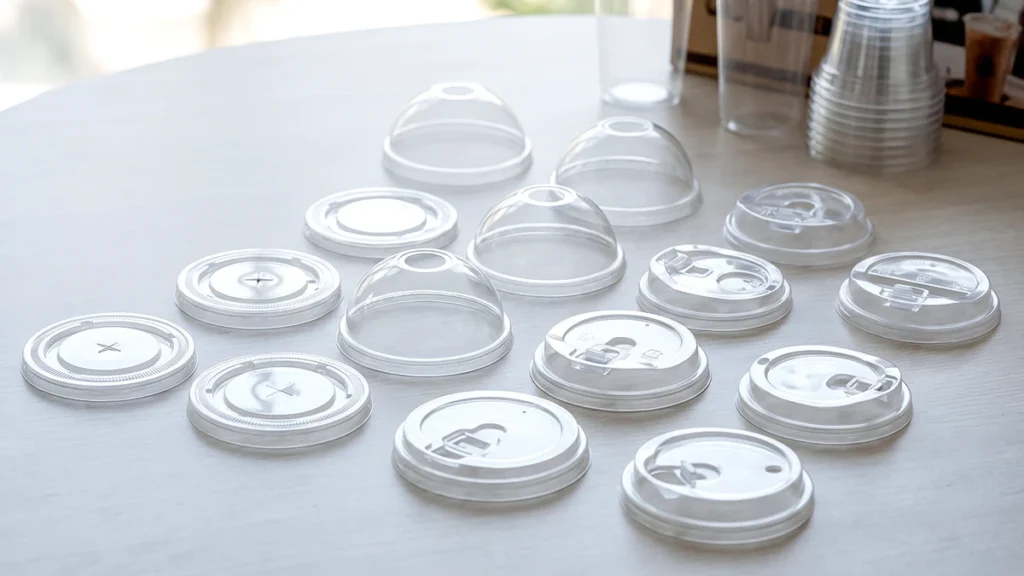
Common lid options within each rim family:
- Flat lids — lowest cost, stackable, standard for cold drinks and takeaway.
- Dome lids — clearance for whipped cream, toppings, and blended drinks.
- Straw-slot and drink-through lids — single-piece service without a separate straw.
- Sip lids and strawless designs — increasingly requested where single-use straw rules apply.
- Sealing film — for delivery and tamper evidence, matched to rim width and material.
Material choice matters as much as the diameter. PET gives clarity for cold applications; PP handles heat and offers a more flexible snap. Where a market or a client account pushes mono-material recyclability, cup and lid need to come from the same resin family, and that constraint can override a small cost advantage elsewhere.
What This Means for Your Purchase Order
Before you compare quotes, pin down five things and put them in writing on the PO. Each one prevents a different class of problem later.
- Rim diameter and tolerance — measured across the outside of the rim bead, with the acceptable range stated.
- Capacity basis — whether the quoted ounce refers to brim or fill-line, and the test method used.
- Lid compatibility — the exact lid SKU qualified for that cup, not just “98 mm lid”.
- Case pack and nesting height — this drives freight and warehouse cube more than unit price does.
- Food-contact compliance — FDA or EU documentation for the specific resin and color, including any recycled content.
Two operational details are easy to overlook. Cup dispensers and sleeves are built around one rim size, so a switch from 90 mm to 98 mm may require new front-of-house equipment. Four-cup carriers and drink trays are sized the same way, and a rim change can invalidate stock you already hold.
Mixing rims inside one product line is workable, but only when the difference is visible at a glance. Color-coded lids or a distinct cup height reduce the chance that a picker grabs the wrong size during a rush.
For buyers assembling a full disposable range, ordering cups, lids, and carriers from one source removes most of these compatibility questions at the quotation stage. Reliancepak supplies plastic cups and paper cups with matched lid families, OEM/ODM tooling, and food-grade documentation for export markets, and provides free samples so you can run a capacity and lid-fit check before committing to volume.
FAQ
Is a 98 mm lid compatible with a 90 mm cup?
No. The two rim families differ by 8 mm, far beyond any molding tolerance, so a 98 mm lid will not snap onto a 90 mm cup. Always order lids by rim diameter and confirm the qualified SKU with your supplier.
Why does my 16 oz party cup seem to hold less than 16 oz?
Because nominal size is usually measured at the brim, while a real serving leaves headspace and often includes ice. A 16 oz cup typically delivers roughly 420–450 ml of drinkable liquid once those factors are applied.
Can I use the same cup for hot and cold drinks?
Not usually. Cold cups are commonly PET or PP with a thin wall, while hot applications need insulation and heat resistance. Using a cold cup for hot beverages can cause deformation and lid failure.
How do I confirm the capacity of a new supplier’s cup?
Run a brim-capacity test on samples from the actual production mold, using water and a graduated cylinder across several cavities. Compare the result with the supplier’s spec sheet and with your filling target before approving the order.
Does rim diameter affect shipping cost?
Yes, indirectly. A larger rim reduces nesting depth and cases per pallet, so 98 mm cups generally carry a higher freight cost per unit than 90 mm cups of similar volume.