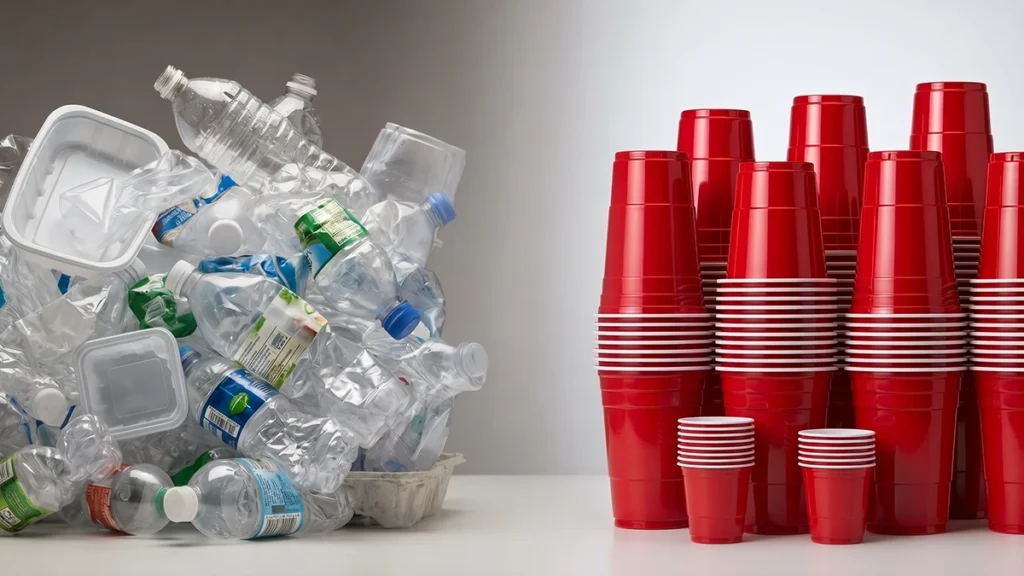
A bottle dropped in a recycling bin and a clear 16 oz party cup leaving a factory are, chemically, the same polymer. What sits between them is a chain of sorting, washing, vacuum decontamination, and paperwork — and that chain, not the chemistry, decides whether the cup can legally touch a drink.
Here is how post-consumer PET actually becomes new food-contact packaging, and what buyers should verify before committing to an rPET cup program.
Post-Consumer PET and rPET: One Is the Input, the Other Is the Output
Post-consumer PET is a waste stream: what gets collected after the first user is done with it, mostly beverage bottles plus tubs, trays, and clamshells. rPET is the resin produced when that stream is reprocessed. One is raw material; the other is the finished input to a cup line.
The gap between them is where quality is won or lost. The same bale can yield food-grade resin or fiber-grade flake headed for a polyester jacket, depending on feedstock discipline and process design.
| Term | What it refers to | Why it matters for a cup program |
|---|---|---|
| Post-consumer PET (PC-PET) | Collected packaging after end use | Determines contamination risk and legal eligibility |
| PCR content | Recycled content from household or commercial waste | The figure regulators and brand claims actually count |
| rPET | Recycled PET resin from reprocessing | The material your converter buys and forms |
| Food-grade rPET | rPET from an authorized process meeting food-contact limits | The only grade legal for direct drink contact |
Not every recycled flake qualifies
Three filters stand between a bale and a food-contact cup. Origin comes first: EU rules require the input to be overwhelmingly from food-contact applications, with only a small tolerance for non-food material. A detergent bottle and a water bottle are both PET, but only one belongs in a food-grade line.
Physical separation comes next. A single PVC bottle can release hydrogen chloride at PET processing temperatures and degrade an entire batch, so near-infrared sorting has to be reliable rather than nominal. Process validation is the third filter — the one buyers should interrogate hardest.
Can Recycled PET Go Back Into Food Packaging?
Yes, but the approval belongs to a process, not to a material.
Regulators do not certify “rPET” as a category. In the United States, a recycler submits challenge-test data to the FDA and, if the review is favorable, receives a Letter of No Objection covering a specific process and set of use conditions.
The EU takes a similar route: a process must be assessed and listed under Regulation (EU) 2022/1616 before its output can be sold for food contact. China, Japan, and other markets run comparable schemes, most borrowing the same logic.
The practical consequence is simple. A certificate is tied to a plant, a line, and a stated use. It does not travel with the material to a different converter, and it may not stretch to a different application.
What a challenge test actually proves
A challenge test deliberately contaminates the feedstock with surrogate compounds — solvents, hydrocarbons, and similar substances chosen to mimic careless disposal. The material then runs through the real process, and residual concentration is measured.
If the decontamination step strips enough of those surrogates, the process is judged capable of producing resin whose migration into food stays below conservative safety thresholds. Temperature, vacuum level, and residence time are the parameters regulators expect to see controlled and recorded.
Why the cup is still new
Decontamination does not restore the polymer perfectly. Heat history from the first life and from reprocessing shortens the molecular chain, which shows up as lower intrinsic viscosity and weaker walls.
Food-grade lines compensate with solid-state polymerization or an equivalent vacuum treatment, rebuilding molecular weight until the resin behaves close to virgin material.
The cup that leaves the mold is new where it counts: new tooling, new wall geometry, restored strength, and a documented decontamination history behind the pellets.
From Bale to Cup: The Conversion in Brief
The sequence below is typical for mechanical recycling feeding a cup line. Details vary by plant; the logic does not.
- Collection and bale breaking. Bottles are aggregated by material and color; clear and light blue streams hold the most value because they keep the final cup visually clear.
- Sorting. NIR units eject PVC, PS, and metal, while color sorters protect the clarity target.
- Grinding and hot wash. Hot caustic solution strips glue, soil, and label residue; flakes are then rinsed and dried.
- Melt filtration and pelletizing. Molten polymer passes through fine-mesh screens that catch undissolved particles before the strand is cut into pellets.
- Decontamination. Vacuum and heat, or a solid-state reactor, strip volatile residues from the polymer matrix. This is the critical control step for food contact.
- Cup forming. Pellets become sheet for thermoforming, or go straight to thin-wall injection molding. Trimming, rim rolling, leak checks, printing, and packing follow.
A party cup adds its own tolerances. Rim diameter has to match lids and cup holders, wall thickness has to survive a full pour without paneling, and clarity has to hold up under venue lighting rather than a lab bench.
Where rPET Party Cups Make Sense — and Where They Do Not
Party cups are cold-service vessels with a short use window, which makes them one of the more forgiving rPET applications. That does not make them universal.
| Use case | Fit | What to watch |
|---|---|---|
| Festivals, stadiums, branded events | Strong | Deposit-return logistics and wash durability if reusable |
| QSR and cinema cold drinks | Strong | Lid fit, stack height, condensation handling |
| Beer and mixed drinks at volume | Good | Wall stiffness at full fill; ink suitability |
| Hot coffee or tea service | Poor | PET softens well below boiling; use PP or a validated alternative |
| Oven or microwave reheating | Not suitable | Outside the scope of food-contact evaluation for rPET |
Three commercial signals are pushing rPET cups from novelty toward default. EU packaging rules set a 30% recycled-content floor for PET contact-sensitive packaging by 2030, rising to 50% by 2040.
Brand owners with public pledges need volume, not samples. And event organizers under single-use scrutiny want a cup that is either genuinely reusable or clearly recyclable.
That last point hides a design decision most programs get wrong. A cup wrapped in a full-body shrink sleeve, printed with carbon-black ink, or paired with a mismatched lid is hard to sort and often ends up as residue.
If the goal is a cup that comes back as a cup, decoration and closure choices matter as much as the resin.
What to Check Before You Place an Order
Confirm what the documentation covers
Ask for the FDA letter or EU register entry for the specific recycling process behind your resin, and check that the stated use conditions match a cold-drink cup. Pair it with a batch certificate of analysis and a food-contact declaration for the finished article.
A supplier who can only produce a logo and a sustainability brochure is telling you something.
Lock the visual and structural specification
Recycled content carries a slight tint that virgin resin does not. Agree on a clarity standard and an approved sample under defined lighting, because “clear” means different things to a buyer, a QA engineer, and a mold setter.
Then pin the structure: top-load strength, rim dimension, base diameter, stack height, carton count. These decide how the cup runs on a filling line and stacks on a pallet, and they belong in a dimensional report attached to the pre-shipment sample.
Be precise about temperature and reuse
For a reusable program, ask for documented wash-cycle performance and the maximum service temperature in writing. Care icons on the cup should match the test data, not a marketing assumption. For single-use cold service, put the temperature range in the purchase order so responsibility stays defined.
Work with a supplier that handles material and compliance together
Reliancepak produces food-grade packaging for wholesale buyers and supplies rPET cups alongside virgin PET, PP, and paper formats, which helps when one event program needs more than one material. Samples and process documentation can be reviewed against your destination market before an order is committed.
FAQ
Is a cup made from post-consumer PET safe to drink from?
Yes, provided the resin comes from an authorized recycling process and the finished cup meets food-contact migration limits for its intended use. Safety comes from validated decontamination and testing, not from the word “recycled” on the box.
Can rPET party cups hold hot drinks?
Generally no. PET softens well below boiling point, so hot coffee or tea service calls for PP or a supplier-validated alternative. Treat rPET party cups as cold-service products unless documented otherwise.
Is rPET more expensive than virgin PET?
Often yes, though the gap moves with oil prices, collection rates, and regional demand for food-grade material. Compare landed cost per thousand units rather than resin price alone, since lightweighting and pallet density can offset part of the premium.
How many times can the same PET be recycled?
Repeated mechanical cycles gradually reduce molecular weight, so each pass needs evaluation rather than assumption. Food-grade streams stay viable through blending with higher-viscosity material and by keeping non-food PET out of the loop.