
Bagasse cups have moved out of the eco-niche catalogue and into mainstream food service supply. The question for most buyers is no longer whether the material works, but whether it fits your cost structure and the way your customers actually use a cup.
This guide covers what bagasse is, what to verify on food contact, what drives landed cost, and where the material still has real limits.
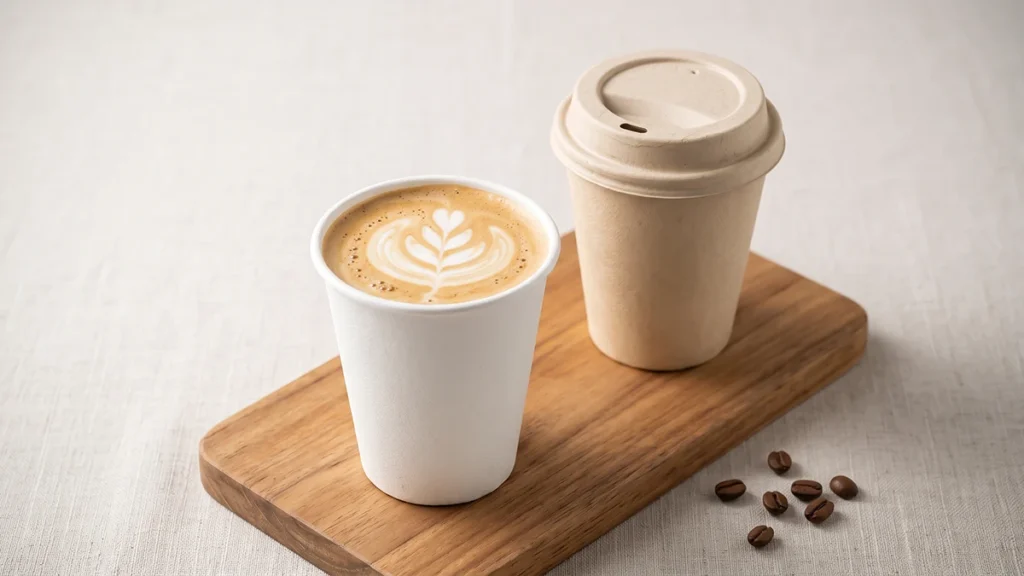
What Bagasse Is
Sugarcane bagasse is the fibrous residue left after the juice is pressed out of the cane. Rather than being burned at the mill, it is cleaned, pulped and molded under heat and pressure into cups, bowls and trays.
That molding step is what makes it useful for food packaging. The fibers bond without added binders on most food-grade lines, and the finished wall is rigid enough to hold its shape under load. Most food-contact grades then receive a thin lining, usually water-based or PLA, to slow liquid penetration.
Food Safety: What to Check Before You Order
Bagasse is a plant fiber, so the safety conversation comes down to three things: raw material cleanliness, the lining, and the converting environment.
Ask for documentation on the specific SKU, not a general company certificate:
- Food-contact compliance — a current FDA or EU 10/2011 declaration that names the product and the production site.
- Lining specification — water-based coatings and PLA are common. An unnamed or solvent-based lining deserves closer questions if you serve hot or fatty foods.
- Migration and heavy metal reports — usually renewed annually and traceable to a batch, not a sample pulled two years ago.
One detail buyers tend to miss: the lining, not the fiber, is the part that meets hot liquid. Very hot drinks held for a long service window put more stress on a thin coating than a quick coffee pour does. If your menu runs to near-boiling tea or oily broth, test samples under your own serving conditions instead of trusting the spec sheet alone.
What Drives the Unit Cost
Bagasse pricing rarely moves for one reason. Four inputs usually explain most of the gap between quotes:
| Cost input | How it behaves in bagasse | What to do about it |
|---|---|---|
| Raw fiber | Residue-based supply, tied to the sugar milling season | Book volume ahead of the off-season |
| Tooling | Mold cost per shape, spread across order quantity | Start with fewer sizes |
| Lining | Water-based is cheaper, PLA carries a premium | Match the lining to the food, not to habit |
| Freight | Low density, bulky cartons | Ask for nest count per carton |
Comparing materials, bagasse usually lands above plain paper and below PLA in the same format, though the gap narrows quickly at container-load volumes. Against thin PP or PS, expect to pay more per unit, and expect that difference to be the main objection your sales team hears.
Durability in Real Service
Rigidity is where bagasse earns its place. An unlined paper cup softens from the outside within minutes; a molded fiber cup holds its wall far longer because the fiber density is higher and the lining is doing less structural work.
- Rim and wall strength — survives lid pressure, stacking and a full tray of drinks.
- Heat — comfortable with hot coffee and tea for a normal service window, behind PP for prolonged hot holding.
- Condensation — the outer wall can soften after long contact with sweat; a sleeve or double-wall format solves it.
- Microwave — varies by lining, so confirm in writing before you promise it to a customer.
Where It Falls Short
Honest limitations matter more than a feature list. Bagasse is heavier per unit than PP, which shows up in freight once you scale. It is opaque, so no one can see what is inside. Custom molds carry lead time that stock shapes do not. And printing on a natural kraft-toned surface reads softer than on bleached board, which some brands like and others do not.
None of these are deal-breakers. They are the reasons bagasse tends to win in dine-in, catering, event and premium takeaway channels rather than in high-volume, low-price beverage programs.
Sourcing Bagasse Alongside Your Other Formats
Most buyers do not switch a whole cup range at once. They add bagasse for the channels that ask for it and keep paper or plastic where the price point is tighter. Sourcing all three from one supplier keeps lids, sizes and carton counts consistent, and cuts the number of incoming inspections your warehouse has to run.
You can review the disposable cups we produce in bagasse, paper and plastic to see how the formats line up. We supply these in wholesale volumes with custom sizing, printing and packing for buyers who need their own specification, and we send samples before production so your team can test fill levels and lid fit first.
FAQ
Are sugarcane bagasse cups safe for hot drinks?
Yes, when the cup carries a food-contact lining rated for hot liquid. Check that the compliance document names the SKU you are ordering, and test a sample with your hottest menu item before committing to volume.
Do bagasse cups cost more than paper cups?
Usually yes at low volumes, and the difference narrows at container-load quantities. The comparison also depends on the lining and the mold. A stock shape with a water-based lining is the cheapest way into the material.
Can bagasse cups be composted?
Yes under commercial composting conditions, where the lining breaks down alongside the fiber. Home compost performance varies by coating, so avoid claiming home compostability unless your supplier documents it for that specific product.
Can we print our logo on bagasse cups?
Yes. Flexo and offset printing both work on molded fiber, and water-based inks keep the cup inside most compostability claims. Expect slightly muted color on the natural fiber surface compared with bleached board.
Are bagasse cups microwave safe?
Not always. It depends on the lining and the reheating duration, so ask for a written statement for the exact SKU rather than assuming the category is safe.