
Polystyrene (PS) still moves through a large share of the world’s takeaway counters, butcher blocks, and bakery shelves. It is cheap, stiff, and fast to thermoform, and the tooling for it is already bolted into thousands of plants.
It also sits inside a narrowing corridor of regulation, retail policy, and end-of-life reality. This guide separates the grades, the food-safety variables, and the alternatives by job, so you can decide per SKU rather than per slogan.
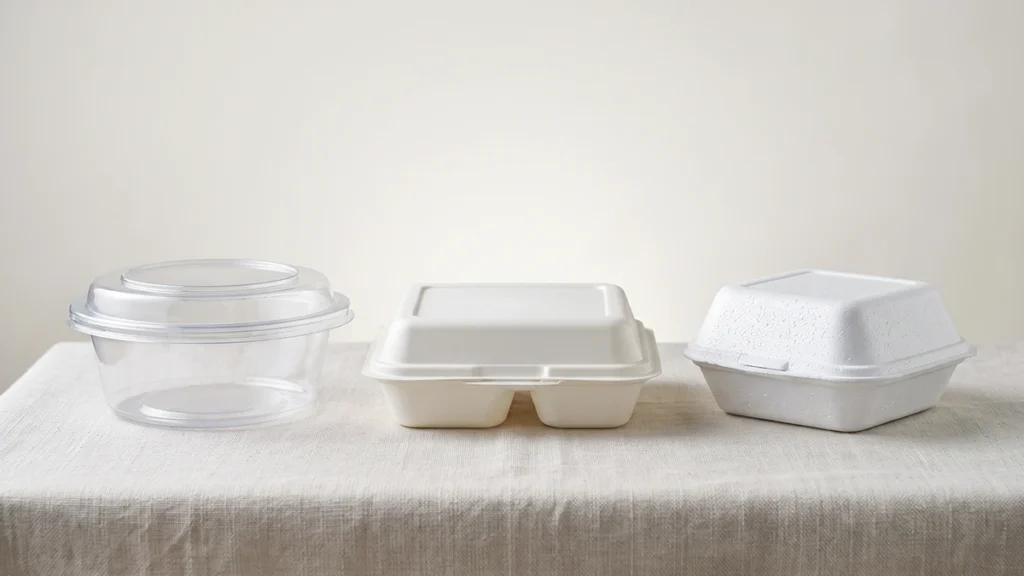
Four Grades That Behave Nothing Alike
“Polystyrene food packaging” is a family, not a product. A foam clamshell and a clear lid share a polymer backbone, but they differ in density, heat tolerance, barrier behavior, and how likely they are to be collected after use.
| Grade | Typical density | Usual food applications | What it does well | Where it struggles |
|---|---|---|---|---|
| EPS (expanded) | 15–30 kg/m³ bead foam | Clamshells, cups, meat and produce trays, insulated boxes | Low unit cost, thermal insulation, stiffness per gram | Bulky to collect, restricted in several markets |
| XPS (extruded) | 30–45 kg/m³ closed-cell sheet | Meat, seafood, and bakery trays | Moisture resistance, clean cut on automated lines | Denser and costlier, thin end markets |
| HIPS | Rigid, opaque, thermoformed | Deli and yogurt cups, lids, vending trays | Impact strength, print quality, fast cycling | Opaque, limited heat ceiling, fatty foods |
| GPPS | Rigid, crystal clear | Clear lids, cold cups, cutlery, display boxes | Clarity, stiffness, low cost | Brittle, poor solvent and heat resistance |
Foam: EPS and XPS
EPS is bead foam expanded with steam. Because the finished part is mostly air, it delivers insulation and stacking strength at very little weight, which is why hot food and chilled protein both end up in it.
XPS is extruded into closed-cell sheet with a smooth skin. Butchers and seafood packers often prefer it because it resists drip, holds a tight seal, and cuts cleanly.
Rigid: HIPS and GPPS
HIPS is rubber-modified and opaque. It absorbs impact instead of shattering, takes six-color print well, and runs quickly on pressure-forming equipment, which suits deli containers and dairy cups.
GPPS is clear and stiff but brittle. It works for lids and cold display, then shows its limits the moment a pack is dropped on a cold loading dock or filled with citrus-heavy dessert.
Where Polystyrene Still Earns Its Place
Pretending the material has no advantages does not help anyone buy well. For short-life, ambient or chilled service, foam is difficult to beat on cost per unit.
It holds shape under a loaded crate, keeps condensation off the food, and runs on inexpensive molds with short cycle times. In markets that lack collection for substitutes, a light PS pack can also carry a lower total logistics burden than a heavier “greener” tray that ends up in the same landfill.
Frozen and chilled distribution is another honest use case. HIPS and XPS give stiffness and moisture resistance where a fiber tray would sag or wick.
Food Safety: The Variables That Decide It
Polystyrene is authorized for food contact in major markets. In the US, polystyrene and rubber-modified polystyrene are listed in FDA’s food-contact regulations at 21 CFR 177.1640; in the EU, PS articles must satisfy the framework regulation for food-contact materials and the plastics measure, backed by migration testing.
Those authorizations attach to a finished article and a defined set of use conditions. They do not attach to the word “polystyrene” on a quotation.
Three variables usually decide whether a specific pack is appropriate:
- Temperature. Standard PS softens well below boiling. A container rated for chilled salad is a different product from one rated for hot noodles, and microwave reheating falls outside the design envelope of most PS packs.
- Fat and solvent load. Fatty sauces and citrus peel oils raise migration and can attack the surface. Dressings, mature cheese, and zest-heavy desserts deserve a compatibility check before the mold is cut.
- Additive package. Insulation-grade foams may carry flame retardants that have no place in food contact. Food-grade resin from a documented source will not, but the declaration is what proves it.
Ask your supplier for the food-contact statement, migration test reports, the rated temperature window, and an explicit answer on post-consumer recyclate in the food-contact layer. EU rules restrict recycled PS in food contact unless a validated process is in place, and “recyclable” claims on the box say nothing about that.
Recycling Is a Collection Problem First
The material can be recycled. Rigid HIPS regrinds into new sheet, and foam can be densified and pelletized for insulation and construction products. Routes that return PS to styrene monomer are running at commercial scale in some regions.
The bottleneck is feedstock. Foam is roughly 95 percent air by volume, so a full truck carries very little polymer, and food residue lowers bale value further. Many municipal programs exclude foam outright, and drop-off networks reach only part of the market.
Rigid PS travels a better road. It is denser, bales well, and is accepted by more sorting facilities, though the same contamination penalty applies when cups arrive with sauce still in them.
Policy Now Sets the Frame
In the EU, the single-use plastics directive took expanded polystyrene food and beverage containers for ready-to-eat food off the market in 2021. The packaging and packaging waste regulation adds design-for-recycling duties, recyclability grading from 2030, recycled-content targets for plastic packaging, and eco-modulated producer fees.
In the US, restrictions sit at state and city level rather than federal, so a foam clamshell can be lawful in one state and prohibited a few hundred miles away. China and several Southeast Asian markets have tightened rules on disposable foam tableware and non-degradable single-use items at different speeds, with different enforcement.
For a buyer distributing across markets, the consequence is concrete: the same SKU can clear customs in Lima and fail in Lyon. Map destination, product category, and food-use condition before you commit to a tool.
Alternatives, Matched to the Job
No substitute wins everywhere. Service temperature, fat load, shelf life, and the local waste system decide more than a sustainability claim on a spec sheet.
| Alternative | Fits well when | Watch for |
|---|---|---|
| Polypropylene (PP) | Hot fill, reheating, fatty and saucy foods, tamper-evident lids | Higher unit cost than foam, needs PP sorting to recycle well |
| PET and rPET | Chilled deli, salads, bakery, clear presentation | Not for hot fill, food-grade recyclate supply varies by region |
| Molded fiber (bagasse, bamboo) | Takeaway mains, hot or cold, plastic-free procurement rules | Grease barrier must be PFAS-free, stack height and moisture limits |
| Coated paperboard | Dry or short-contact items, bakery, fries, dry snacks | Weak against prolonged wet contact |
| PLA and CPLA | Cold and warm service where industrial composting exists | Heat ceiling, no home composting, limited collection |
| Aluminum foil | High heat, baking, catering, long hold times | Cost, no product visibility |
A few field notes. PP is the usual upgrade for hot and oily menus because it tolerates reheating; the recycling advantage only materializes where PP is sorted. Molded fiber satisfies plastic-free mandates, but the barrier chemistry matters more than the fiber source. rPET works well for chilled, transparent packs where food-grade recyclate is available. PLA needs industrial composting to mean anything at end of life.
How We Approach This at Reliancepak
We still run polystyrene lines, and there is no point pretending otherwise. Distributors with established foam programs, buyers in price-sensitive markets, and processors with PS molds already paid for have real reasons to keep ordering it. Refusing to quote would only move the order to a supplier with thinner documentation.
What we do instead is quote both sides. When a request comes in for a foam clamshell, we ask what goes inside, at what temperature, and where it ships. If the answer is a hot, oily product bound for the EU, a PP or molded fiber option appears next to the PS price, with the test reports attached, and the choice stays with you.
That is also why molded fiber, PP, PET, and paperboard sit in the same catalog as PS, and why samples are free. A pack that jams your filling line or leaks in transit is not a saving, whatever the unit price says.
OEM and ODM work follows the same logic. Your artwork, your dimensions, your destination market’s paperwork, whether the substrate is foam, fiber, or film — and the compliance file travels with the container instead of chasing it at the port.
FAQ
Is polystyrene food packaging safe for hot food?
No, not for hot fill or reheating in most cases. Standard PS softens below boiling, and heat combined with fat raises migration; PP or fiber is the safer route for hot service.
Is EPS the same as Styrofoam?
No. Styrofoam is a trademarked extruded foam used mainly in construction, while EPS is the expanded bead foam found in food containers and cups.
Can polystyrene food containers be recycled?
Yes, technically. Rigid PS recycles well where sorting exists; foam is seldom collected because it is mostly air and frequently contaminated with food.
Which alternative replaces foam clamshells most easily?
Molded fiber or PP, depending on the menu. Fiber matches plastic-free procurement rules; PP handles heat and grease with fewer barrier compromises.
Does Reliancepak still supply polystyrene packaging?
Yes. We keep PS production running for buyers who need it, and we quote PP, PET, fiber, and paper alternatives alongside so the comparison is on the same table.