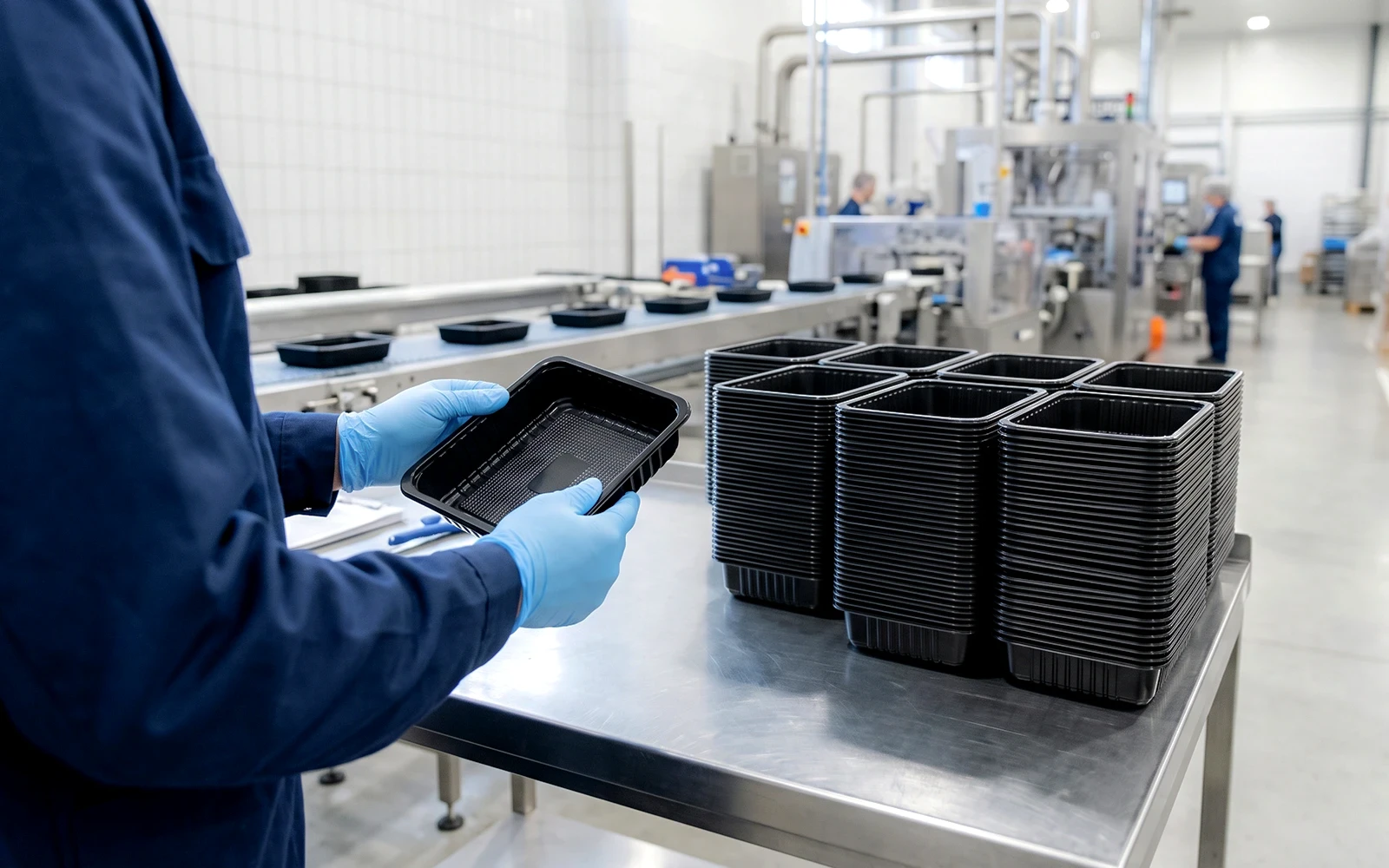
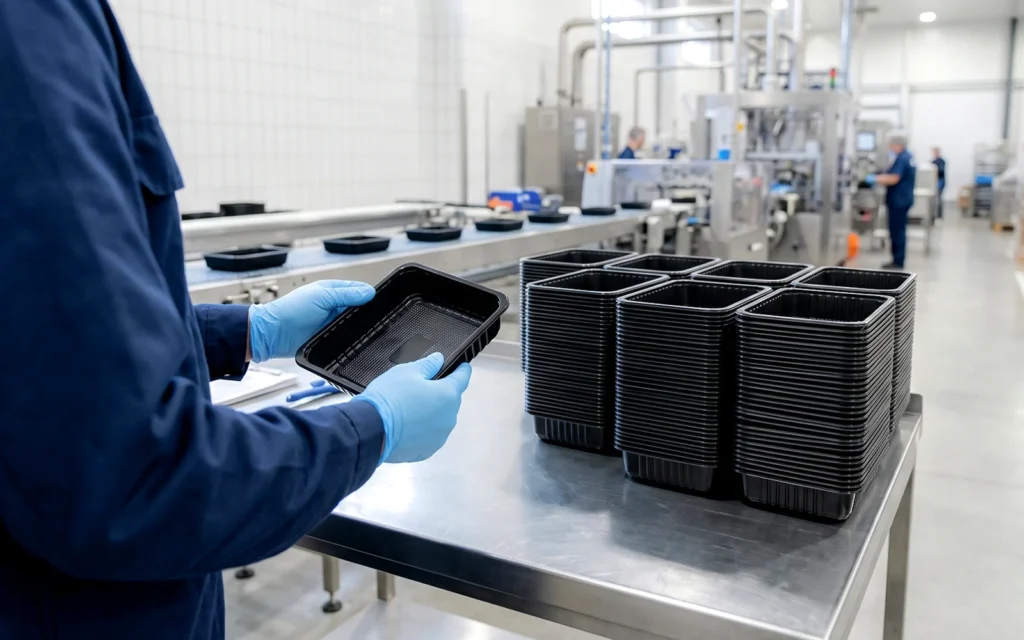
A PP tray (polypropylene tray) is one of the most widely used substrates in modern food packaging, from fresh produce and meat trays to ready-meal and bakery inserts. This guide walks you through the details that actually matter when you buy: typical sizes and thickness ranges, how thermoforming shapes the tray, what customization looks like in practice, and the MOQ terms you should expect from a wholesale supplier.
Whether you run a food processing plant, a packaging distribution business, or a produce farm shipping to retail chains, the goal is the same — pick a tray that protects the product, runs on your packing line, and keeps your landed cost predictable.
Why PP Is a Default Material in Food Packaging
Polypropylene earns its place in food packaging for a few practical reasons rather than marketing ones:
- Temperature tolerance. PP handles both chilled and microwave reheating scenarios in many applications, which matters for ready meals and deli products.
- Moisture and oil resistance. Fresh meat, seafood, and prepared foods release liquids and fats; PP resists both without delaminating the way some paper-based options can.
- Food-contact compliance. Reputable manufacturers supply trays that meet FDA and EU food-contact requirements — always ask for the certification documents before placing a trial order.
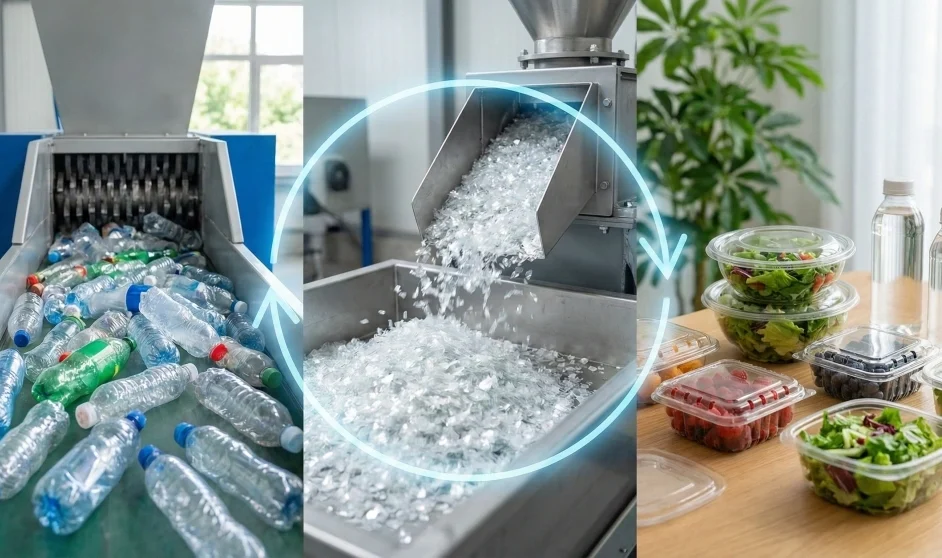
- Recyclability. PP is coded as resin identification code 5 and is accepted in many recycling streams, which supports retailer sustainability requirements.
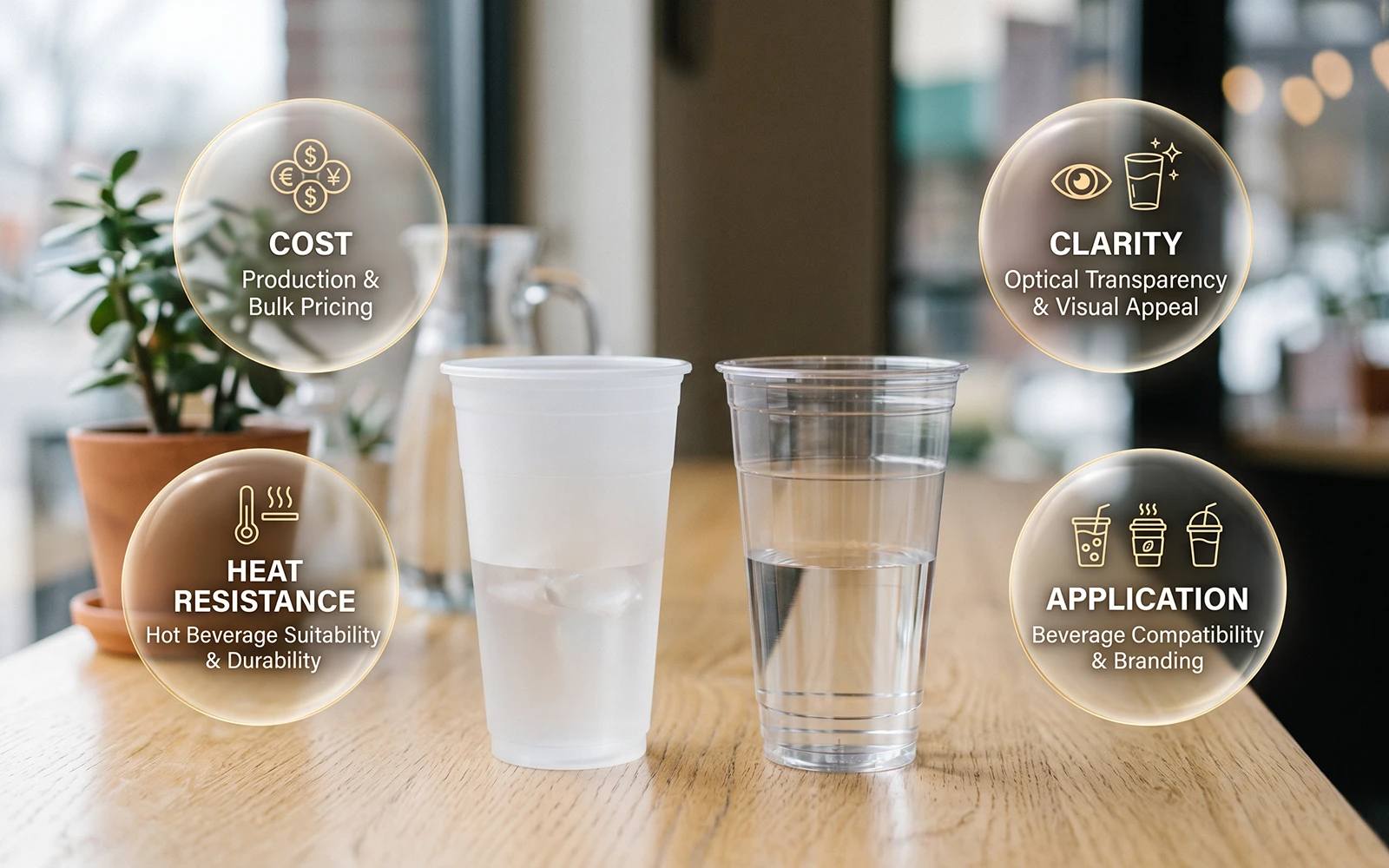
Compared with PET or molded pulp, PP typically offers a better balance of flexibility and cost for applications where the tray needs to survive freezing, heating, or oily contents. The right choice still depends on the specific application, so it is worth testing samples under your real product conditions.
Where PP Trays Are Used Across the Food Industry
Application shapes the tray far more than the other way around. The same material serves very different jobs:
- Fresh produce. Fruit and vegetable trays for supermarkets need rigidity for stacking plus ventilation holes or dome-lid compatibility to manage condensation.
- Meat and seafood. Absorbent-pad compatible trays with high moisture resistance; darker colors are common to mask liquid staining at retail.
- Ready meals and deli. Microwave-safe containers and compartment trays, often paired with lidding film on automated sealing lines.
- Bakery and confectionery. Insert trays that hold pastries or chocolates in place inside a paperboard sleeve or box.
- Sushi and chilled snacks. Clear or black base trays sized for retail shelf spacing and MAP (modified atmosphere packaging) workflows.
If your product sits in more than one of these categories, it is usually cheaper to consolidate on one tray platform with size variations than to manage several unrelated SKUs.
Typical Sizes and Thickness Ranges
There is no universal standard, but the industry clusters around predictable ranges. The table below reflects commonly seen configurations in wholesale food packaging — treat them as orientation points, not fixed specs:
| Tray Type | Typical Thickness | Common Use Case | Notes |
| Thin-wall produce tray | ~0.3–0.6 mm | Berries, grapes, cherry tomatoes | Lightweight; often with vent patterns |
| Meat / seafood tray | ~0.5–0.9 mm | Fresh cuts, fish, poultry | High rigidity; pairs with absorbent pads |
| Ready-meal container | ~0.6–1.0 mm | Chilled and reheatable meals | Microwave-safe grades; rim designed for lidding film |
| Compartment tray | ~0.5–0.9 mm | Bento-style meals, snack packs | Multi-cavity forming; custom tooling usually required |
| Bakery insert | ~0.3–0.7 mm | Pastries, cookies, chocolates | Fits inside cartons; low-profile cavities |
Thickness drives two things you will feel immediately: stiffness under stack weight, and material cost per tray. A tray that is too thin warps on the shelf; one that is too thick wastes resin on every unit. For high-volume buyers, that difference compounds quickly across a full container load.
How Thermoforming Shapes a PP Tray
Most food-grade PP trays are produced by thermoforming: a heated plastic sheet is softened, formed over or into a mold under vacuum or pressure, then trimmed. Understanding the process helps you communicate with suppliers and spot quotes that are unrealistic.
The basic flow looks like this:
- Sheet extrusion. PP resin is extruded into roll stock at the target thickness, often with additives for food contact or color.
- Heating and forming. The sheet is heated to forming temperature and pulled into the mold cavity, which defines cavity depth, radii, and wall distribution.
- Trimming and stacking. Formed trays are die-cut from the web, inspected, and stacked for packing.
Two practical implications for buyers. First, tooling: a standard catalog tray uses existing molds and carries no tooling cost, while a fully custom cavity design requires new tooling with a lead time and an upfront fee — many suppliers amortize this into the order once volume reaches an agreed threshold. Second, design constraints: very deep cavities, sharp internal corners, and inconsistent wall thickness targets all increase forming difficulty, so a design review with the manufacturer before committing to tooling saves revision cycles.
Customization and OEM/ODM Options
For distributors and food brands, customization is usually where a supplier either proves their value or falls apart. A capable manufacturer of PP food trays can typically offer:
- Size and cavity engineering matched to your product dimensions and your packing line’s denesting speed.
- Color matching, including retail-standard black, clear, and white, plus brand-specific colors at higher volumes.
- Surface options such as debossing or printed labels on rim areas, depending on the forming process.
- Material adjustments — for example, additives that improve low-temperature performance for frozen applications.
The distinction between OEM and ODM matters here. With OEM, you provide the design and the manufacturer produces to your drawings. With ODM, the manufacturer adapts an existing mold or co-develops the design, which shortens lead time and lowers cost. If you are testing a new product line, starting from an ODM-modified catalog tray is usually the faster route.
MOQ, Lead Time, and Samples: What to Expect
Wholesale terms vary by supplier and region, but the patterns below reflect how most food-packaging factories operate:
| Item | Typical Practice | What to Negotiate |
| MOQ for stock trays | Low; sometimes mixed-SKU trial orders allowed | Sample quantities and mixed sizes per shipment |
| MOQ for custom trays | Higher; tied to tooling amortization | Volume-based tooling fee waiver |
| Free samples | Common for stock items; buyer pays freight | Sample evaluation support (specs, certifications) |
| Lead time (stock) | Short, subject to production scheduling | Buffer stock or rolling forecasts for seasonal peaks |
| Lead time (custom) | Longer; includes tooling and trial runs | Milestone-based approval (drawing → sample → bulk) |
One warning based on how these negotiations usually go: a low quoted unit price means little if the MOQ forces you to hold six months of inventory. Ask for the total cost of the first order — tooling, freight, and duty included — not just the per-tray number.
How to Evaluate a PP Tray Supplier
A shortlist worth trusting usually shows the same signals:
- Integrated factory and trade operation. Manufacturers with their own extrusion and thermoforming lines control quality and scheduling better than pure trading intermediaries.
- Documented food-contact compliance. Ask for FDA or EU food-grade certification for the exact material grade, not just a general claim on the product page.
- Export experience in your market. Suppliers who already ship to your region understand the documentation, labeling, and logistics requirements you will face.
- Sample-first workflow. A supplier confident in their production will send physical samples and support your line trials before asking for a bulk commitment.
For buyers sourcing PP trays for food packaging, our Plastic Tray category lists standard formats with specification details, and the team can quote custom tooling when your project moves past the sampling stage.
FAQ
What MOQ should I expect when ordering custom PP food trays?
Custom tooling raises the MOQ because the supplier needs to recover mold and setup costs. Expect higher minimums than stock trays, and negotiate tooling amortization — some suppliers waive the fee once your cumulative volume reaches an agreed level.
Can PP trays go in the microwave and freezer?
Yes, PP performs well across chilled storage and microwave reheating in most food applications, which is why it dominates ready-meal packaging. Still, confirm the specific grade and wall thickness with your supplier, since performance depends on the formulation and the food’s temperature profile.
How thick should a PP tray be for fresh meat packaging?
Thickness depends on product weight, liquid release, and stacking requirements, so there is no single correct answer. Meat trays typically sit in the mid-range of tray thicknesses — request samples at two or three thicknesses and test stack performance with your actual product.
What is the difference between vacuum forming and pressure forming for PP trays?
Both are thermoforming methods. Vacuum forming pulls the heated sheet into the mold with suction and suits most standard food trays, while pressure forming adds air pressure for sharper detail and texture — usually relevant for premium retail presentation rather than basic utility trays.
Do suppliers provide food-contact certificates?
Yes, established manufacturers provide FDA or EU food-contact documentation for their material grades on request. If a supplier hesitates to share certificates for the exact grade they will produce, treat that as a selection risk.