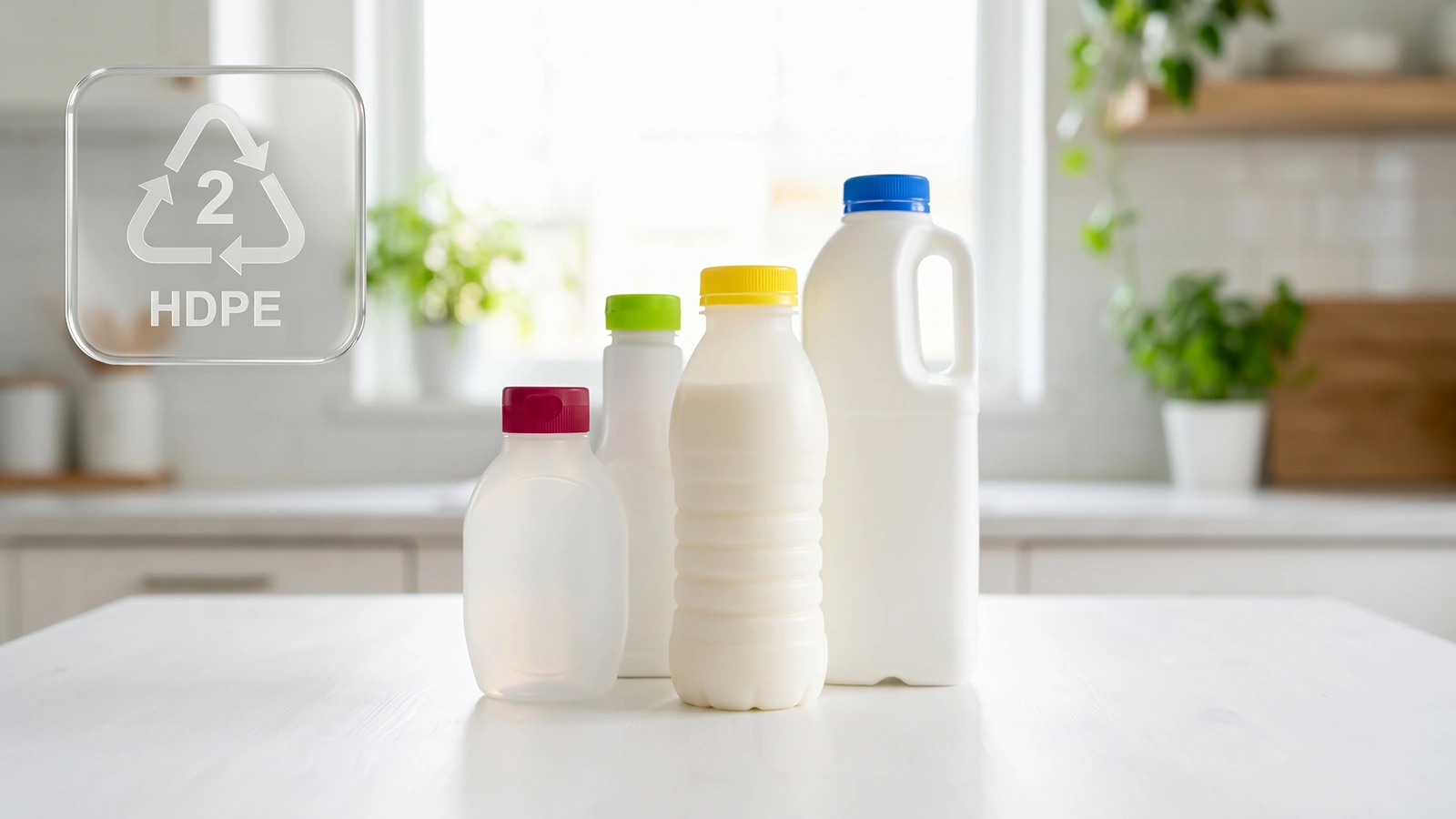
High-density polyethylene is one of the most common polymers in rigid food packaging. It shows up in milk jugs, deli tubs, butter and yogurt containers, cutting boards, and reusable produce crates across retail, food service, and export channels.
Picking HDPE, though, is rarely a material-only decision. Buyers compare it against PET and PP on barrier, clarity, and thermal limits, then weigh those results against tooling cost, minimum order quantity, lead time, and food-contact documentation. This guide works through both sides of that decision.
Where HDPE Earns Its Place in Food Packaging
HDPE is a thermoplastic produced by polymerizing ethylene. Catalysts and process conditions can be adjusted to shift density and molecular weight, which is why one base polymer ends up in blow-molded bottles, injection-molded tubs, and extruded film.
Within food packaging, the material tends to appear in four recurring formats:
- Blow-molded bottles and jugs for milk, juice, and edible oils
- Injection-molded tubs, lids, and deli containers
- Injection-molded crates and trays for produce handling and cold chain
- Extruded sheet and film for liners and lidding
Direct food contact is the common thread. Each format loads the resin differently, which is where grade selection starts rather than ends.
How HDPE Behaves in a Food-Contact Application
Moisture and chemical performance
HDPE is nonpolar and semi-crystalline, so water vapor moves through it slowly. Condensation in cold chain, moisture migration from wet produce, and sweating on chilled surfaces are less of a problem than they are with more hydrophilic materials.
Chemical resistance is the second half of that story. HDPE shrugs off most acids, bases, and alcohols, so a container rarely reacts with the food inside it. That is the practical reason it holds up for sauces, dressings, and cleaning-adjacent food service environments.
Temperature ceiling and where it matters
HDPE softens at a lower point than polypropylene, and that single difference decides a lot of packaging briefs. A container that needs hot fill, retort, or microwave reheating usually points toward PP, or toward a crystallized PET grade for ovenable trays.
HDPE stays in its comfort zone from frozen distribution through ambient storage, and handles warm fill in some configurations. Confirm the actual service window against the resin supplier’s datasheet before you commit a tool to it.
Grade selection is not optional
HDPE is a family, not a single specification. Blow-molding grades, injection grades, and film grades differ in melt flow index, and a grade built for one process will not run cleanly on another.
Two things follow from this. First, an RFQ that lists “HDPE” without a density band and MFI range is incomplete, and it invites a supplier to quote whatever is cheapest on hand. Second, switching grade mid-program is not a paperwork change — it typically means retesting wall thickness, cycle time, and seal performance.
HDPE vs PET vs PP: A Buyer’s Comparison
The three polymers overlap more than most spec sheets admit. The gaps that actually change a packaging decision show up in optical clarity, thermal ceiling, and barrier profile.
| Attribute | HDPE | PET | PP |
| Optical clarity | Translucent to opaque; easy to pigment | High clarity in amorphous grades; CPET is opaque | Translucent to opaque; clarified grades approach clear |
| Moisture vapor barrier | Strong | Moderate | Strong |
| Oxygen barrier | Low on its own | Moderate; improves with barrier layers such as EVOH | Low on its own |
| Chemical resistance | Strong against acids, bases, and alcohols | Weakens against strong alkalis and some solvents | Strong; widely used for hot fill and chemical exposure |
| Thermal ceiling | Lower; comfortable across cold chain and ambient | Standard grades have a low softening point; CPET is formulated for ovenable trays | Highest of the three; supports hot fill, retort, and microwave |
| Rigidity | High | High | Moderate to high, depending on grade and wall thickness |
| Typical food formats | Jugs, tubs, crates, closures | Bottles, thermoformed trays, jars | Cups, tubs, closures, microwave containers |
| Resin identification code | 2 | 1 | 5 |
| Recycling infrastructure | Widely recycled | Widely recycled | Recyclable where collection exists |
| Relative cost position | Generally among the lower-cost commodity resins | Typically higher, tied to bottle-grade demand | Mid-range, tracks propylene markets |
Reading the table by application is more useful than reading it row by row.
HDPE suits opaque or pigmented containers where toughness and moisture barrier matter more than shelf visibility. Think dairy, bulk condiments, produce logistics, and anything that takes a knock in transit.
PET is the choice when the product needs to be seen. Beverage bottles, clear juice, fresh-cut produce clamshells, and premium packaging all lean on its clarity, and bottle-grade PET also carries high recycled content availability in many markets.
PP takes over once heat enters the picture. Hot fill, retort, and microwave applications, along with parts that need a living hinge or very thin walls, generally resolve to polypropylene. If you need a quick orientation on the material itself, the PP overview covers its grades and processing routes in more detail.
Food-Contact Compliance: What to Ask For
Compliance belongs to the finished article, not to the resin alone. Colorants, processing aids, and any recycled content all feed into whether a container is cleared for food contact.
For virgin HDPE, the common reference points are 21 CFR 177.1520 for olefin polymers in the United States and Regulation (EU) No 10/2011 for plastic food-contact materials in the European Union. Both apply to the material and its additives, which is why a supplier should be able to hand over documentation rather than a verbal assurance.
Four documents are worth requesting at the shortlist stage:
- A declaration of compliance that names the regulation it is issued against
- Migration data, or at least a statement covering overall and specific migration limits
- Food-contact status of every colorant and masterbatch used in the part
- Confirmation of whether the resin is virgin, reprocessed, or post-consumer recycled
That last point deserves attention. Post-consumer recycled HDPE for food contact sits under additional scrutiny. In the United States it generally requires a letter of no objection for the specific recycling process, and the European Union governs recycled plastic food-contact material under a separate framework from virgin material.
What to Specify in an HDPE Packaging RFQ
Material comparison narrows the field. Procurement is where a shortlist turns into a purchase order, and vague RFQs are the usual source of downstream disputes.
| Specification area | What to lock down | Why it matters |
| Resin grade | Density band, melt flow index, homopolymer or copolymer | The wrong grade shows up as warping, short shots, and rejects |
| Food-contact documents | Declaration of compliance, migration data, colorant status | Retail audits, customs, and export markets all ask for it |
| Part specification | Cavity dimensions, wall thickness, gram weight, tolerances | Small weight drift shifts both unit cost and performance |
| Tooling | Mold ownership, cavity count, tooling cost and amortization | Sets your switching cost and shapes the MOQ |
| MOQ | Per SKU, per color, per print job | Drives inventory risk and where you land on the price curve |
| Customization scope | OEM or ODM, logo, print method, color matching | Each addition carries setup cost and lead time |
| Lead time and terms | Production window, Incoterms, port, shipping mode | Feeds straight into your reorder point |
| Sampling | Free or paid, sample lead time, approval loop | The cheapest way to catch a defect before tooling money is spent |
| Packaging and palletization | Carton count, pallet pattern, labeling, stretch wrap | Changes landed cost and warehouse handling time |
| Pricing | Unit price by tier, currency, validity window | Protects your margin when resin prices move |
| Quality terms | AQL level, inspection method, defect definitions, remedy | Defines what “reject” means before the first shipment |
One line item deserves extra attention. HDPE pricing tracks feedstock and ethylene markets, so unit prices quoted in isolation can age quickly. Buyers who purchase at volume often negotiate a short validity window or an index-linked formula rather than a fixed number, and that clause is easier to agree before the PO than after.
Sourcing Route: Distributor, Trader, or Direct Manufacturer
There are broadly three ways to buy HDPE food packaging, and the right one depends on order size and how much customization you need.
Distributors and traders carry mixed SKUs and accept smaller volumes, which helps when you are testing a format or filling gaps across several categories. Direct manufacturers typically offer better unit economics at volume, hold the tooling, and can run OEM or ODM work in-house.
For larger buyers, the tradeoff usually comes down to breadth against depth. A supplier who covers HDPE, PET, and PP under one roof lets you consolidate POs and negotiate across categories, though a specialist may go deeper on a single format. Reliancepak operates on the first model, supplying wholesale food packaging with OEM/ODM tooling and free samples for qualified buyers.
Sample evaluation resolves most of these questions faster than any quotation. Order samples of the same part in HDPE, PET, and PP where the format allows, run them through your own filling, sealing, and cold chain steps, and let the failure points make the decision.
Frequently Asked Questions
Is HDPE microwave-safe?
Generally no. HDPE has a lower softening point than polypropylene, so a container can warp or degrade under sustained microwave heat. Treat any plastic container as microwave-safe only when it carries that label.
Can HDPE be used for hot-fill applications?
Only within limits. HDPE sits below PP on the thermal scale, so hot fill usually points to polypropylene or a crystallized PET grade. Some warm-fill and pasteurized products do run successfully in HDPE, but the fill temperature and cooling profile should be confirmed against the specific resin datasheet.
How can I tell HDPE, PET, and PP apart?
Check the resin identification code molded into the container. HDPE is code 2, PET is code 1, and PP is code 5. The code identifies the base polymer, not the grade, so it confirms the family but not the processing suitability.
Is recycled HDPE safe for food packaging?
It can be, under controlled conditions. The material needs a stringent cleaning and decontamination process to meet safety standards. In the United States, the FDA has issued letters of no objection for certain recycled HDPE processes, and the European Union regulates recycled plastic food-contact material under a separate framework.
Which HDPE grade should I specify for a food container?
There is no single answer, because the format decides it. Injection-molding grades suit tubs, lids, and crates, while blow-molding grades suit bottles and jugs. Within each, homopolymer and copolymer variants trade stiffness against impact resistance. Specify density and melt flow index, then confirm the choice with a molding trial before committing to tooling.