
A custom party cup looks like the easiest line item on a packaging order. Single-wall vessel, one print, low unit price. Most buyers sign off without much examination.
That is usually where the trouble starts. Color drift across runs, cups that crack at the rim when lids go on, a container that lands two weeks after the event. None of it is rare, and all of it is decided at the quotation stage rather than on the loading dock.
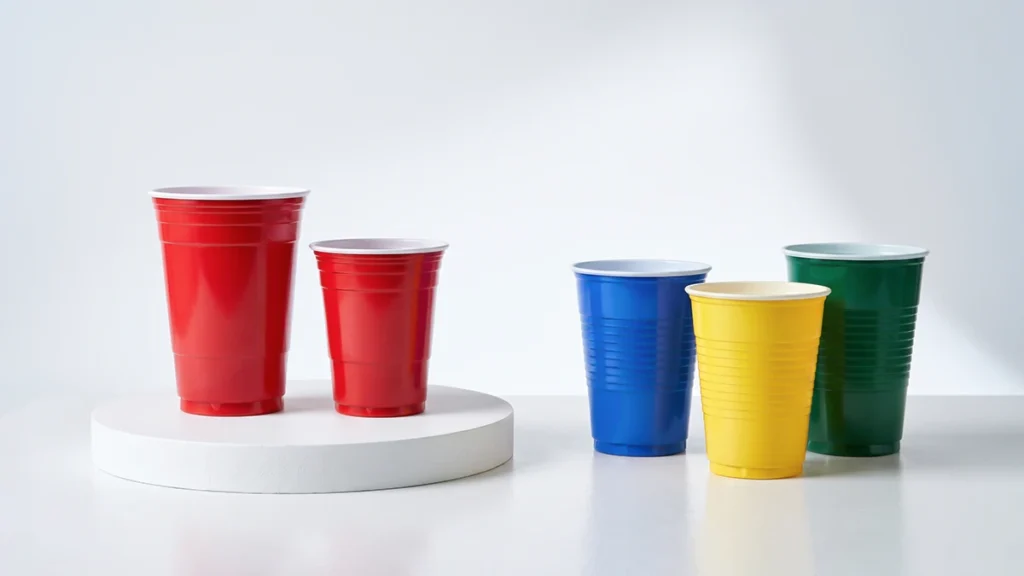
Why Party Cups Are Easier to Get Wrong Than They Look
Party cups sit at an awkward intersection. They are bought in industrial volumes but judged like marketing material, because a cup printed for a brand activation has to look right in a photograph and match a color reference someone else already approved.
Use cases diverge more than buying teams expect. A restaurant chain running a summer promotion needs a cup that survives a delivery route; a bar needs a format that stacks tightly behind the counter; an event organizer needs the pallet on time and does not care about a third print color. Three buyers, one product category, three different purchases. Treating party cup sourcing as a pure commodity buy is the fastest route to a reprint.
From Artwork Files to Pallet: How a Custom Order Actually Runs
The order opens with an enquiry carrying artwork, quantity, and a target date. If the brief is thin, the supplier sends questions back, and that exchange is where calendar time quietly disappears.
Once the brief is clear, the supplier issues a proof or a physical sample. The proof confirms layout, color reference, and any marks that must appear on the cup. The sample confirms wall thickness, rim geometry, and how the print sits on a tapered surface, which a flat PDF cannot show you.
Production follows approval, normally against a deposit, and clears faster on a repeat run than on a new design that needs fresh tooling. Inspection and packing come last, then booking and loading. None of those steps is complicated alone; what breaks a schedule is finding a gap between approved artwork and production reality after the plates are cut.
What You Should Have Ready Before Requesting a Quote
Your first quotation is only as good as the brief behind it. Suppliers can work from partial information, but they will either quote a conservative assumption or send questions back, and both cost you a cycle.
- Volume and release schedule: total quantity, and whether you need one shipment or staggered drops.
- Format and capacity: cup size in ounces or millilitres, plus lid compatibility if lids are in scope.
- Material direction: PP, PET, or paperboard, and whether the cup serves cold or hot drinks.
- Print requirements: color count, full wrap or single panel, and whether a specific reference is being matched.
- Compliance destination: the market where the cups will be sold, since documentation expectations shift by region.
A brief covering those five points returns a quotable price instead of a range. Buyers active in food packaging bulk will recognize the pattern: the supplier is rarely slow, the input was ambiguous.
Matching Cup Format and Material to the Pour
Material choice follows the drink rather than the budget. Polypropylene handles cold and ambient service and takes print cleanly. PET gives the clarity that iced and layered drinks depend on but is less forgiving on heavy coverage. Paperboard suits hot beverages and brings a separate lining requirement into the conversation.
The table is a starting point for a sourcing discussion, not a specification sheet. Final dimensions should come from the supplier’s own sample.
| Cup format | Typical use | Common material | Print suitability | What to watch |
|---|---|---|---|---|
| 9 oz squat | Kids’ parties, dessert service | PP | Full wrap, small billboard | Stack height, lid retention |
| 12 oz standard | Bar service, mixed drinks | PP or PET | Full wrap | Rim cracking on thin walls |
| 16 oz pint | Beer, large soft drinks, catering | PP | Full wrap or side panel | Rigidity under a full pour |
| 18–20 oz stadium | Festivals, outdoor events | PP | Large billboard area | Pallet cube and freight cost |
| 8–12 oz paper hot cup | Coffee, tea, catering | Paperboard with lining | Single-side print | Seam integrity, lining fit |
Two notes sit behind that table. A larger cup does not simply cost more per unit; it changes how many fit a carton, which changes freight per thousand. And a full-wrap print on a tapered cup distorts toward the top and bottom margins, so artwork should be built with that movement in mind rather than corrected after the proof.
Procurement Packaging Details That Change the Landed Cost
The unit price on a quotation is an opening figure. What you pay per usable cup is set by variables that are easy to skim past on a first read.
Order quantity is the obvious one. Minimums apply per design, and the step between price tiers can be steep; splitting a total volume across three designs may push every one into a higher band. One large single-design order is cheaper per unit, but leaves you holding stock for months.
Inner packing deserves equal scrutiny. A bulk-bagged carton costs less than a retail-ready carton with individual sleeves, and if the cups go straight to a back-of-house operation, retail packaging is money spent on nothing. On a shelf, it is not.
Then the physical side of freight: units per carton, cartons per pallet, how efficiently that pallet fills a container. A cup that nests slightly tighter than a competitor’s can move freight cost per thousand by a meaningful margin at volume.
Lead time closes the picture. Demand concentrates in specific months, and a booking placed inside that window quotes a longer cycle. Build the buffer into your release schedule, not into an upgraded shipping mode.
Quality and Food-Safety Checks Worth Insisting On
Ask what the inspection covers before the order is placed, not after the pallets are loaded.
- Wall and rim integrity: holds shape under a full pour, accepts a lid without cracking at the rim.
- Print adhesion and color: tape test plus visual comparison against the approved reference from first carton to last.
- Food-contact documentation: material declarations and test reports for the destination market, shipped with the goods rather than on request.
- Packing accuracy: carton counts, label accuracy, pallet configuration matching what was agreed.
Two further questions are worth raising with a supplier. Ask whether the same line runs non-food or recycled-content material and how changeover is handled, since cross-contact control matters when the cup will hold a beverage. Then ask about sample retention: a supplier holding an approved sample on file has a reference point when a color dispute surfaces a month later.
Documentation varies by market. Buyers shipping into the United States, the EU, or the Gulf face different food-contact expectations, and a supplier with experience on those routes usually knows which paperwork a given buyer needs. Confirm it in writing at quotation stage rather than assuming it will be attached.
FAQ
How long does a custom party cup order usually take?
It depends on whether the design is new and whether peak season is in play. The sequence runs from artwork confirmation through sampling, production, and inspection, with new designs taking longer than repeat runs.
Is there a minimum order quantity for custom printed cups?
Yes. Minimums apply per design because the print setup carries a fixed cost. The figure varies by cup format and printing method, and mixed-design orders may be treated as separate minimums.
Can I get samples before placing a bulk order?
Yes, and you should request one. Ask for a physical production sample rather than a photograph, since wall thickness, rim fit, and print placement on a curved surface cannot be judged from an image.
Do custom cups need different compliance documents for different markets?
Yes. Food-contact requirements are set by the destination market, so what a US buyer needs differs from the EU or the Gulf.