A quoted price for custom printed plastic cups is the sum of seven decisions, not one. Material grade, print method, color count, tooling, order volume, lead time, and sample rounds each move the number — and each one can be negotiated separately if you know where it sits.
Two surprises catch buyers most often: a tooling charge that appears after the quote, and a lead time that started counting from artwork approval rather than from the purchase order. This guide covers the commercial terms behind both, so your next wholesale order arrives on schedule and at the price you agreed.
What Actually Goes Into a Unit Price
Cup pricing is built from the bottom up, and every layer has a lever you can pull. Ask any supplier to quote by resin weight in grams per cup rather than by nominal size alone — a “16 oz cup” from two factories can differ by several grams of material, which makes the two prices incomparable until you normalize them.
| Cost Component | Main Cost Drivers | Leverage for the Buyer |
| Resin | Material grade (PET, PP, PS, PLA) and cup weight in grams | Match grade to real fill temperature, not to worst case |
| Printing | Print method, number of colors, ink coverage | Fewer colors and no full-wrap coverage |
| Conversion | Tooling cavity count, line speed, wall thickness | Accept standard wall thickness for non-structural uses |
| Tooling | Plate and mold charges, one-time or amortized | Reuse plates and existing molds on reorders |
| Packaging and yield | Carton spec, pallet pattern, make-ready waste | Standardize carton count and pallet height |
| Logistics | Incoterms, container loading, inland delivery | Optimize units per container, not just units per pallet |
Freight and tooling sit outside the unit price in most quotes, which is why two suppliers can show the same cup cost and still produce very different landed totals. Build a landed-cost sheet before you compare anything.
MOQ: What Sets the Floor
Minimum order quantity is not an arbitrary gate. It reflects two real costs: the smallest resin purchase a factory can make economically, and the setup and make-ready time on the printing line. A plain stock cup carries almost no setup, so its MOQ is often just a carton or a pallet. Add printing and the floor rises.
| Order Type | Typical MOQ Signal | Why the Floor Sits There |
| Plain stock cups | By carton or pallet | No setup cost to recover |
| 1–2 color print on a stock cup | Often 10,000–30,000 per size | Plate and press setup spread across the run |
| 4+ colors or full-wrap | Higher, commonly 30,000 and up | Longer make-ready and more start-up waste |
| Private mold or new shape | Several tens of thousands per run, or tooling amortized | Mold cost must be absorbed somewhere |
One rule matters more than the table: MOQ applies per SKU, meaning per size plus per print design. Splitting a 50,000-piece order across five cup sizes does not earn the 50,000-piece price on any of them, because each size needs its own plates and its own press run. If you need variety, ask for a mixed-size quote at a single total volume and expect a premium for the smaller lines.
Printing Methods and What Each Costs
The method determines your color ceiling, your setup charge, and how the cost behaves as volume grows.
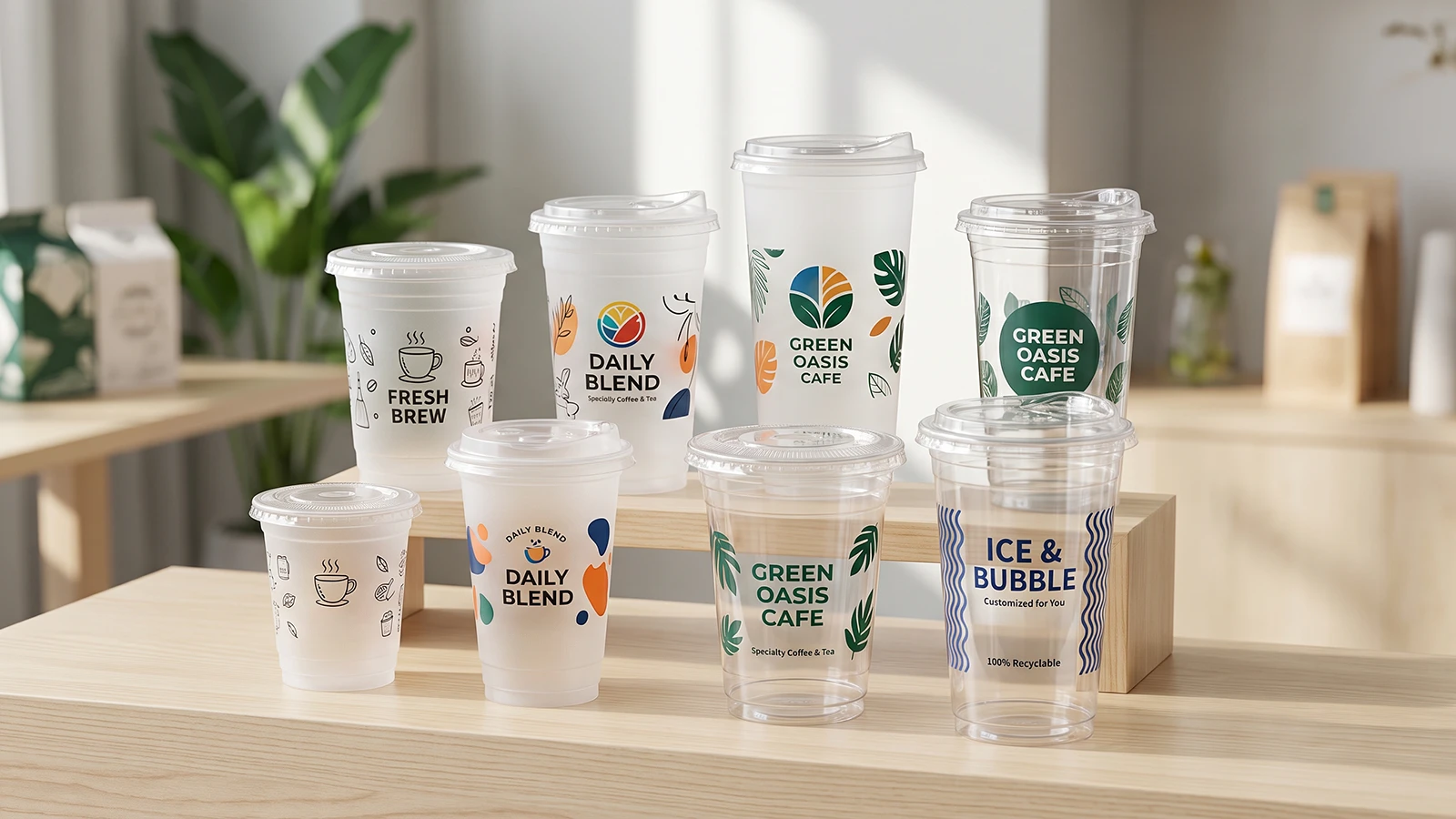
- Dry offset — the workhorse for high-volume branded cups. One plate per color wrapped on a cylinder; setup is expensive, unit cost is the lowest at scale. Best fit for 1–6 spot colors.
- Flexographic — softer plates that handle large solid areas well on PP and PS. Setup is moderate, and it tolerates broader coverage than offset at mid volumes.
- Screen printing — a thick ink deposit that stays opaque on dark or colored cups. Setup is low per screen, unit cost is above offset, and speeds are slower.
- Heat transfer — the practical route to gradients and photographic detail at short runs, where plate economics would otherwise rule the design options out.
- In-mold labeling — the label fuses into the wall, so graphics survive condensation, abrasion, and cold storage. Requires IML-capable tooling and a higher per-unit cost.
For wholesale programs, dry offset with one or two colors covers the large majority of brand requirements at the lowest achievable cost. Reserve in-mold labeling for premium retail lines where the graphic is part of the product promise.
Color Choices That Move the Price
Every spot color adds a plate or a screen, and plates are charged once per color per design. Four colors means four charges, not one.
Pantone matching is typically available without a separate charge, but sign off the ink drawdown under the lighting your customer will judge it in. A red that reads correctly in daylight can shift under retail LED lighting, and reprinting a 30,000-piece run to fix a shade is an expensive way to learn that.
A few design habits reduce cost without weakening the branding:
- Print on clear or white cups. Dark and colored cups need an opaque white base layer before any other ink, which adds a print station.
- Avoid large solid ink fields. Coverage consumes ink and slows the line more than complexity does.
- Keep type at least a few millimeters from the rim and base radius, where print registration is hardest to hold.
- Supply vector artwork with one color per layer and outlined fonts. Artwork redraws bill by the hour.
Molds and Tooling: Who Owns What
Standard cylindrical cups in 8, 12, 16, 20, 24, and 32 oz, along with their lid variants, run on existing molds and carry no tooling charge. A private mold is only worth the money for geometry that stock tooling cannot produce — a distinctive profile, base branding, or a rim fitted to your own filler.
Two numbers guide that decision. Mold cost scales with cavity count: more cavities mean a larger tooling invoice and a lower unit price at volume. That trade only pays back above a volume you can commit to. A new mold typically runs 25–45 days from approved 3D drawings to first shots, plus sampling rounds for fit and seal verification.
Negotiate ownership in writing before the first shot. Confirm whether the tool belongs to you, whether it can be transferred to another factory, who pays for maintenance, and what the buy-out price is if you move. A mold you paid for but cannot take with you is a hostage, not an asset.
Where a supplier prefers to keep the tool in-house, ask for both quote structures — a one-time tooling invoice versus amortization into the piece price — and compare total cost at your realistic annual volume.
Lead Time: The Clock Starts Later Than You Think
Production lead time commonly means the days after artwork approval, not after the purchase order. Approvals, proofs, and plate making sit in front of that number and are usually the fastest part to compress.
| Stage | Typical Duration | What Delays It |
| Artwork proof | 2–5 working days | Fonts not outlined, print size and position unspecified |
| Plate or screen making | 3–7 working days | Number of colors on the design |
| Pre-production sample | 5–10 working days | Print position changes after review |
| Mass production, stock mold | 10–20 working days | Peak-season queue, resin availability |
| New private mold | 25–45 days to first shots, plus sampling | Dimension changes after the first shot |
| Sea freight | 20–40 days typical | Port congestion and destination inland trucking |
Seasonality moves all of these. Beverage and foodservice demand peaks ahead of summer, retail packaging peaks ahead of the fourth quarter, and Chinese New Year shuts production for a stretch that freight schedules do not absorb. Orders placed three to four weeks before the holiday commonly ship after it. If your launch date is fixed, work backward from the holiday, not from the production lead time.
Samples: Free, Paid, and Credited
Stock samples are generally free, with courier costs sometimes on the buyer. Ask for the exact size and wall thickness you intend to buy rather than a similar-looking cup, then check four things: fill line against your actual serving volume, lid fit and removal force, nesting when stacked empty, and print registration on the finished surface.
Printed samples fall into two categories. A digital proof costs nothing and confirms layout only. A physical proof pulled on the real line confirms color, registration, and ink adhesion, and is charged because it consumes plates and press time — most suppliers credit that charge against the bulk order.
Custom-mold samples are first shots from the new tool. Expect to pay for them, expect to run more than one round, and confirm in advance whether the charge is credited to mass production.
Suppliers with integrated production and multiple lines can typically turn proofs and tooling samples faster than pure trading companies, because nothing is queued behind a third party. You can review the production setup on our about Reliancepak page.
Send your size, print colors, material, target volume, and destination port in one message, and you will get a quote with the tooling, MOQ, and lead time already itemized rather than discovered later. Our sales team can confirm pricing for your specific configuration.
FAQ
What is the MOQ for custom printed plastic cups?
It depends on whether new tooling is required and how many colors you print. Plain stock cups can ship by the pallet, while a printed stock cup commonly starts around 10,000–30,000 pieces per size.
Can I get free samples before placing a wholesale order?
Yes for stock cups — most suppliers provide them at no charge, with courier costs sometimes on the buyer. Printed and custom-mold samples carry a fee that is frequently credited against the bulk order.
Do I need a custom mold to print my logo?
No. Logo printing runs on existing stock molds and adds only plate charges. A private mold is needed only for non-standard geometry, such as a distinctive profile or branding molded into the base.
How long does a custom printed cup order take?
Plan on roughly four to six weeks for a stock-mold order: proofing, plate making, and 10–20 working days of production after artwork approval. A new mold adds several weeks for tooling and sampling.
Does printing fewer colors really save money?
Yes. Each color needs its own plate, so a one-color design avoids the extra plate charges and shortens make-ready time. Two colors covers most wholesale branding, and four or more usually only makes sense at high volume.