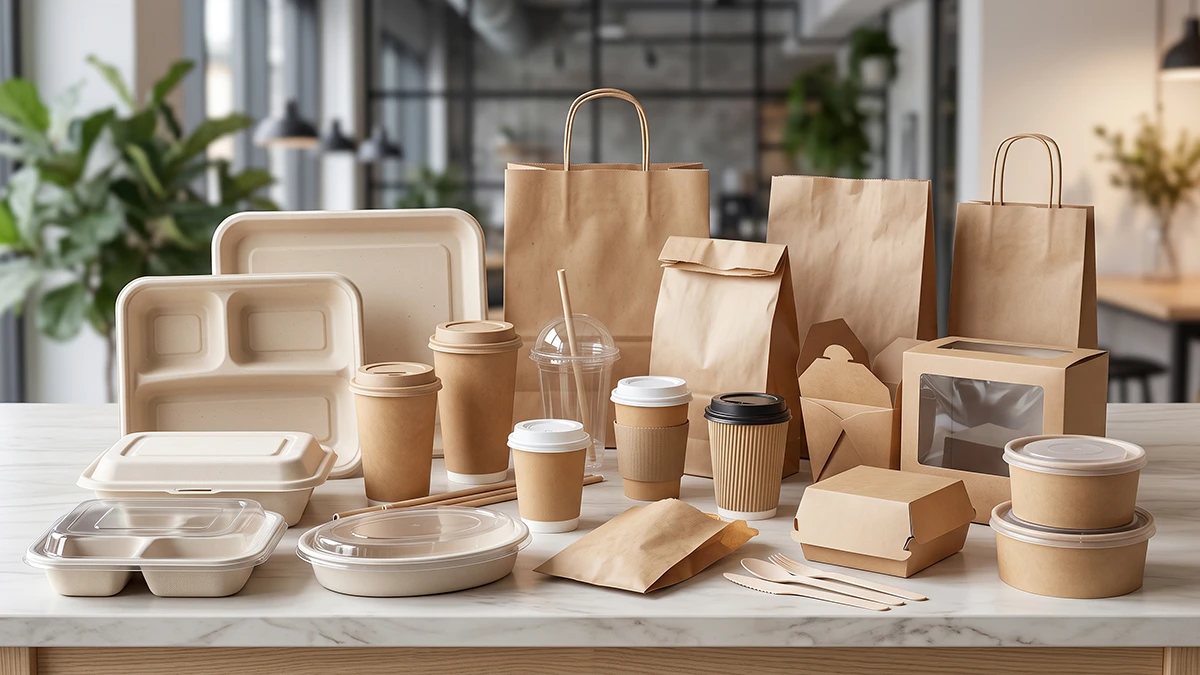
Food packaging procurement is the structured process of sourcing packaging materials and containers for food products, from trays and containers to films, lids, and paper-based packaging. For buyers in food manufacturing, distribution, or retail supply chains, getting this process right directly affects product safety, shelf life, unit cost, and brand compliance.
This guide walks through what food packaging procurement actually involves, the end-to-end process, the documents you should expect at each stage, and the strategic decisions that separate a reliable sourcing program from a reactive one. Use it as a checklist framework to compare and filter suppliers on your own terms.
What Food Packaging Procurement Means
At its core, food packaging procurement covers every activity required to acquire packaging that protects food, meets regulatory standards, and fits your production line — at a commercially sustainable cost.
In practice, the scope typically includes:
- Material sourcing: plastic (PP, PET, rPET), paper and paperboard, molded fiber, aluminum, and compostable or biodegradable alternatives
- Specification management: dimensions, barrier properties, seal compatibility, print artwork, and food-contact compliance
- Supplier selection and qualification: auditing manufacturers, traders, or a mix of both
- Commercial negotiation: pricing models, MOQs, payment terms, and lead times
- Quality and compliance control: incoming inspection, certification verification, and ongoing supplier performance reviews
It helps to distinguish procurement from simple purchasing. Purchasing is a transaction — placing an order against a known requirement. Procurement is the broader discipline: defining what you need, validating who can supply it reliably, managing the relationship, and continuously improving cost and risk positions over the product lifecycle.
The stakes are higher in food than in most other categories because packaging is a food-contact material. A defective seal, an off-spec migration level, or a missing declaration of compliance can trigger product recalls, customs holds, or retail delistings — costs that far exceed any unit-price saving.
The Food Packaging Procurement Process: Step by Step
Most procurement programs follow a recognizably similar flow, though the depth of each step depends on your volume, product risk level, and internal governance.
Step 1: Define Requirements and Specifications
Start internally, not with supplier research. Work with your product development, quality, and production teams to build a written specification that covers:
- Product characteristics: weight, moisture, oil content, frozen/chilled/ambient storage, intended shelf life
- Packaging format: tray, cup, container, bag, film, or a multilayer solution
- Regulatory targets: FDA compliance for the US market, EU food-contact regulations for Europe, or local equivalents
- Sustainability constraints: recyclability requirements, recycled-content targets, or plastic-reduction mandates from your customers
- Line compatibility: machine dimensions, sealing temperature windows, and denesting behavior
A vague specification is the most common root cause of failed sample evaluations later. If your spec only says “a 500ml PP container,” every supplier will interpret it differently.
Step 2: Research and Shortlist Suppliers
With a spec in hand, search across multiple channels: trade exhibitions, B2B marketplaces, industry directories, and referrals from peers. In many scenarios, buyers evaluate a mix of manufacturer-direct sources and trading companies — manufacturers offer tighter cost and process control, while traders may consolidate multiple packaging categories and handle smaller mixed orders.
Build a shortlist of three to five candidates and screen them against:
- Whether they produce your required material and format in-house
- Export experience in your target market and familiarity with its compliance regime
- Certifications relevant to your category (food-contact compliance, quality management systems)
- Production capacity relative to your forecast volume
This is also the stage to apply the first filter: any supplier unable to provide basic compliance documentation or food-grade material evidence should be excluded before deeper discussions begin.
Step 3: Request Quotations and Samples
Issue a formal RFQ to the shortlist with your specification attached, so all quotations are comparable on the same basis. Ask each supplier to quote against identical quantities, Incoterms, and packaging configurations — otherwise you are comparing apples to oranges.
In parallel, request physical samples. For food packaging, sample evaluation should go beyond appearance:
- Fit testing with your actual product and production equipment
- Seal integrity and leak testing where applicable
- Transit simulation if the packaging will ship filled over long distances
- Sensory checks (odor, taint) for food-contact applications
Many buyers run at least two rounds of samples — an initial stock sample to judge general quality, then a custom sample with your artwork and any dimensional adjustments.
Step 4: Evaluate and Qualify the Supplier
Quotation comparison should never be a single-column price race. Weighted scorecards are a common approach, letting you rank suppliers objectively across the criteria that matter to your business.
A sample evaluation framework:
| Criterion | Typical Weight | What to Assess |
| Unit price (at your volume) | 25–35% | Landed cost basis, price-break tiers, raw material pass-through terms |
| Compliance & certifications | 15–25% | Food-contact declarations, ISO or equivalent systems, market-specific approvals |
| Quality consistency | 15–20% | Sample quality, defect rates, in-process controls, inspection reports |
| Lead time & reliability | 10–15% | Production lead time, on-time delivery record, capacity headroom |
| Communication & service | 10–15% | Responsiveness, English capability, technical support, sample turnaround |
| Flexibility | 5–10% | MOQ willingness, custom development ability, order-change tolerance |
Beyond the scorecard, consider a factory audit — on-site or virtual — for higher-volume or higher-risk categories. An audit verifies what documents cannot: actual production lines, quality control stations, warehouse conditions, and the gap between what the supplier claims and what it operates.
Step 5: Negotiate Terms and Place a Trial Order
Negotiation covers more than unit price. Key terms to settle explicitly:
- Pricing mechanism: fixed price validity period, or a raw-material index adjustment clause — resin and paper prices move, and silence on this becomes a dispute later
- MOQ and scaling: trial-order quantities, then volume commitments as the relationship matures
- Payment terms: deposit/balance splits, letters of credit, or open terms once trust is established
- Lead time and penalties: committed production plus shipping windows, with defined remedies for delays
- IP and tooling ownership: who owns custom molds, print plates, and dies if the relationship ends
A trial order (or pilot run) is standard practice before committing to long-term volume. It tests the full cycle — production, quality, documentation, logistics — at manageable risk.
Step 6: Quality Control, Shipping, and Incoming Inspection
For cross-border sourcing, arrange pre-shipment inspection either through a third-party inspection service or your own QA protocol, against an agreed AQL standard and inspection checklist. Review shipping documents before goods depart, and run incoming inspection on receipt — dimension checks, seal tests, and carton condition — before releasing material to the production line.
Step 7: Supplier Performance Management
Procurement does not end at the first delivery. Set a review cadence (typically quarterly for active suppliers) covering on-time delivery rate, defect and complaint rates, responsiveness, and cost trends. This record becomes your leverage in renegotiations and your evidence base when deciding whether to consolidate, dual-source, or replace a supplier.
Key Documents in Food Packaging Procurement
Documentation is where food packaging differs sharply from general packaging. Because packaging touches food, buyers should expect a defined document set — and treat reluctance to provide any of these as a red flag.
| Document | Purpose | When You Need It |
| Specification sheet / datasheet | Confirms material, dimensions, weight, tolerances | RFQ and sample stages |
| Declaration of Compliance (DoC) | Declares the material meets applicable food-contact regulations (e.g., FDA, EU 1935/2004 framework) | Before production; required by many retailers and importers |
| Migration test report | Verifies no harmful substance transfer above legal limits | Qualification of new materials or suppliers |
| ISO or QMS certificate | Evidence of systematic quality management | Supplier shortlisting and audits |
| Material safety data (where applicable) | Handling and composition information for films, inks, adhesives | Technical review |
| Commercial invoice & packing list | Customs clearance and receiving verification | Every shipment |
| Bill of lading / air waybill | Title and transport document for the shipment | Every shipment |
| Certificate of origin | Tariff treatment and import compliance | Cross-border orders |
| Pre-shipment inspection report | Independent quality verification before release | Trial orders and ongoing QC |
| Sustainability documentation (e.g., recycled-content or compostability certificates) | Supports customer ESG requirements and market claims | Where sustainability is specified |
Two practical notes. First, documents have shelf life — certificates expire, and formulations change, so set a refresh cycle rather than filing them once. Second, a DoC is only as credible as the lab behind the migration report; when stakes are high, buyers commonly re-test samples at an independent laboratory rather than relying solely on supplier-provided reports.
Procurement Strategy: Beyond the Transaction
Once the basic process is running, strategic decisions determine long-term cost and risk positions.
Total Cost of Ownership, Not Unit Price
The cheapest container that jams on your filling line, fails transit testing, or triggers a customs query is not cheap. Factor in freight and duties, defect and rejection rates, line efficiency on your equipment, and administrative overhead. Many buyers find that a mid-priced, reliable supplier beats the lowest bidder once landed cost and failure rates are counted.
Single vs. Dual Sourcing
Single sourcing maximizes volume leverage and simplifies quality management. Dual sourcing protects against disruption — a fire, a raw-material shortage, a port closure. A common middle path: a primary supplier carrying most volume, plus a qualified backup that receives occasional orders to stay warm. The backup only works if it is genuinely qualified, with samples and documentation already approved.
Regional and Nearshore Options
Long supply chains suit stable, high-volume categories. Shorter or more volatile categories — promotional packaging, seasonal items, rapid product launches — may justify nearshore or domestic suppliers despite higher unit prices, because responsiveness reduces inventory and obsolescence risk.
Sustainability as a Procurement Criterion
Regulatory pressure on single-use plastics and retailer sustainability commitments are reshaping packaging specifications in many markets. Building recyclability, recycled content, or fiber-based alternatives into your supplier evaluation now avoids a forced requalification later. When evaluating eco-friendly claims, ask for the underlying certification rather than the marketing label — terms like “biodegradable” vary widely in what they actually certify.
Build a Comparison Discipline
The most reliable protection against a bad sourcing decision is process: score suppliers against the same weighted criteria, keep written records of quotations and sample results, and re-run comparisons periodically even for incumbent suppliers. A supplier who won on merit three years ago may not still be your best option today — material prices, exchange rates, and supplier capabilities all move.
Common Pitfalls to Avoid
- Sourcing before the spec is final: changes after tooling or plates are made are expensive and slow
- Accepting verbal compliance claims: “it’s food grade” is not a document
- Ignoring MOQ mismatches: a great supplier whose MOQ exceeds your demand creates inventory problems, not savings
- Skipping trial orders on new suppliers or new materials, however attractive the price
- Letting documents lapse: an expired certificate discovered during an audit or customs review halts shipments
FAQ
What is the difference between food packaging procurement and general packaging procurement?
Food packaging procurement adds a food-contact compliance layer: regulations on material migration, documentation such as Declarations of Compliance and migration test reports, and stricter hygiene standards in production. General packaging for non-food goods does not carry these requirements, so the qualification and documentation workload is typically lighter.
What documents should I request from a new food packaging supplier?
At minimum: a specification sheet, a Declaration of Compliance for the target market, migration test reports from a credible laboratory, and a quality management system certificate. Add commercial and shipping documents — invoice, packing list, bill of lading, certificate of origin — for each shipment.
How do I verify that a food packaging material is genuinely food-safe?
Yes, verification is possible and recommended. Ask for the Declaration of Compliance and migration test report first, then check that the issuing laboratory is accredited and the report matches your actual material and usage conditions. For higher-risk applications, re-test independent samples at a third-party laboratory rather than relying only on supplier documents.
What is a reasonable MOQ when sourcing food packaging?
It depends on the product and process. Commodity items such as standard cups or trays typically carry low MOQs, while fully custom packaging requires tooling amortization and higher minimums. Rather than chasing an absolute number, compare MOQs across several suppliers for the same specification — wide variation signals different production models, and some suppliers will negotiate trial-order quantities for qualified buyers.
How long does the full procurement process usually take?
From final specification to first production delivery, a straightforward stock-item purchase can complete in a few weeks. Custom packaging with tooling, sample iterations, and compliance testing commonly runs two to four months, depending on complexity and shipping distance. Building the qualification timeline into your product launch plan avoids compressing sample and testing stages.