
Biodegradable packaging typically costs 15-40% more than traditional plastic packaging at the point of purchase, but total cost of ownership analysis reveals a more nuanced picture when factoring in disposal fees, regulatory compliance expenses, and brand value considerations. For B2B buyers making procurement decisions, understanding both direct and indirect cost components determines whether the investment delivers positive returns.
You are likely facing pressure from multiple directions: customers demanding sustainable options, regulations restricting plastic use in your target markets, and finance teams questioning any cost increases. The challenge lies in building a business case that accounts for all relevant factors rather than focusing solely on unit price comparisons. This article breaks down the real cost differences between biodegradable packaging and traditional plastic, providing the data you need to make informed sourcing decisions.
What Drives the Price Difference Between Biodegradable and Plastic Packaging?
The price premium for biodegradable packaging stems primarily from raw material costs, manufacturing scale differences, and certification requirements. Traditional plastics benefit from decades of production optimization and massive global scale, while biodegradable alternatives are still climbing the efficiency curve.
Raw materials account for 40-50% of the cost difference. Petroleum-derived plastics like PET and PP draw from established global supply chains with consistent pricing and abundant availability. Biodegradable materials such as PLA require agricultural feedstocks that face seasonal variations and compete with food production. Here’s the deal: this gap narrows as production capacity expands and agricultural sourcing diversifies.
How Do Raw Material Costs Compare Across Material Types?
PLA resin currently trades at approximately $2,000-2,500 per metric ton, compared to $1,200-1,500 for virgin PET and $1,000-1,300 for PP. Bagasse pulp costs roughly $800-1,000 per metric ton but requires energy-intensive molding processes that add manufacturing expense. Paper pulp prices fluctuate between $600-900 per metric ton depending on grade and certification status.
Material cost breakdown factors:
- Agricultural commodity pricing for corn, sugarcane, and wood pulp
- Processing and refining energy requirements
- Transportation costs from production regions
- Certification compliance and testing expenses
- Quality consistency requirements for food-grade applications
The petroleum pricing volatility that affects traditional plastics creates uncertainty in the opposite direction. Oil price spikes can temporarily close or even reverse the cost gap between conventional and biodegradable options.
What Manufacturing Factors Influence Pricing?
Production scale represents the largest manufacturing cost driver. Traditional plastic packaging runs on equipment operating continuously for decades, with manufacturers producing billions of units annually. Biodegradable packaging production lines are newer, smaller in scale, and still optimizing processes.
Manufacturing cost components include:
- Equipment amortization across production volumes
- Energy consumption per unit produced
- Labor efficiency and automation levels
- Scrap rates and quality rejection percentages
- Changeover time between product runs
- Maintenance and tooling replacement cycles
Biodegradable material processing often requires different temperature profiles, cycle times, and handling procedures than conventional plastics. These differences translate to lower throughput rates and higher per-unit costs until manufacturers achieve comparable optimization levels.
| Cost Component | Traditional Plastic | Biodegradable Packaging | Premium Range |
|---|---|---|---|
| Raw Materials | $1,000-1,500/MT | $1,800-2,500/MT | 50-80% |
| Manufacturing | Baseline | +15-25% | 15-25% |
| Certification | Minimal | +5-10% | 5-10% |
| Logistics (weight) | Baseline | +5-15% | 5-15% |
| Total Unit Cost | Baseline | +15-40% | 15-40% |
The certification layer adds costs unique to biodegradable products. Testing for EN 13432, ASTM D6400, and food contact compliance requires laboratory analysis, documentation maintenance, and periodic re-certification.
Key Takeaway: Raw material costs and manufacturing scale drive the majority of the price premium, but both factors are trending favorable as the biodegradable packaging market matures and production volumes increase.
How Do Hidden Costs Change the Total Cost Equation?
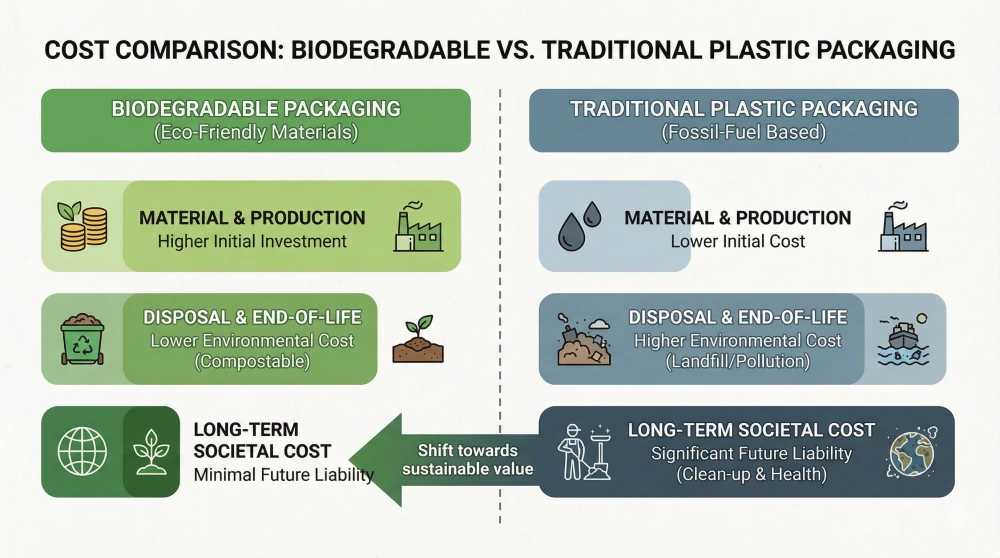
Direct purchase price tells only part of the cost story. Disposal fees, regulatory compliance expenses, potential penalties, and brand impact create significant cost components that procurement analysis often overlooks. When these factors enter calculations, the effective premium for biodegradable packaging shrinks considerably.
Disposal costs increasingly favor biodegradable options in markets with developed composting infrastructure or plastic waste levies. The UK Plastic Packaging Tax adds £210.82 per metric ton to plastic packaging containing less than 30% recycled content. Similar schemes exist or are planned across European markets, Canada, and select US states.
What Disposal and Waste Management Costs Apply?
Waste disposal costs vary dramatically by jurisdiction and disposal method. Landfill tipping fees range from $30-150 per ton depending on location, while specialized plastic recycling processing adds $50-200 per ton. Commercial composting fees typically fall between $40-80 per ton where facilities accept certified compostable packaging.
Disposal cost considerations:
- Landfill fees trending upward in most developed markets
- Plastic waste export restrictions increasing domestic processing costs
- Extended producer responsibility schemes assigning end-of-life costs to brands
- Contamination penalties when non-recyclable items enter recycling streams
- Collection and sorting costs for multi-material packaging
For food service packaging contaminated with food residue, recycling becomes impractical regardless of material type. Biodegradable packaging designed for composting actually offers a lower-cost disposal pathway than plastic in these applications.
How Do Regulatory Compliance Costs Factor In?
Regulatory compliance costs extend beyond disposal fees to include documentation, reporting, and potential reformulation expenses. Companies operating in multiple jurisdictions face compounding complexity as regulations diverge.
Compliance cost elements include:
- Plastic packaging taxes and levies (UK, Spain, Italy, others)
- Single-use plastic ban compliance in food service categories
- Documentation and reporting requirements for packaging declarations
- Legal and consulting fees for regulatory interpretation
- Product reformulation costs when regulations change
- Market access restrictions for non-compliant products
The EU Single-Use Plastics Directive bans specific plastic items entirely, making compliance cost infinite for those categories. Switching to biodegradable alternatives becomes the only path to market access rather than a cost optimization choice.
| Hidden Cost Category | Traditional Plastic Impact | Biodegradable Impact |
|---|---|---|
| Disposal Fees | Rising, especially for food-contaminated | Lower where composting available |
| Plastic Taxes | £210+/MT (UK), similar elsewhere | Exempt in most schemes |
| Regulatory Compliance | Increasing restrictions | Generally favorable treatment |
| Brand/Customer Requirements | Potential loss of business | Competitive advantage |
| Future-Proofing | High reformulation risk | Aligned with regulatory direction |
Key Takeaway: Total cost analysis that includes disposal, taxes, and compliance expenses often reduces the effective premium for biodegradable packaging to single digits, and in some applications creates cost parity or advantage.
What Does a Real-World Cost Comparison Look Like?
Examining specific product categories with realistic volumes illustrates how cost comparisons play out in practice. The examples below use representative pricing for wholesale quantities, acknowledging that actual quotes vary by supplier, specification, and market conditions.
A food service operator replacing 100,000 plastic clamshell containers monthly with bagasse equivalents faces different economics than a retailer switching cold cup suppliers. Product category, volume, and disposal pathway all influence the financial outcome.
How Do Container Costs Compare by Material?
Takeaway food containers represent one of the highest-volume biodegradable packaging applications. Bagasse clamshells have achieved near price parity with plastic equivalents in many specifications due to manufacturing scale increases and plastic price inflation.
Container cost comparison (per 1,000 units, wholesale):
- Standard plastic hinged container (500ml): $45-60
- Bagasse hinged container (500ml): $55-75
- Premium plastic with recycled content: $55-70
- PLA clear container (500ml): $70-90
The 20-30% premium for bagasse drops to 10-15% when comparing against recycled-content plastic options that satisfy some sustainability requirements. For operations in jurisdictions with plastic taxes, bagasse achieves effective cost parity.
How Do Cup Category Economics Differ?
Hot and cold cups present different cost dynamics due to material requirements and competitive intensity. Paper hot cups with PLA linings compete in a mature market segment, while PLA cold cups face comparison against low-cost PET options.
Cup cost comparison (per 1,000 units, wholesale):
- Paper hot cup with PE lining (12oz): $35-45
- Paper hot cup with PLA lining (12oz): $40-55
- PET cold cup (16oz): $30-40
- PLA cold cup (16oz): $50-65
Cold cups show larger premiums because PET production efficiency sets a very low baseline. Hot cups demonstrate smaller gaps because paper-based construction is standard regardless of lining material.
| Product Category | Plastic Baseline | Biodegradable Option | Premium % | Notes |
|---|---|---|---|---|
| Hinged Container 500ml | $50/1000 | $65/1000 | 30% | Bagasse, drops with volume |
| Hot Cup 12oz | $40/1000 | $48/1000 | 20% | PLA-lined paper |
| Cold Cup 16oz | $35/1000 | $58/1000 | 66% | PLA vs PET |
| Cutlery Set | $25/1000 | $45/1000 | 80% | CPLA vs PS |
| Food Tray | $30/1000 | $42/1000 | 40% | Bagasse vs foam |
Volume commitments significantly influence these figures. Annual contracts for 500,000+ units per SKU can reduce premiums by 10-15 percentage points compared to spot purchasing.
Key Takeaway: Cost premiums vary substantially by product category, with food containers approaching parity while cold cups and cutlery maintain larger gaps. Strategic category prioritization helps buyers capture sustainability benefits where economics are most favorable.
How Can Buyers Reduce the Cost Gap Through Strategic Sourcing?
Procurement strategies directly impact the effective cost premium for biodegradable packaging. Volume consolidation, supplier selection, specification optimization, and timing decisions all contribute to better pricing outcomes without sacrificing product quality or sustainability credentials.
Working with integrated manufacturers rather than pure trading companies eliminates intermediary margins and provides better visibility into cost drivers. Suppliers controlling their own production can offer pricing flexibility that traders cannot match.
What Volume Strategies Deliver Better Pricing?
Order consolidation across product categories creates leverage that single-product purchasing cannot achieve. Suppliers value customers who simplify their operations through predictable, diversified volume.
Volume optimization approaches:
- Consolidate multiple SKUs with single suppliers for total volume leverage
- Commit to annual volume agreements with quarterly releases
- Coordinate ordering across business units or locations
- Join purchasing cooperatives or group buying arrangements
- Accept longer lead times in exchange for production scheduling efficiency
Annual commitments of $100,000+ typically unlock pricing tiers 10-15% below spot rates. Suppliers facing capacity constraints may offer additional incentives for orders that fill production gaps during slower periods.
What Specification Decisions Affect Cost?
Product specifications directly impact manufacturing costs. Custom sizes, colors, and configurations require dedicated production runs with setup costs spread across smaller volumes. Standard specifications benefit from continuous production efficiency.
Cost-effective specification practices:
- Adopt industry-standard sizes where operational requirements allow
- Limit custom colors to one or two brand-critical applications
- Accept standard product configurations before requesting modifications
- Specify performance requirements rather than exact material compositions
- Allow suppliers flexibility in meeting functional specifications
Requesting non-standard dimensions or unusual closure mechanisms can add 20-40% to product costs. Evaluating whether customization delivers proportional value helps buyers allocate budgets effectively.
| Sourcing Strategy | Potential Savings | Implementation Complexity |
|---|---|---|
| Annual volume commitment | 10-15% | Low |
| Category consolidation | 5-10% | Medium |
| Standard specifications | 15-25% | Low |
| Integrated manufacturer | 5-10% | Medium |
| Timing optimization | 5-10% | High |
Key Takeaway: Strategic sourcing practices can reduce biodegradable packaging premiums by 20-35% compared to unoptimized purchasing, making the business case substantially more attractive for budget-conscious buyers.
When Does Biodegradable Packaging Deliver Positive ROI?
Return on investment for biodegradable packaging depends on your specific market position, customer requirements, regulatory environment, and operational context. Some businesses achieve positive ROI immediately through customer retention or market access, while others require longer payback periods.
The ROI calculation should include both quantifiable financial returns and strategic value that may be harder to measure but equally relevant to business success.
What Quantifiable Returns Can Buyers Expect?
Measurable financial returns from biodegradable packaging adoption include avoided costs, price premiums achieved, and market share gains. Documentation of these returns supports ongoing investment in sustainability initiatives.
Quantifiable return categories:
- Avoided plastic taxes and levies (direct savings)
- Reduced disposal costs where composting is cheaper than landfill
- Price premiums from customers valuing sustainability
- New customer acquisition in sustainability-focused segments
- Avoided costs of future reformulation as regulations tighten
Businesses serving corporate customers with sustainability procurement policies report winning contracts specifically due to packaging credentials. These wins may represent the largest ROI component even when unit cost premiums remain.
How Should Buyers Evaluate Strategic Value?
Strategic benefits resist precise quantification but influence long-term business value. Brand positioning, risk mitigation, and stakeholder relationships all factor into comprehensive ROI assessment.
Strategic value considerations:
- Brand differentiation in crowded market segments
- Risk reduction from regulatory change exposure
- Employee engagement and recruitment advantages
- Investor and stakeholder relationship benefits
- Supply chain resilience through diversified material sourcing
- First-mover advantages in transitioning market segments
Companies delaying transition face compressed timelines and premium pricing when regulations force rapid change. Early adopters secure supplier relationships and operational learning that late movers must acquire under pressure.
| ROI Factor | Measurement Approach | Typical Impact |
|---|---|---|
| Tax/Levy Avoidance | Direct calculation | 2-5% of packaging spend |
| Disposal Cost Savings | Waste audit comparison | 1-3% of packaging spend |
| Customer Premium | Price testing, win/loss analysis | Variable, 0-10% |
| New Customer Acquisition | Sales attribution | Variable |
| Regulatory Risk Avoided | Scenario analysis | Significant |
Key Takeaway: Biodegradable packaging delivers positive ROI for businesses where customer requirements, regulatory pressure, or brand positioning create value beyond direct cost comparisons. Comprehensive analysis that includes avoided costs and strategic benefits often justifies the investment.
Take the Next Step Toward Cost-Effective Sustainable Packaging
The cost comparison between biodegradable and traditional plastic packaging continues evolving in favor of sustainable options. Raw material costs are declining as production scales, regulatory pressures are increasing costs for conventional plastics, and customer requirements are shifting toward sustainability. The question is no longer whether to transition but when and how to execute the change most effectively.
Reliancepak provides B2B buyers with biodegradable packaging solutions that balance sustainability requirements with cost efficiency. Our integrated manufacturing operations with 9 production lines deliver competitive pricing through direct production control, while comprehensive product lines enable single-source procurement that simplifies your supply chain. Free samples allow you to evaluate quality and suitability before committing to volume orders.
The packaging industry transformation is accelerating. Buyers who establish efficient biodegradable packaging supply chains now position themselves ahead of competitors still relying on increasingly restricted conventional materials.
Frequently Asked Questions
Can I achieve cost parity between biodegradable and plastic packaging?
Yes, in specific product categories and purchasing scenarios. Bagasse food containers have reached near-parity pricing at wholesale volumes, particularly when plastic taxes apply. Strategic sourcing including volume commitments and specification standardization can reduce premiums across most categories to levels that total cost analysis justifies.
How much do plastic packaging taxes add to traditional packaging costs?
Current plastic packaging taxes range from £210.82 per metric ton in the UK to comparable levels in Spain, Italy, and other European markets. For packaging with less than 30% recycled content, these taxes add approximately $0.20-0.25 per kilogram, significantly narrowing the gap with biodegradable alternatives that typically qualify for exemptions.
Will biodegradable packaging costs decrease over time?
Industry projections indicate 5-8% annual cost reductions for major biodegradable packaging materials as production scales and manufacturing efficiency improves. PLA capacity expansions in Asia and North America are particularly significant. The premium compared to conventional plastics is expected to shrink to 5-15% within five years for most product categories.
How do shipping costs compare between biodegradable and plastic packaging?
Biodegradable packaging, particularly bagasse and molded fiber products, often weighs 10-20% more than plastic equivalents, increasing freight costs proportionally. However, some biodegradable products nest more efficiently, partially offsetting weight disadvantages. Consolidated shipping planning helps minimize logistics cost impacts.
What minimum order quantities should I expect for competitive biodegradable packaging pricing?
Competitive wholesale pricing typically requires minimum orders of 10,000-50,000 pieces per SKU for standard products, with custom printed items requiring 25,000-100,000 pieces. Annual volume commitments of $50,000-100,000 across product categories unlock the best pricing tiers and may include additional benefits such as extended payment terms or priority production scheduling.