Biodegradable packaging unit prices run 15-40% above traditional plastic, but that single number obscures the real purchasing picture. Once you factor in bulk order discounts, printing setup fees, material thickness choices, freight weight differentials, certification costs, and mounting plastic taxes, the effective gap narrows — and in some product categories, disappears entirely.
Procurement Decision Summary: Bagasse food containers and paper hot cups with PLA lining reach near cost parity at volumes above 50,000 units per SKU. Buyers operating in the UK, EU, or markets with plastic levies can offset 100% of the remaining premium through tax avoidance alone. The fastest ROI path: start with high-volume food-contact items where disposal costs already favor compostable materials, then expand category coverage as volume commitments unlock deeper pricing tiers.
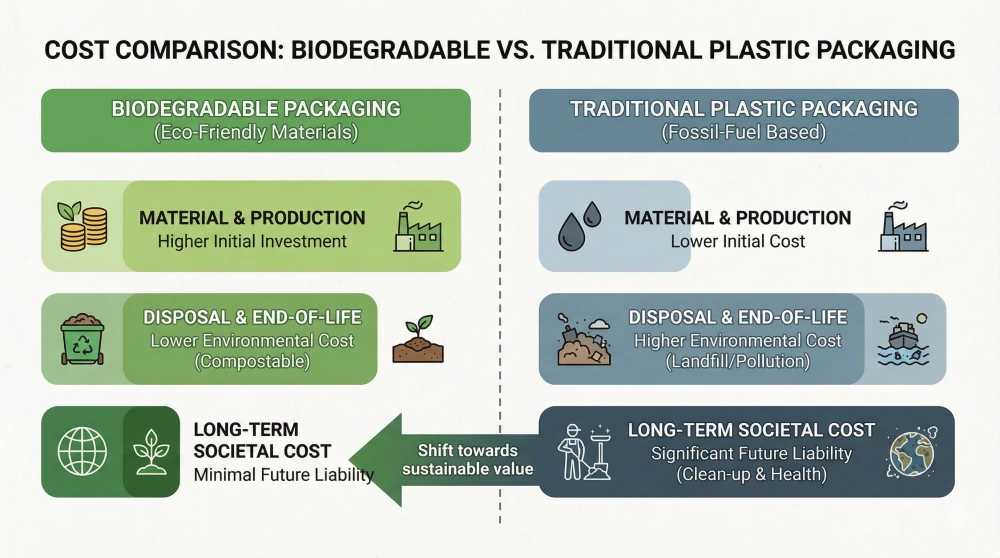
What Actually Drives the Price Gap Between Biodegradable and Plastic Packaging?
The premium you see on a quote sheet originates from three cost layers: raw materials, manufacturing scale, and compliance certification. Traditional plastics have benefited from sixty years of global supply chain optimization. Biodegradable alternatives are still building that infrastructure — but the economics shift with every new production line that comes online.
Raw Material Costs by Type
PLA resin trades at approximately 2,000-2,500 per metric ton. Virgin PET sits at 1,200-1,500, and PP at 1,000-1,300. Bagasse pulp — a sugarcane byproduct — costs 800-1,000 per metric ton in raw form, though the thermoforming process adds energy expense that partially offsets the lower feedstock price.
Material cost variables include:
- Agricultural commodity pricing for corn, sugarcane, and wood pulp feedstocks
- Processing and refining energy requirements per ton of finished material
- Regional transportation costs from production zones to your port of entry
- Food-contact certification testing and documentation maintenance
- Consistency requirements for food-grade applications across production batches
Petroleum price volatility introduces uncertainty in the opposite direction. When oil spikes above $90/barrel, the raw material gap between PET and PLA compresses noticeably — a dynamic worth monitoring when locking in annual contracts.
Manufacturing Scale and Thickness Considerations
Production volume drives per-unit cost more than any other factor. A traditional plastic thermoforming line producing 200 million clamshells annually amortizes tooling, labor, and overhead across far more units than a typical bagasse line running 30-50 million pieces.
Material thickness adds another cost dimension buyers often overlook. Specifying thicker walls for structural strength increases material consumption per unit — and the cost impact differs by material type:
- PLA containers: adding 0.1mm thickness increases material cost by approximately 8-12%
- Bagasse containers: thickness increases have a smaller cost impact (4-7%) due to lower raw material pricing per kilogram
- PET/PP containers: thickness adjustments cost 5-9% depending on gauge
Working with standard thickness specifications your supplier already runs avoids custom tooling charges and keeps unit costs closer to catalogue pricing.
Certification Costs for Compostable and Food-Grade Claims
Biodegradable packaging sold with compostability claims requires third-party testing. These are real costs that suppliers build into pricing:
- EN 13432 (European compostability standard): $8,000-15,000 per product family for initial certification
- ASTM D6400 (US compostability standard): $6,000-12,000 per product family
- FDA food-contact compliance testing: $3,000-8,000 per material formulation
- EU food-contact regulation compliance: $5,000-10,000 per material type
- Annual re-certification and documentation maintenance: $2,000-5,000 per product line
Suppliers with existing certifications spread these costs across high-volume production runs, which is one reason integrated manufacturers typically offer better pricing than trading intermediaries sourcing from multiple small factories.
Printing and Custom Branding Costs
Custom printing on biodegradable packaging carries different economics than printing on conventional plastic:
- Flexographic printing on bagasse/paper: setup plates cost $300-800 per color, with minimum runs of 25,000-50,000 units
- Screen printing on PLA: setup costs $500-1,200 per color, minimum runs of 20,000-30,000 units
- Offset printing on paper-based packaging: $200-500 per color plate, minimum runs of 30,000-50,000 units
- In-mold labeling for plastic: $1,000-2,500 per design, but runs as low as 10,000 units
The higher minimum order quantities (MOQs) for printed biodegradable packaging reflect setup costs distributed across fewer total production runs. Buyers who commit to 100,000+ units per print design reduce per-unit printing costs by 40-60% compared to minimum-run orders.
How Do Hidden and Lifecycle Costs Reshape the Total Picture?
The purchase price on your invoice represents only what you pay your supplier. Disposal obligations, regulatory levies, and market access requirements create cost layers that procurement teams frequently underestimate — until the finance department flags them as line items.
Disposal and Waste Management Fees
Waste disposal costs vary sharply by jurisdiction and material contamination level. For food-contact packaging — which represents the largest volume category for biodegradable alternatives — disposal economics often favor compostable materials:
- Landfill tipping fees: $30-150 per ton depending on region
- Plastic recycling processing (clean materials only): $50-200 per ton
- Commercial composting (certified compostable packaging): $40-80 per ton
- Contamination penalties when food-soiled plastic enters recycling streams: $50-300 per incident
Food-contaminated plastic packaging cannot be recycled in most municipal systems. It goes to landfill regardless of the material’s theoretical recyclability. Biodegradable packaging designed for commercial composting sidesteps this problem entirely.
Plastic Taxes and Regulatory Levies
Governments worldwide are attaching direct financial costs to plastic packaging. These are not future proposals — they are active and increasing:
- UK Plastic Packaging Tax: £210.82 per metric ton on packaging with less than 30% recycled content
- Spain plastic tax: €450 per ton on non-reusable plastic packaging
- Italy plastic tax: €0.45 per kilogram on single-use plastic items (implementation pending)
- France: progressive penalties under the AGEC Law for non-recyclable packaging
- Canada: escalating federal plastic surcharges planned through 2030
Biodegradable packaging qualifying under these schemes typically receives full exemption. For a buyer importing 20 metric tons of food packaging annually into the UK, the plastic tax alone represents £4,200+ in avoided costs — roughly equivalent to a 5-8% premium on biodegradable alternatives.
Shipping and Freight Weight Differentials
Biodegradable packaging — particularly bagasse and molded fiber — weighs 10-20% more than thin-wall plastic equivalents. This weight difference directly affects ocean freight and inland logistics costs.
Shipping cost factors to model:
- Per-container weight difference: bagasse clamshells average 18-22 grams vs. 12-15 grams for comparable PET containers
- Container loading density: some biodegradable products stack more efficiently, partially offsetting weight disadvantages
- Freight class and carrier pricing: a 10% weight increase typically translates to 6-12% higher shipping costs depending on route and mode
- Consolidation opportunities: ordering multiple biodegradable product categories in a single shipment reduces per-unit logistics costs
Requesting packaging samples before committing to volume orders lets you verify actual weight and stacking performance rather than relying on specification sheets alone.
Complete Cost Comparison: Biodegradable vs. Plastic by Product Category
The tables below present side-by-side cost analysis for the most common food packaging categories, incorporating unit price, MOQ thresholds, printing costs, and hidden cost factors.
Direct Unit Cost Comparison
| Product Category | Plastic Unit Cost (per 1,000) | Biodegradable Unit Cost (per 1,000) | Premium % | Notes |
|---|---|---|---|---|
| Hinged container 500ml | $45-60 | $55-75 | 20-30% | Bagasse; drops to 10-15% at 500K+ annual volume |
| Hot cup 12oz | $35-45 | $40-55 | 14-22% | PLA-lined paper; gap narrows with volume |
| Cold cup 16oz | $30-40 | $50-65 | 50-66% | PLA vs. PET; largest premium category |
| Cutlery set (knife/fork/spoon) | $20-30 | $38-50 | 60-90% | CPLA vs. PS; premium drops with annual contracts |
| Food tray (single compartment) | $25-35 | $35-48 | 30-40% | Bagasse vs. foam; competitive at 100K+ units |
| Clamshell salad container 750ml | $55-70 | $68-85 | 18-25% | Bagasse or paper; approaching parity |
MOQ and Printing Cost Comparison
| Factor | Traditional Plastic | Biodegradable (Bagasse/Paper) | Biodegradable (PLA) |
|---|---|---|---|
| Standard MOQ (unprinted) | 5,000-10,000 units | 10,000-30,000 units | 10,000-20,000 units |
| Custom print MOQ | 10,000-20,000 units | 25,000-50,000 units | 20,000-30,000 units |
| Print setup cost (per color) | $200-500 | $300-800 | $500-1,200 |
| Standard thickness range | 0.3-0.5mm | 0.8-1.5mm | 0.3-0.6mm |
| Thickness cost impact (per 0.1mm) | 5-9% | 4-7% | 8-12% |
Total Cost of Ownership (Including Hidden Costs)
| Cost Factor | Traditional Plastic | Biodegradable | Advantage |
|---|---|---|---|
| Unit purchase price | Baseline | +15-40% | Plastic |
| Bulk discount at 500K+ units | -5-10% | -10-15% | Biodegradable |
| Plastic tax (UK, per MT) | +£210.82 | Exempt | Biodegradable |
| Disposal (food-contaminated) | Landfill only ($30-150/ton) | Compostable ($40-80/ton) | Biodegradable |
| Certification amortization | Minimal | +3-7% (spread over volume) | Plastic |
| Shipping (weight differential) | Baseline | +6-12% | Plastic |
| Regulatory risk exposure | High and increasing | Low | Biodegradable |
| Net effective premium | — | 0-15% (category dependent) | — |
The net effective premium for biodegradable packaging lands between 0-15% for most food-contact categories once you account for bulk pricing, tax exemptions, and disposal cost differences. In markets with active plastic levies, several categories reach effective cost parity.
How Strategic Sourcing Reduces the Biodegradable Premium
The gap between catalogue pricing and what you actually pay depends heavily on how you structure your procurement. Buyers who treat biodegradable packaging sourcing the same way they buy commodity plastics leave money on the table.
Volume Commitment and Consolidation Strategies
Suppliers price based on production scheduling efficiency. Orders that fill capacity gaps or provide predictable annual volume command better rates:
- Consolidate multiple SKUs with a single supplier to build total volume leverage across your product range
- Structure annual volume agreements with quarterly release schedules — this gives suppliers planning certainty while preserving your flexibility
- Coordinate purchasing across business units or regional locations to aggregate spend
- Time orders to align with your supplier’s production calendar rather than your purchasing cycle
Annual commitments exceeding $100,000 typically unlock pricing 10-15% below spot rates. Suppliers with integrated manufacturing — controlling raw material processing through finished goods — have more pricing flexibility than trading intermediaries.
Specification Optimization
Over-specification drives unnecessary cost. Before adding custom requirements, evaluate whether the standard specification actually fails to meet your operational needs:
- Use industry-standard sizes and shapes where your application allows — custom dimensions require dedicated tooling and smaller production runs
- Limit custom printing to brand-critical applications; consider labels or sleeves for secondary product lines
- Specify performance requirements (load capacity, grease resistance, temperature tolerance) rather than prescribing exact material compositions
- Ask your supplier which of their existing certifications cover your target market before requesting additional testing
Non-standard dimensions or closure mechanisms can add 20-40% to unit costs. The payback period on that customization rarely justifies the expense unless it directly enables a new sales channel or customer contract.
| Sourcing Strategy | Potential Savings | Complexity |
|---|---|---|
| Annual volume commitment (500K+ units) | 10-15% | Low |
| Multi-SKU consolidation with one supplier | 5-10% | Medium |
| Standard specifications (no custom tooling) | 15-25% | Low |
| Direct from integrated manufacturer | 5-10% | Medium |
| Off-peak production timing | 5-10% | High |
When Does Biodegradable Packaging Deliver Positive ROI?
ROI timing depends on your specific combination of market position, customer requirements, regulatory exposure, and order volumes. Some businesses recover the premium immediately through contract wins or tax avoidance. Others build the case over 12-18 months as volume commitments unlock better pricing tiers.
Quantifiable Financial Returns
Measurable returns from switching to biodegradable packaging include:
- Direct tax and levy avoidance: 2-5% of total packaging spend in regulated markets
- Disposal cost reduction: 1-3% where commercial composting costs less than landfill for contaminated waste
- Customer acquisition and retention: businesses reporting that packaging credentials won or retained contracts attribute 0-10% revenue impact
- Future reformulation avoidance: switching now prevents forced rapid transitions at premium pricing when regulations tighten further
Companies serving corporate clients with formal sustainability procurement policies increasingly report that packaging material compliance functions as a qualifying criterion rather than a differentiator — meaning non-compliant suppliers get excluded from bidding entirely.
Strategic Value That Resists Simple Quantification
Beyond direct financial returns, biodegradable packaging adoption creates value through:
- Brand positioning in market segments where sustainability influences buyer behavior
- Regulatory risk reduction as plastic restrictions expand across jurisdictions
- Supply chain diversification away from petroleum-dependent material sourcing
- Employee engagement advantages in companies with published sustainability commitments
- First-mover positioning in categories where transition is inevitable but not yet universal
The cost of delaying transition compounds over time. Early adopters lock in supplier relationships, negotiate favorable long-term pricing, and build operational experience that late movers must acquire under deadline pressure — often at premium rates.
Take the Next Step: Request Your Custom Biodegradable Packaging Quote
The cost trajectory favors biodegradable packaging on every front: raw material prices are declining as production scales, plastic taxes are expanding to new markets each year, and customer procurement policies increasingly mandate sustainable materials. The practical question is identifying which product categories offer your business the fastest path to cost-neutral or cost-positive switching.
Reliancepak manufactures biodegradable food packaging across 9 production lines, covering bagasse containers, PLA cups, paper-based trays, and custom-printed eco-friendly packaging. Our integrated factory-to-buyer model eliminates intermediary margins, and we provide free samples so your team can verify product performance before committing to volume orders.
Ready to compare pricing? Browse our eco-friendly packaging products or submit a bulk inquiry for a custom quote — our team responds within 24 hours with MOQ breakdowns, certification documentation, and shipping cost estimates to your destination port.
Frequently Asked Questions
Can biodegradable packaging reach cost parity with plastic?
Yes, for several product categories. Bagasse food containers and PLA-lined paper hot cups approach parity at volumes above 50,000 units per SKU. In markets with plastic packaging taxes (UK, Spain, Italy), biodegradable options achieve effective cost parity or advantage once tax avoidance is factored in.
What minimum order quantities do I need for competitive biodegradable packaging pricing?
Standard unprinted products typically require 10,000-30,000 units per SKU. Custom-printed items generally need 25,000-50,000 units minimum to distribute setup costs effectively. Annual volume commitments of $50,000-100,000 across product categories unlock the best pricing tiers and may include extended payment terms.
How do printing and branding costs compare between biodegradable and plastic packaging?
Print setup costs for biodegradable packaging run 30-60% higher per color plate (300-1,200 vs. 200-500 for plastic), with higher minimum order quantities. However, per-unit printing costs converge rapidly at volumes above 50,000 units, and some printing methods (water-based inks on paper substrates) actually cost less than UV-cured inks on plastic.
Will biodegradable packaging costs continue to decrease?
Industry data indicates 5-8% annual cost reductions for major biodegradable materials as production capacity expands. PLA facility buildouts in Asia and North America are particularly significant. The premium compared to conventional plastics is projected to shrink to 5-15% within five years across most product categories.
How do shipping costs affect the total cost of biodegradable packaging?
Biodegradable packaging typically weighs 10-20% more than thin-wall plastic equivalents, adding 6-12% to freight costs. Some biodegradable products stack and nest more efficiently, partially offsetting weight disadvantages. Consolidating multiple product categories into single shipments reduces per-unit logistics costs significantly.