
Choosing the best biodegradable packaging for wholesale purchase requires evaluating material certifications, supplier manufacturing capabilities, product specifications matching your application needs, and total cost of ownership rather than unit price alone. The decision impacts your operational efficiency, regulatory compliance, and ultimately your customers’ perception of your brand.
You are likely facing pressure from multiple directions: end consumers demanding sustainable options, regulations restricting conventional plastics, and corporate sustainability targets requiring documented progress. Meanwhile, the market offers a confusing array of materials, certifications, and supplier claims that make confident purchasing decisions difficult. This guide walks you through a systematic approach to biodegradable packaging selection that balances environmental responsibility with practical business requirements.
What Criteria Should Guide Your Material Selection?
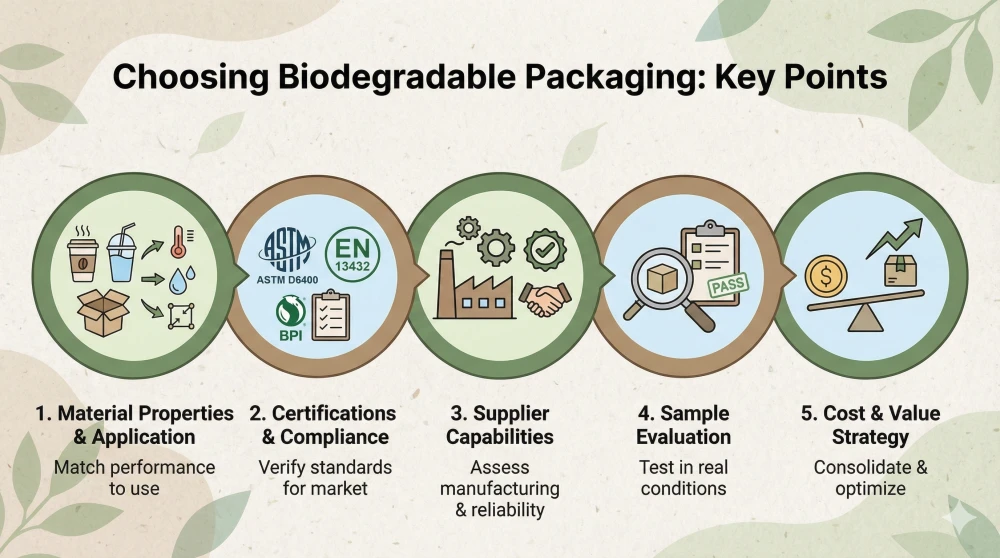
The foundation of successful biodegradable packaging procurement lies in matching material properties to your specific application requirements. Temperature exposure, moisture contact, structural demands, and disposal environment all influence which materials will perform adequately in your use case.
Starting with application analysis rather than material preference prevents costly mismatches. A material that works perfectly for cold beverages may fail dramatically when used for hot soup, and packaging designed for industrial composting may not break down in home compost systems your customers actually use.
How Do Temperature and Moisture Requirements Narrow Your Options?
Temperature exposure during use represents the most common specification failure point for biodegradable packaging. Standard PLA softens at temperatures above 50-55°C, making it unsuitable for hot food applications despite its appealing clarity and cost profile.
Material temperature capabilities to consider:
- Standard PLA: Maximum 50-55°C, suitable for cold applications only
- CPLA (crystallized PLA): Maximum 85°C, appropriate for hot beverages
- Bagasse: Maximum 100°C, excellent for hot food service
- Paper with aqueous coating: Maximum 90°C, good for most food service
- Palm leaf: Maximum 120°C, premium heat resistance
Moisture resistance varies equally across materials. Uncoated paper products absorb liquids within minutes, while bagasse with appropriate treatments maintains integrity for hours. Define your required moisture exposure duration and intensity before evaluating options.
Here’s the deal: requesting samples and testing them under your actual operating conditions reveals performance gaps that specification sheets cannot capture. A container that passes laboratory tests may still fail when filled with hot curry and transported in a delivery bag for thirty minutes.
What Certifications Must Your Products Carry?
Certification requirements depend on your target markets, customer expectations, and disposal infrastructure available to end users. European markets typically require EN 13432 certification, while US buyers look for ASTM D6400 or BPI certification.
Certification verification checklist:
- Confirm certificates apply to specific products, not just raw materials
- Check certificate validity dates and renewal status
- Verify certificates directly with issuing organizations when possible
- Ensure food contact certifications match your market requirements
- Request certificates for the exact product configuration you will purchase
Multiple certifications on a single product increase sourcing complexity and cost but may be necessary for companies serving diverse geographic markets. Discuss certification requirements early in supplier conversations to avoid discovering gaps after significant time investment.
| Application Type | Temperature Need | Moisture Exposure | Recommended Materials | Required Certifications |
|---|---|---|---|---|
| Cold beverages | Below 40°C | High, extended | PLA, Paper/PLA | EN 13432 or ASTM D6400 |
| Hot beverages | 85-95°C | High, extended | Paper/PLA, CPLA lids | EN 13432, FDA or EU food contact |
| Hot food takeaway | Up to 100°C | High, moderate duration | Bagasse, coated paper | EN 13432, FDA or EU food contact |
| Dry goods retail | Ambient | Minimal | Paper, uncoated bagasse | Market-specific |
Key Takeaway: Material selection should flow from application requirements to suitable options, not from material preference to forced applications, and certification verification must be product-specific rather than relying on general supplier claims.
How Do You Evaluate Potential Suppliers Effectively?
Supplier evaluation for biodegradable packaging requires examining manufacturing capability, quality systems, commercial reliability, and service responsiveness. The complexity of this product category makes supplier expertise particularly valuable, as knowledgeable suppliers can guide specification development and troubleshoot application issues.
Distinguishing between trading companies and integrated manufacturers helps set appropriate expectations. Integrated manufacturers who control production offer greater customization flexibility and typically better pricing, while pure trading companies may provide wider product selection but less control over quality and lead times.
What Questions Reveal True Manufacturing Capability?
Direct questions about production operations separate suppliers with genuine manufacturing capability from those who simply source products from unknown factories. Understanding a supplier’s production infrastructure helps assess their ability to meet your volume requirements and quality standards consistently.
Questions to ask potential suppliers:
- Do you own manufacturing facilities or source from partner factories?
- How many production lines do you operate for biodegradable products?
- What is your monthly capacity for the products I need?
- Can you provide factory certification documents and audit reports?
- What quality control processes occur during production?
- How do you handle production quality issues when they arise?
Suppliers with integrated trading and manufacturing operations, such as those maintaining multiple production lines under direct control, typically offer better visibility into production processes and faster response to quality concerns. Request production facility information early in your evaluation process.
How Should You Structure the Sample Evaluation Process?
Sample evaluation bridges the gap between supplier claims and actual product performance. A systematic sampling approach prevents disappointment when production orders arrive different from expectations.
Effective sample evaluation steps:
- Request samples of exact products you intend to purchase, not similar items
- Test samples under real operating conditions, not just visual inspection
- Document sample specifications as reference standards for production orders
- Retain approved samples for comparison with incoming shipments
- Request production samples from initial orders to verify consistency
Here’s the deal: samples represent a supplier’s best effort, so any issues visible in samples will likely amplify in production. Minor concerns during sampling often become major problems at scale.
| Supplier Type | Advantages | Disadvantages | Best For |
|---|---|---|---|
| Integrated manufacturer | Price control, customization, quality visibility | Potentially narrower product range | High volume, custom requirements |
| Trading company | Wide selection, sourcing flexibility | Less quality control, higher pricing | Small volumes, diverse needs |
| Distributor | Local inventory, fast delivery | Premium pricing, limited customization | Urgent needs, trial orders |
Key Takeaway: Thorough supplier evaluation focused on manufacturing capability and systematic sample testing prevents quality surprises and builds the foundation for reliable long-term supply partnerships.
What Ordering Strategies Optimize Value for Wholesale Buyers?
Strategic ordering approaches reduce effective costs and improve supply reliability for biodegradable packaging. Volume consolidation, timing optimization, and specification standardization all contribute to better outcomes than simply negotiating unit prices.
Understanding supplier economics helps frame negotiations productively. Suppliers face setup costs for each production run, making larger consolidated orders more efficient and enabling better pricing without margin compression.
How Does Order Consolidation Reduce Total Costs?
Consolidating orders across product categories with single suppliers improves pricing through volume leverage and reduces administrative overhead from managing multiple supplier relationships. Suppliers offer better pricing when orders provide production efficiency through scale and scheduling predictability.
Consolidation opportunities include:
- Grouping multiple product types in single orders
- Committing to annual volume agreements with quarterly releases
- Coordinating orders with other buyers through supplier programs
- Timing orders to combine with container shipments for freight efficiency
- Standardizing specifications to maximize production run lengths
The savings from consolidation often exceed what aggressive price negotiation achieves, while simultaneously improving supplier relationships and service priority.
What Specification Decisions Impact Pricing Most?
Custom specifications drive costs upward through setup charges, minimum quantity requirements, and production inefficiency. Evaluating which customizations deliver genuine value versus those that simply add cost helps optimize the specification-to-price relationship.
Specification factors affecting pricing:
- Custom sizes versus standard dimensions
- Custom printing versus stock products
- Special materials versus standard formulations
- Unique colors versus natural or common options
- Special certifications versus standard compliance
Accepting standard products where possible while customizing only elements that genuinely matter to your customers balances brand differentiation with cost management. Printing adds modest cost relative to size or material customization, making it the most cost-effective personalization approach for most buyers.
| Strategy | Potential Savings | Implementation Complexity |
|---|---|---|
| Volume consolidation | 10-20% | Moderate |
| Annual agreements | 5-15% | Low |
| Standard specifications | 15-25% | Low |
| Freight optimization | 5-10% | Moderate |
| Timing optimization | 5-10% | High |
Key Takeaway: Wholesale buyers achieve the best value through strategic ordering approaches that improve supplier economics rather than simply demanding lower prices, with specification standardization offering the largest savings opportunity for most purchasers.
How Do You Manage Quality and Supplier Relationships Long-Term?
Maintaining consistent quality across multiple orders requires systematic inspection processes, clear communication protocols, and relationship investment that motivates suppliers to prioritize your business. Quality management for biodegradable packaging follows principles applicable to any critical supply category but requires attention to material-specific concerns.
Building genuine partnerships with suppliers yields better results than transactional purchasing approaches. Suppliers who understand your requirements, value your business, and anticipate your needs invest more in maintaining quality and service levels than those treated as interchangeable commodity sources.
What Inspection Procedures Protect Against Quality Variation?
Incoming inspection procedures catch quality issues before products reach your customers or operations. Defining acceptance criteria and inspection protocols in advance prevents subjective disputes when shipments arrive.
Inspection elements to implement:
- Visual inspection against approved samples for appearance consistency
- Dimensional verification for size-critical applications
- Performance testing under operating conditions for initial shipments
- Documentation review for certifications and compliance materials
- Random sampling protocols based on shipment size and supplier history
- Clear rejection and return procedures for non-conforming materials
Documenting inspection results creates performance records that support supplier discussions and identify trending issues before they become critical problems.
How Should You Handle Quality Issues When They Occur?
Quality issues are inevitable in any supply relationship, and how both parties handle them determines relationship trajectory. Prompt, documented communication with specific information enables efficient resolution.
Quality issue communication should include:
- Specific identification of affected products and quantities
- Clear description of the quality deviation observed
- Photographic documentation where applicable
- Reference to specification requirements not met
- Proposed resolution expectation
- Timeline for supplier response
Fair but firm quality management builds supplier respect and maintains standards without destroying relationships. Suppliers who respond professionally to issues and implement corrective actions demonstrate partnership commitment worth rewarding with continued business.
| Quality Practice | Frequency | Purpose |
|---|---|---|
| Visual inspection | Every shipment | Appearance verification |
| Dimensional check | Every shipment | Specification compliance |
| Performance testing | Initial and periodic | Application suitability |
| Supplier review | Quarterly or annual | Trend analysis and improvement |
| Audit or visit | Annual for key suppliers | Capability verification |
Key Takeaway: Systematic quality management protects your operations and customers while building supplier relationships based on clear expectations and fair treatment, creating conditions for continuous improvement rather than adversarial negotiation.
Ready to Source Biodegradable Packaging with Confidence?
Selecting the right biodegradable packaging for wholesale purchase requires balancing multiple factors: material performance matching your applications, supplier capability ensuring consistent quality, certification credentials satisfying regulatory requirements, and commercial terms supporting your business economics. The systematic approach outlined here transforms a confusing market into manageable decisions.
Reliancepak operates as an integrated trading and manufacturing company with 9 production lines dedicated to biodegradable packaging products. Our range includes PLA cups, bagasse containers, paper products, and complementary items, enabling single-source procurement that simplifies your supply chain. Food-grade certifications including EU and FDA compliance provide the documentation your quality systems require, and free samples let you evaluate products before volume commitment.
The companies building reliable biodegradable packaging supply chains today position themselves advantageously as sustainable packaging transitions from market differentiator to baseline requirement.
Frequently Asked Questions
Can I order mixed product types in a single shipment?
Yes. Consolidating multiple product types in single orders improves freight efficiency and often qualifies for better pricing through combined volume. Coordinate with your supplier on container loading plans to maximize space utilization while protecting products during transit.
How do I know if a supplier’s certifications are legitimate?
Request certificate copies showing product identification, testing dates, and issuing organization details. Valid certifications from recognized bodies include unique certificate numbers you can verify directly with the issuing organization. Be cautious of certificates lacking specific product identification or showing expired validity dates.
What happens if products do not match approved samples?
Document deviations with photographs and specific measurements, then contact your supplier immediately with clear information about the discrepancy. Reputable suppliers will investigate, acknowledge legitimate issues, and propose resolution through replacement, credit, or return. Establish quality expectations and resolution procedures before placing production orders.
Should I visit supplier facilities before placing large orders?
Facility visits provide valuable insight for significant purchasing relationships, though third-party audits offer similar verification at lower cost. For critical suppliers representing substantial annual spend, direct visits or commissioned audits justify the investment. For smaller relationships, detailed questioning, sample evaluation, and reference checks may suffice.
How far in advance should I place orders to ensure delivery timing?
Plan 8-12 weeks from order placement to warehouse receipt for international orders, including 2-4 weeks for production and 3-5 weeks for sea freight. Custom printed products may require additional time. Building safety stock and placing orders before urgent need provides buffer against delays from production issues, shipping disruptions, or customs clearance variations.