
PS plastic is safe for food contact applications when manufactured under strict regulatory standards and used within its designated thermal boundaries. While chemical migration remains a topic of industrial scrutiny, the consensus from global health authorities confirms that polystyrene poses no health risk to consumers if used for cold or ambient temperature storage as intended.
You likely face rigorous quality control standards when selecting packaging for your food service business or wholesale distribution network. Ensuring that your containers meet FDA or EU certifications is not just a matter of legal compliance; it is about protecting your brand from the fallout of safety failures. This guide provides a detailed analysis of the safety profile of ps plastic, the regulatory landscape governing its use, and the technical limits you must respect to ensure consumer safety.
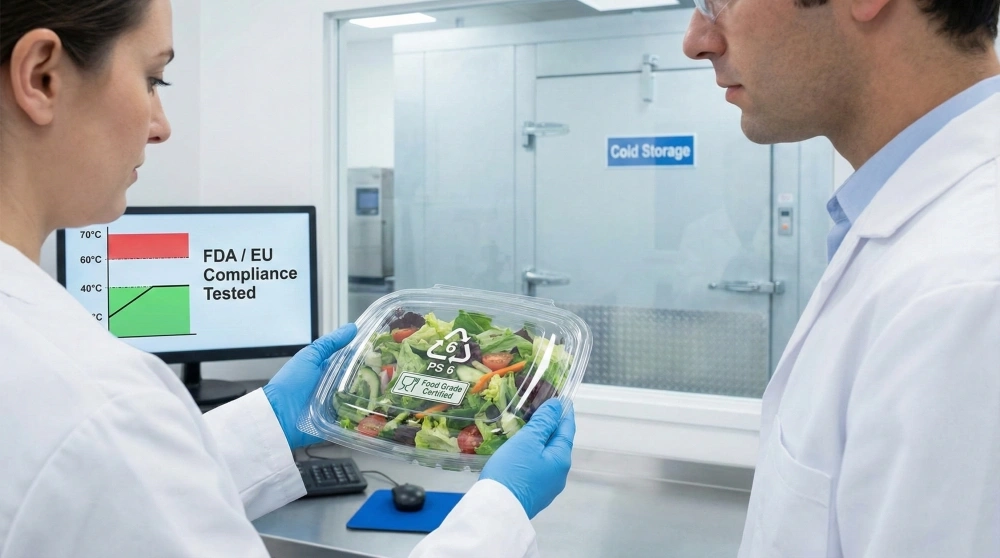
What Are the Global Regulatory Standards for PS Plastic?
Before any ps plastic container reaches a supermarket shelf, it must undergo extensive testing to ensure it does not leach harmful substances into food. The primary focus of these regulations is the “Specific Migration Limit” (SML) of styrene monomers.
FDA Compliance in the United States
The U.S. Food and Drug Administration (FDA) has cleared polystyrene for use in food packaging for decades. Their safety assessment is based on the potential amount of styrene that might migrate from the packaging into the food, which they have determined is infinitesimal compared to the levels naturally occurring in common foods.
- Extraction Testing: Manufacturers must prove that the material does not transfer more than a negligible amount of its chemical constituents.
- Purity Requirements: Only high-purity resin grades are permitted for direct food contact to avoid secondary contaminants.
European Union (EU) 10/2011 Regulations
The EU maintains some of the world’s strictest plastics regulations. Under EU 10/2011, ps plastic must be tested against specific food simulants—such as acetic acid for acidic foods—to ensure migration levels remain below 10 mg/dm².
- Declaration of Compliance (DoC): Reliable suppliers provide a DoC that outlines the testing conditions and confirms the material’s safety.
- Batch Traceability: EU standards require that every production lot can be traced back to its raw material source.
| Regulation | Region | Key Requirement |
| FDA 21 CFR | USA | Migration testing and purity |
| EU 10/2011 | Europe | Specific Migration Limits (SML) |
| GB 4806 | China | Material-specific safety standards |
One thing is certain, compliance is your best insurance.
Key Takeaway: Adhering to FDA and EU standards ensures that your PS packaging is legally compliant and safe for global distribution.
What Are the Precise Temperature Limits for PS Plastic?
The safety of ps plastic is inextricably linked to temperature. Unlike more heat-resistant polymers, polystyrene has a relatively low glass transition temperature, which dictates its functional use cases.
Cold and Ambient Storage Performance
ps plastic is ideally suited for cold storage. At temperatures between 0°C and 40°C, the polymer chain is stable, and the risk of styrene migration is virtually non-existent.
- This makes it a premier choice for deli salad containers and fruit punnets.
- It is highly effective for dairy packaging like yogurt and ice cream tubs.
The Critical “Danger Zone”
Wait, there is a limit you cannot ignore. When ps plastic is exposed to temperatures exceeding 70°C (158°C), it begins to soften.
- Exceeding the recommended temperature range can cause the plastic to soften, potentially affecting the seal or structural shape.
- Unless specifically labeled as microwave-safe, standard polystyrene should never be heated in a microwave.
Key Takeaway: PS plastic is a specialist for cold and ambient applications; exceeding 70°C risks both structural failure and increased migration.
How Does Styrene Migration Impact Health and Safety?
There is often confusion regarding the health risks associated with ps plastic. As a professional, it is important to distinguish between “styrene” as a raw chemical and “polystyrene” as a finished, inert plastic.
Fact vs. Fiction in Chemical Leaching
While styrene monomer in its pure form is a point of study, once polymerized into ps plastic, it becomes chemically stable.
- Migration levels found in actual food contact studies are typically 10,000 times lower than safety thresholds.
- The human body metabolizes and eliminates small amounts of styrene quickly.
The Impact of Food Composition
The type of food packaged also influences safety.
- Polystyrene is highly resistant to diluted acids and bases.
- It is stable for most common food types, though extremely high-fat foods at elevated temperatures require more caution.
Key Takeaway: Chemical migration in PS plastic is well-controlled and far below hazardous levels when used within standard guidelines.
Is PS Plastic Safe for Acidic and Fatty Foods?
The chemical resistance of ps plastic is a major factor in its widespread use. However, the interaction between the plastic and specific food types depends on the food’s chemical makeup.
Resistance to Acidity
Here’s the deal: polystyrene is naturally resistant to many acidic substances.
- It is safe for vinaigrettes, citrus-based salads, and pickled items.
- The material does not corrode or leach when in contact with common food acids.
Stability with Fatty Foods
Make no mistake, fatty foods at room temperature are generally safe in PS containers.
- However, fatty foods can act as a solvent for monomers if the temperature rises.
- This is why PS is preferred for refrigerated dairy but not for hot, greasy take-out.
| Food Type | Safety Level (at <40°C) | Recommendation |
| Dry Goods | High | Excellent for shelf stability |
| Acidic Foods | High | Safe for pickles and citrus |
| Fatty Foods | Moderate/High | Ideal for cold dairy and oils |
Key Takeaway: PS plastic offers excellent resistance to acidic and most fatty foods, provided they are kept at refrigerated or room temperatures.
Why Is Being BPA-Free a Critical Advantage for PS?
A significant advantage for many B2B buyers is that ps plastic is naturally BPA-free. Bisphenol A is primarily used in polycarbonates, not polystyrene.
Addressing Consumer Concerns
You can market your PS-based containers as BPA-free to address a major consumer concern.
- This allows for better brand positioning in health-conscious markets.
- It simplifies the certification process for products aimed at sensitive demographics.
Comparison with Other Resins
The real story is that while PET and PP are also common, PS provides this safety benefit without the need for expensive additives.
- Naturally occurring purity makes PS a reliable choice for “clean label” packaging.
- It reduces the complexity of chemical safety disclosures for your business.
Key Takeaway: The inherent BPA-free nature of PS plastic provides a marketing edge and peace of mind for health-conscious end-users.
How Can Suppliers Ensure Consistent Batch Safety?
To mitigate risks, your procurement strategy should focus on transparency and verification. Relying on a manufacturer that manages the entire production cycle is the most effective way to guarantee safety.
The Importance of Virgin Resin
Here is the bottom line: for direct food contact, 100% virgin resin is the gold standard.
- Using virgin ps plastic ensures there are no contaminants from post-consumer waste.
- It provides consistent clarity and strength that recycled blends often lack.
Third-Party Auditing and Testing
The situation is simple: trust, but verify.
- Always ask for recent FDA or EU test reports from labs like SGS or Intertek.
- Ensure the supplier has a robust Quality Management System (QMS).
Key Takeaway: Safety is a result of virgin material usage and rigorous third-party testing to verify compliance.
What Are the Long-Term Stability Risks of PS Packaging?
Over long storage periods, the stability of ps plastic remains excellent under the right conditions. However, environmental factors can play a role.
UV Exposure and Oxidation
Wait, there is more to consider than just temperature.
- Prolonged exposure to direct sunlight (UV) can cause polystyrene to yellow over time.
- Oxidation is generally not a concern for the food inside, but it can make the plastic more brittle.
Moisture and Humidity Resistance
Polystyrene is naturally hydrophobic, meaning it does not absorb water.
- This makes it an excellent barrier for liquid-heavy foods.
- It ensures the packaging remains strong even in humid or wet storage conditions.
Key Takeaway: PS plastic is exceptionally stable over long durations, provided it is stored away from extreme UV light and high heat.
How Do Customizations Affect the Safety of PS Containers?
When you opt for professional customization, you must ensure that additives do not compromise the ps plastic safety profile.
Printing and Inks
The real story lies in the application of brand logos.
- Only food-safe, low-migration inks should be used for printing on PS containers.
- External printing is generally safer than internal contact printing.
Colorants and Clarifiers
Adding color to your HIPS or GPPS must be done with certified masterbatches.
- These colorants must also meet FDA/EU food contact requirements.
- Professional suppliers use internal testing to ensure that colors do not bleed into the food.
Key Takeaway: Customizations like printing and coloring are safe only when utilizing food-grade certified additives and inks.
Conclusion
For a broader perspective on how these safety standards integrate with industrial applications, you can refer back to our [What Is PS (Polystyrene) Plastic?] pillar guide.
At Reliancepak, food safety is our primary manufacturing pillar. We operate 9 specialized production lines using 100% virgin, food-grade polystyrene that meets both FDA and EU standards. We provide full documentation and free samples so you can conduct your own internal safety audits before committing to a bulk wholesale order.
Protect your brand and your customers with certified packaging. Contact Reliancepak today for a consultation on safe PS packaging solutions.
Our vision is to provide the global food industry with packaging that is not only functional and safe but also increasingly integrated into a sustainable, circular economy.
FAQ
Is it safe to drink hot coffee from a PS lid?
Yes. While the lid is made of ps plastic, it is not in constant, long-term contact with the hot liquid, and the surface area is small. However, the cup itself should be made of a more heat-resistant material like paper or PP.
Does ps plastic react with acidic foods like vinegar?
No. Polystyrene is highly resistant to diluted acids and bases, making it safe for vinaigrettes and pickled items, provided they are kept at cool temperatures.
Is ps plastic waterproof?
Yes. Polystyrene is naturally hydrophobic and does not absorb water, ensuring structural form in wet storage.
Does PS plastic contain BPA?
No. Polystyrene is naturally BPA-free as it does not require Bisphenol A in its production process.
How can I verify if a supplier is using virgin resin?
Request a “Material Safety Data Sheet” (MSDS) and a certificate of analysis (COA) for each batch. These documents will state the resin source and grade.