Recycled PET has moved from a niche material to a standard line item in foodservice procurement. If you are sourcing cups for a cafe chain, a catering distributor, or a private-label program, rPET is probably already on your shortlist — and probably raising the same three questions: is it safe for food contact, what does it cost, and where does it actually perform worse than virgin material.
What rPET Is, and Why It Entered Food Packaging
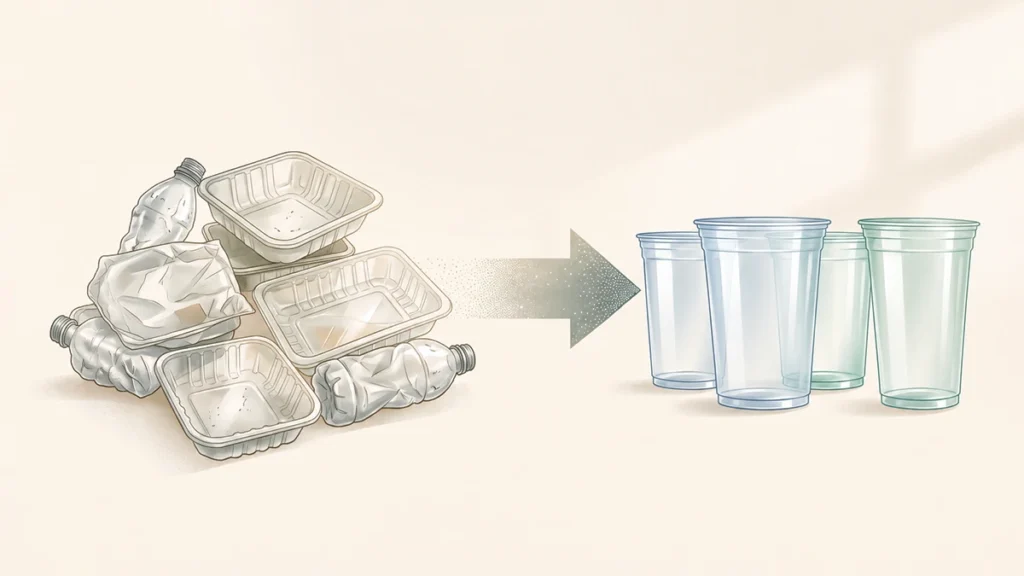
rPET is polyethylene terephthalate that has been collected, cleaned, and reprocessed into new resin. The feedstock is usually post-consumer beverage bottles, which is convenient because bottle PET is already a high-purity, food-grade stream with an established collection infrastructure.
Regulation pushed adoption faster than consumer sentiment did. The EU’s packaging rules now require recycled content in PET beverage bottles, and several member states have extended recycled-content or single-use-plastic levies to foodservice ware. For buyers, the practical effect is that rPET is no longer a sustainability add-on; in some markets it is the default specification.
Where rPET Fits in the Cup Category
Clear cold cups are the most natural application. PET gives the glass-like clarity that operators want for iced drinks, smoothies, and desserts, and rPET retains it as long as the recycler controls color and IV (intrinsic viscosity).
The material is less suited to hot-fill. Standard PET softens well below boiling, so rPET cups are typically specified for cold and ambient use rather than tea or coffee service. For hot beverages, PP or a paper-and-liner construction is the more sensible route.
Food-Contact Safety: What to Verify, Not Assume
Food-grade rPET is safe when the recycling process has been assessed for food contact and the finished article meets the applicable migration limits. The safety case rests on the process, not on the word “recycled.”
In the EU, recycled plastic for food contact falls under Regulation (EU) 2022/1616, which replaced the earlier framework and sets requirements for recycling technologies, process authorization, and traceability. In the US, the FDA evaluates recycled processes through its chemistry guidance and issues no-objection letters for specific process-and-feedstock combinations. EFSA publishes scientific opinions on individual recycling processes in Europe.
What this means at the purchasing desk is simple: ask for documents, and check that they match the material you are buying.
A workable document request looks like this:
- Recycling process authorization or no-objection letter, naming the process and the feedstock scope.
- Migration test reports from an accredited lab, covering overall and specific migration against the destination market’s limits.
- Declaration of Compliance listing the article type, use conditions, and any restriction on hot-fill or high-fat contact.
- A statement on recycled content percentage, since “rPET” alone does not tell you whether the cup is 30% or 100% recycled.
Two failure modes show up often. The first is a supplier quoting a certificate that covers resin, while the cup is molded by a different converter with no process control. The second is a food-grade claim on a product that was actually made from industrial-grade flake. Both are avoided by requiring lot-level traceability rather than a single PDF on file.
The Cost Picture
Food-grade rPET does not carry a permanent green premium, and it is not reliably cheaper either. Its price tracks virgin PET closely and swings with the cost of collected feedstock, sorting capacity, and regional recycled-content mandates.
When bottle collection is tight — or when mandated recycled content forces brand owners into the same pool of material — food-grade rPET can trade at or above virgin PET. When collection outpaces demand, the gap narrows or reverses. Buyers who fix rPET pricing for twelve months on the assumption that it is always the discount option tend to renegotiate mid-year.
Other cost lines matter as much as resin. Color sorting for high-clarity cups, tighter incoming inspection, and the documentation burden all add cost that does not appear on a resin index.
| Material | Clarity | Heat tolerance | Recycled content available | Relative unit cost | Typical fit |
|---|---|---|---|---|---|
| Virgin PET | High | Cold / ambient | None | Baseline | Cold cups, premium visibility |
| rPET (food-grade) | High | Cold / ambient | 30–100% | Near parity to slight premium | Cold cups with recycled-content targets |
| PP | Moderate | Hot-fill capable | Limited | Similar to PET | Hot drinks, lids, straws |
| PLA (biobased) | High | Low | N/A (compostable route) | Premium | Compostable programs with collection |
| Paper + liner | Low | Hot-fill capable | Varies by liner | Mid to premium | Hot cups, branding-led programs |
Relative cost bands are directional and move with region and contract volume; confirm against current quotes rather than planning from a table.
Advantages and Trade-offs Worth Writing Into a Spec
On the plus side, rPET delivers clarity and stiffness close to virgin PET, prints and lids work without redesign, and it carries a recycled-content story that is verifiable rather than decorative. It also drops into existing cold-cup tooling in most cases, which keeps changeover cost low.
The trade-offs are real but manageable:
- Color drift. Repeated recycling can push the resin slightly gray or yellow, so clarity specifications need a measured tolerance, not a verbal promise.
- Heat ceiling. Cold and ambient only. Hot-fill requires a different polymer.
- Supply volatility. Food-grade rPET availability tightens when mandates pull volume into beverages.
- Documentation load. Compliance paperwork per lot adds administrative work your QA team should budget for.
- Recyclability caveat. An rPET cup is recyclable where PET collection exists; in markets without it, the recycled content is a material choice, not a circular one.
Specifying and Sourcing rPET Cups
A specification that holds up in production names the material grade, the recycled content percentage, the clarity tolerance, the intended temperature range, and the documentation package. Vague language like “eco-friendly material” invites substitution.
Where the cup is molded also matters. Resin quality from a good recycler can still produce a poor cup if the converter runs unstable cycle times or lets regrind accumulate in the feed.
On that front, if you are building an rPET cup program at volume, we mold food-grade rPET cups and can align recycled content, wall thickness, lid fit, and print to your specification, with OEM and private-label runs handled in-house. Samples and compliance documents are available before you commit to tooling — useful if your QA team wants to run its own migration review first. The disposable cups range shows the formats we currently produce, and quoting against your volume and destination market is the fastest way to see where rPET lands on your cost sheet.
FAQ
Is rPET safe for direct food contact?
Yes, provided the recycling process has been assessed for food contact and the finished cup meets the migration limits of your market. Safety comes from process validation and testing, not from the material name — so request the process authorization or no-objection letter and the migration reports.
Can rPET cups hold hot drinks?
No, generally not. Standard PET and rPET soften at temperatures below boiling, so these cups suit cold and ambient beverages. For hot service, specify PP or a paper cup with an appropriate liner.
Is rPET more expensive than virgin PET?
Not consistently. Food-grade rPET often prices close to virgin PET and can trade above it when recycled feedstock is scarce or recycled-content mandates tighten supply. Treat it as a floating input and build a review clause into longer contracts.
What recycled content should I specify?
Whatever your compliance target or customer commitment requires, stated as a percentage with a verification method. 100% rPET is available for many cold-cup formats, but clarity and cost both shift with the level, so confirm samples at the exact percentage you plan to buy.
Does using rPET make a cup compostable?
No. rPET is recyclable, not compostable. The two claims are often confused in marketing copy; if compostability is the requirement, PLA or fiber-based formats are the relevant options.