
A food tray looks simple. It is a shallow box with a rim. But the material under that rim decides how the tray stacks, how it seals, how it photographs on a shelf, and how much air you ship across an ocean.
Wholesale buyers usually learn this the hard way. A tray that passed the sample stage can still fail on a filling line, or arrive with a smell nobody tested for. This guide covers the six materials that account for most of the market, and shows where each one earns its place.
The Materials You Will Actually Be Choosing Between
Nearly every disposable food tray on the market falls into six material families. None of them wins on every count. Each one trades something away: clarity for toughness, insulation for print quality, compostability for load strength.
The better question is not which material is best. It is which trade-off your application can live with.
PP (Polypropylene)
The default choice for most wholesale buyers, and for good reason. PP comes out rigid and slightly flexible at the same time, so a corner that takes a hit in transit tends to bend instead of split.
The surface reads matte to semi-gloss. It feels smooth and a little waxy under the thumb, not glassy. Water and oil resistance are both high, and the tray tolerates microwave reheating without deforming.
That mix makes PP the workhorse for hot takeaway, meal prep, catering, and chilled deli. Watch wall thickness on low-priced lots. A tray can match the stated dimension and still feel flimsy, because the dimension says nothing about gram weight.
PET and rPET
This is the clear one. PET gives near-glass transparency, sharp edges, and a crisp snap when you flex the rim. Buyers pick it when the product has to sell itself through the lid.
The hand feel is harder and more brittle than PP. A dropped PET tray can crack along the corner. Water resistance is high, but heat tolerance is not, so these trays belong in cold and ambient display rather than on a hot-fill line or in a microwave.
rPET, the recycled variant, handles much the same way with a lower virgin-material content. It also carries more paperwork. Food-contact approval for recycled resin varies by market, so confirm the documentation your destination country requires before committing to a volume.
PS and EPS Foam
Two products under one name, and buyers confuse them constantly. Rigid PS is the brittle, glossy, inexpensive tray under bakery items and supermarket sandwiches. EPS foam is the white cellular tray used for meat, poultry, and fish.
Rigid PS feels glassy and stiff, cracks easily, and offers no insulation. EPS feels light and slightly soft, weighs almost nothing, and holds temperature well, which is why protein packers keep using it.
Both handle water without trouble. Both dislike high heat. The real problem with foam is not performance but perception: several markets have restricted or taxed EPS in food service, so check the regulatory direction of your destination before you build a program around it.
Coated Paperboard
Paper trays are the print-friendly option. You get a natural paper feel, a matte surface that takes ink cleanly, and a shape that reads premium takeaway rather than plastic container.
The coating does the work. A polyethylene or water-based barrier layer decides whether the tray survives a greasy portion. Board without a barrier will wick oil within minutes.
Rigidity is moderate and depends heavily on board weight and fold geometry. These trays suit bakery, dry snacks, and light hot food. They are a poor fit for anything heavy, wet, or held for hours.
Bagasse and Molded Fiber
Sugarcane bagasse and other molded fiber trays are pressed from plant pulp. You can see and feel the fiber: a slightly rough, egg-carton texture with soft rounded edges.
Water resistance is limited. The material absorbs moisture and oil over time, so a sauce-heavy dish will eventually mark the surface. Rigidity is acceptable when dry and weaker once wet.
The right use is short-hold service. Salads, dry sides, fruit, bakery, and event catering where the tray is discarded within the hour all work. A lining improves barrier performance, but it also complicates the compostability claim you are likely selling.
Aluminum Foil
Foil trays are the heat specialists. Bright metallic surface, dead-soft hand feel, and a rim you can crimp by hand. They go from freezer to oven without complaint.
Water and oil resistance are near-total, because the barrier is metal. Rigidity comes only from the formed shape, so a loaded foil tray needs support: a holder, a sleeve, or a flat surface.
Use them for oven-ready meals, roasting, catering pans, and delivery where the food goes back into heat. Do not expect them to seal against a film lid the way a plastic tray does.
Material Comparison at a Glance
The table below summarizes how each material behaves on the attributes buyers ask about most. Ratings are relative, not absolute. A moderate rating can still be the right answer in the right application.
| Material | Look and feel | Rigidity | Water and oil resistance | Heat performance | Typical use | Relative cost |
|---|---|---|---|---|---|---|
| PP | Matte to semi-gloss, smooth waxy touch | High, flexes without splitting | High | Microwave-tolerant, hot-fill capable | Hot takeaway, meal prep, deli | Low to moderate |
| PET / rPET | Glass-clear, hard, crisp snap | High but brittle | High | Cold and ambient only | Fruit, chilled dessert, retail display | Moderate |
| Rigid PS | Glossy, glassy, stiff | Moderate, cracks on impact | High | Cold and warm holding only | Bakery, sandwiches | Low |
| EPS foam | White, light, slightly soft | Moderate, shape-dependent | High | Insulating, not oven-safe | Meat, poultry, fish | Low |
| Coated paperboard | Natural paper, matte, print-ready | Moderate, board-weight dependent | Coating-dependent | Short hot-hold only | Bakery, dry snacks, light hot food | Low to moderate |
| Bagasse / molded fiber | Visible fiber, rough, rounded | Moderate dry, weaker wet | Low to moderate | Short hot-hold only | Salad, fruit, event catering | Moderate |
| Aluminum foil | Metallic, soft, hand-crimpable | Low without support | Near-total | Oven and freezer safe | Roasting, oven meals, catering | Moderate |
Matching the Tray to the Application
Choosing by material alone leads to mismatches. Choose by what the tray has to survive: fill temperature, holding time, display condition, and the trip in between.
Fresh produce and cut fruit
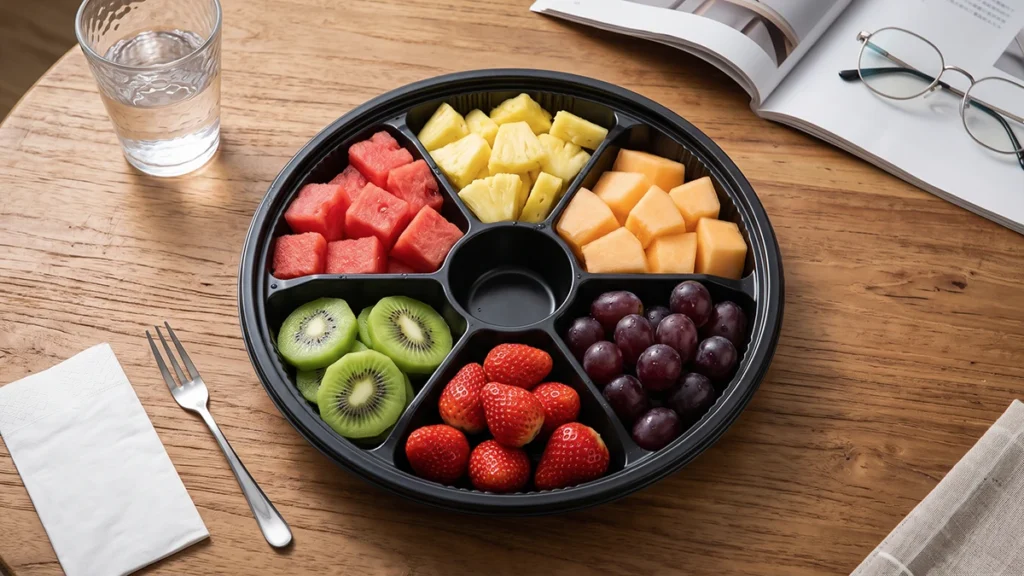
Clarity sells here, so PET leads. Use vented PET for whole fruit that needs airflow, and unvented for cut fruit that needs a barrier. Bagasse works for farm-direct and farmers market channels, where the fiber look supports the story the buyer is already telling.
Chilled protein and seafood
EPS foam still dominates on insulation and cost per unit. Where foam is restricted, PP with an absorbent pad is the practical substitute. Check that the base stays flat under load. Wet protein is heavy, and a bowed tray leaks into the carton below it.
Bakery and deli
Rigid PS delivers the glossy, low-cost shelf look. Coated paperboard takes over when the brand needs print space. For open display, a paperboard base with a clear PET window covers both needs and has become common in retail bakery.
Hot takeaway and catering
PP for anything sealed with film or a lid. Foil where the food returns to an oven. Bagasse for short-hold catering, where the tray is a serving vessel rather than a storage container.
What to Check Before You Place the Order
Most disputes in this category trace back to specifications nobody wrote down. Settle these before the first production run.
- Gram weight, not only dimensions. Two trays can share a footprint and differ by a fifth in material. Ask for gram weight per piece in writing.
- Food-contact documentation. Request the certificate that matches your destination market, and confirm its scope covers the specific resin or coating.
- Dimensional tolerance. State the acceptable range for rim diameter and depth. Stacking and sealing both depend on it.
- Mixed loads. One container usually carries several tray sizes. Confirm the pallet plan and nesting ratio, since freight cube often costs more than the tray itself.
- Sample before volume. Run a paid sample through your own process. Free samples confirm appearance; only a line trial confirms behavior.
For buyers assembling a full disposable range, sourcing trays, lids, cups, and bags from one supplier cuts the coordination load and keeps certifications in a single file. Reliancepak supplies a disposable food tray range in plastic and eco-friendly materials for wholesale programs, with OEM/ODM tooling, free samples, and food-grade documentation for FDA and EU markets.
FAQs
Are PP trays safe for microwave use?
Yes. PP is one of the few tray materials built to tolerate microwave reheating without warping. Confirm that the lid or film you pair with it carries the same rating, since the seal layer is often the weaker part.
Can bagasse trays hold oily or wet food?
Yes, within limits. Bagasse handles a light oil sheen and short holding times well. A sauce-heavy dish held for hours will soak through, so use a lined variant or move that item to PP.
What is the difference between PET and rPET for food trays?
The base resin. PET is virgin material; rPET contains recycled content. Clarity, handling, and heat limits are close. The real difference sits in documentation, because recycled resin needs market-specific food-contact approval.
Do I need different trays for hot-fill and cold display?
Yes. Hot-fill calls for PP or foil, both of which hold shape at temperature. Cold display favors PET for clarity or PS for cost. Running a cold-display tray on a hot line leads to warping, seal failure, and leakers in the case.