If your business ships fried foods, grilled entrées, or any hot menu item through delivery and takeaway channels, the container you choose directly affects what your customer tastes. Vented clamshell food containers are built to release steam during transit, which keeps crispy textures intact and prevents the condensation buildup that sealed packaging tends to create.
This guide is written for procurement teams, packaging distributors, and food manufacturing buyers rather than end consumers. Beyond explaining how ventilation works, it covers the purchasing side of the decision: material selection, MOQ structures, custom vs. stock options, compliance documentation, and how to screen suppliers before committing to a bulk order.
Why Hot Food Fails in Sealed Packaging
When hot food is closed inside a non-vented container, rising steam hits the cooler lid surface and condenses into water droplets. The consequences show up quickly in delivery scenarios:
- Soggy textures: Fried items lose their crust within minutes of trapped-steam exposure.
- Wilted produce: Fresh garnishes and salad components soften and discolor.
- Flavor dilution: Condensation dripping back onto the food alters its intended taste profile.
- Negative first impressions: A fogged, water-marked container signals poor quality before the meal is opened.
For a foodservice operation, each of these outcomes translates into complaints, refunds, and lost repeat orders. Ventilation addresses the root cause rather than the symptom.
How Ventilated Clamshell Design Works
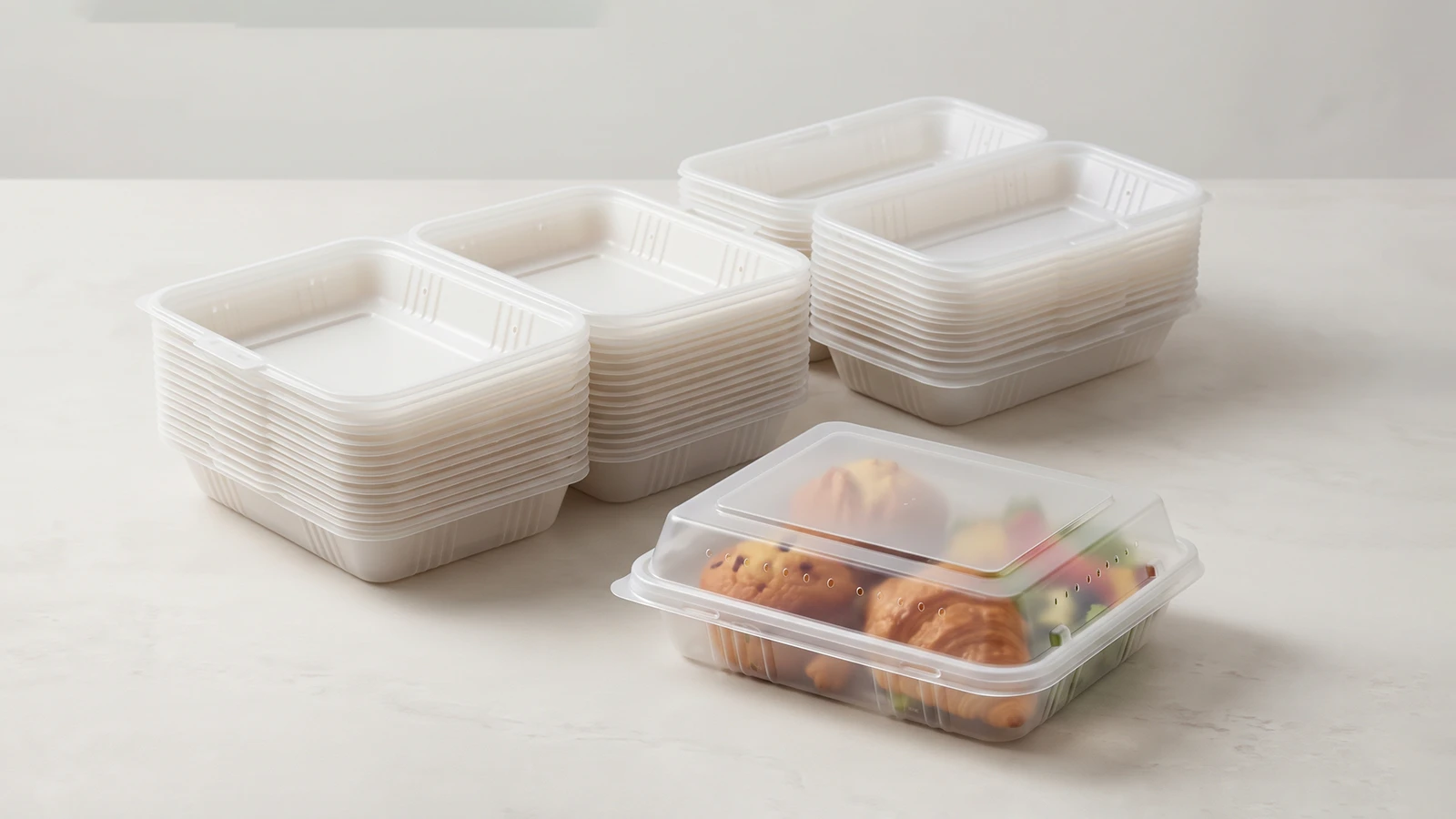
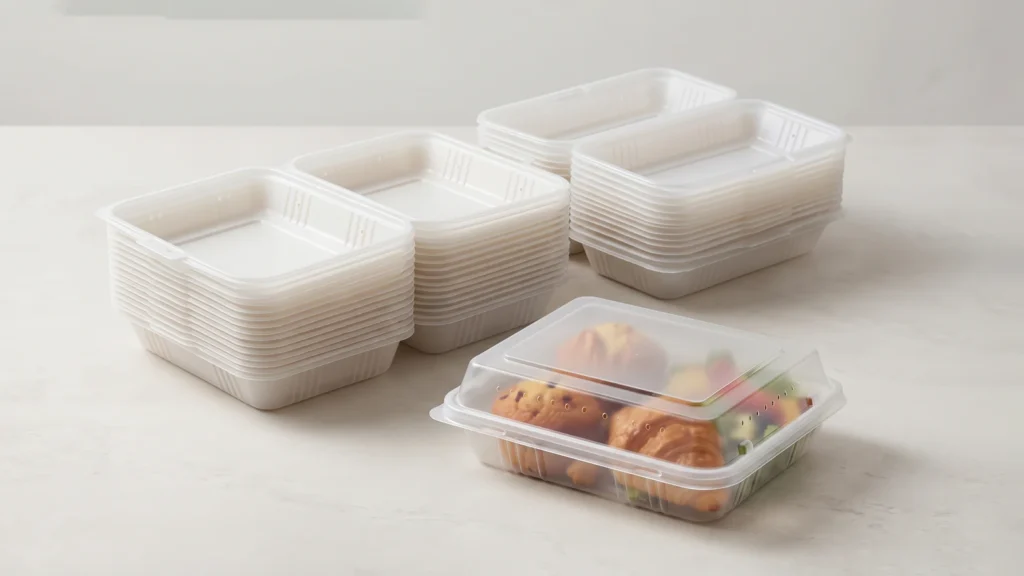
A vented clamshell uses strategically placed perforations or raised lid clearances to let steam escape while the hinged structure still protects the food. Three mechanisms are at work:
- Steam release: Vents channel rising vapor out of the container before it can condense.
- Humidity regulation: Continuous vapor escape keeps interior moisture levels low throughout transit.
- Air circulation: Controlled airflow preserves surface texture, which matters most for breaded and fried products.
The engineering detail lies in balance. Vents must be large enough to evacuate steam, yet positioned and sized so they do not accelerate heat loss, admit contaminants, or weaken the container’s structure. This is why production precision and tooling quality are worth verifying when you audit a supplier — a topic covered later in this guide.
Material Selection: Comparing the Main Options
Material choice determines heat tolerance, microwave compatibility, sustainability positioning, and unit cost. The table below summarizes the options most commonly quoted by manufacturers.
| Material | Heat Suitability | Microwave Use | Compostability | Best-Fit Applications |
| PP (Polypropylene) | High; handles hot fill and reheating | Yes | No | Fried foods, hot entrées, general takeaway |
| CPLA | High; heat-resistant bioplastic | Generally suitable | Yes, industrial composting | Brands with compostable packaging mandates |
| Bagasse (sugarcane fiber) | High; naturally breathable | Yes | Yes | Fried, greasy, or moisture-heavy hot foods |
| PET | Low; warm-food use only | No | No | Warm (not hot) items, display-oriented retail |
A few practical observations from the sourcing side. PP remains the volume default because it combines heat resistance with low unit cost and wide mold availability. Bagasse is gaining share where buyers face single-use plastic restrictions or corporate sustainability targets, though it typically prices higher than PP. CPLA sits between the two and depends on access to industrial composting infrastructure in your market — worth confirming before you commit.
MOQ and Order Structure: What Buyers Should Clarify First
Minimum order quantities are usually the first commercial variable to lock down, because they shape your cash flow, warehouse space, and SKU flexibility. MOQ levels are not uniform across the industry, and they generally move in relation to these factors:
- Stock vs. custom production: Standard sizes in existing molds carry the lowest MOQ. Custom dimensions, colors, or vent patterns usually require a higher commitment because they occupy dedicated production runs.
- Material type: Compostable materials such as bagasse and CPLA often carry different MOQ thresholds than commodity PP, reflecting their production economics.
- Printing and branding: A plain container is simpler to produce than one with logo printing or embossing, so branding requirements typically push the minimum quantity upward.
- Container size: Larger formats consume more machine time and material per unit, which commonly raises the MOQ compared with small formats.
When you request quotes, ask suppliers to state the MOQ for each scenario separately — stock, custom size, and custom print. A structured quote lets you compare offers on the same basis and avoids surprises after the proforma invoice is issued. It also opens room to negotiate a phased plan, for example a smaller trial volume followed by scheduled bulk releases as your sell-through is confirmed.
Custom vs. Stock Containers: A Procurement Comparison
Deciding between ready-made stock clamshells and a custom program is largely a trade-off between speed, unit cost, and brand differentiation.
| Factor | Stock Containers | Custom Containers |
| Lead time | Short; often ships from existing inventory | Longer; includes mold or tooling where needed |
| Unit cost | Lower at comparable volumes | Higher, offset by branding and fit benefits |
| MOQ | Lower | Higher; varies by customization depth |
| Brand presentation | Generic | Logo, color, and structural differentiation |
| Fit to product | Compromise sizing | Sized to your actual menu items |
For many distributors, a staged approach works well: launch with stock containers to validate demand, then move high-velocity SKUs into a custom program once volumes justify the tooling. If you are comparing supplier programs, browsing an established clamshell container catalog is a practical starting point to see which stock formats exist before investing in custom molds.
Certifications, Compliance, and Documentation
Food-contact compliance is a screening criterion, not a nice-to-have. Before placing a bulk order, request and file the following documentation from any prospective supplier:
- Food-contact compliance: Material safety declarations covering applicable FDA and EU food-contact requirements, matched to the specific resin or fiber grade being quoted.
- Migration and safety testing: Third-party test reports for the actual product, not generic material datasheets.
- Compostability certification: If you are buying bagasse or CPLA for a sustainability claim, verify the certification scope applies to your destination market.
- Traceability records: Batch-level traceability matters if your customers include retail chains with audit requirements.
A supplier that hesitates to provide these documents during the quoting stage will rarely be faster about it after payment.
Samples and Pre-Production Validation
Reputable wholesale suppliers typically offer free samples so buyers can test performance with real food before committing to volume. Use the sampling stage actively rather than as a formality:
- Run realistic transit tests: Pack hot food at production temperature and hold it for your typical delivery window, not a best-case scenario.
- Check structural performance: Test hinge durability through repeated open-close cycles and confirm the closure survives stacking and transport handling.
- Validate the vent design: Confirm condensation stays controlled across your full menu range, including the greasiest and highest-moisture items.
- Confirm dimensions in context: Verify the container fits your existing bags, delivery boxes, and shelf or warmer slots.
Document any failures with photos and send them back to the supplier for revision before mass production. A supplier’s responsiveness at this stage is a reliable indicator of how the partnership will run afterward.
How to Evaluate a Clamshell Supplier Before Committing
Product quality aside, several commercial and operational factors separate reliable packaging manufacturers from risky ones:
- Manufacturing depth: Suppliers that run their own production lines control tooling precision and vent consistency directly; pure traders introduce a layer between you and the factory floor.
- Delivery reliability: Ask about typical production lead times and on-time performance for your region, and check whether logistics support exists for your market.
- One-stop range: Consolidating clamshells, trays, paper boxes, and cups with one supplier simplifies procurement and often improves container-level pricing.
- Customization capability: Confirm in-house OEM/ODM capacity — mold modification, printing, and structural design — rather than an outsourced arrangement.
- Communication quality: Fast, specific answers during quoting generally predict fast problem-solving during production issues.
Reliancepak, for instance, operates as an integrated industry-and-trade food packaging manufacturer with multiple production lines, supplying clamshell containers and a broader disposable packaging range to wholesale buyers across North America, Europe, the Middle East, and South America, with food-grade material compliance and free sample support built into its standard B2B process. Whatever supplier you shortlist, holding them against the checklist above — MOQ transparency, documentation, sampling discipline, and customization depth — will filter the field quickly.
Frequently Asked Questions
What is a typical MOQ for vented clamshell food containers?
There is no single industry-wide number; MOQ depends on material, size, and whether you order stock or custom formats. Stock PP clamshells in standard sizes usually carry the lowest minimums, while custom sizes, colors, or printed branding raise the commitment. Ask each supplier to quote MOQ separately for stock, custom-size, and custom-print scenarios so offers are comparable.
Can vented clamshells be customized with our logo and brand colors?
Yes, most manufacturers with OEM/ODM capability support logo printing, embossing, custom colors, and modified vent patterns. Customization typically requires a higher MOQ than stock items and, for new structural designs, may involve tooling. Confirm which customization options use existing molds versus new tooling, since that distinction drives both cost and lead time.
Are bagasse clamshells a viable alternative to plastic for hot food?
Yes, bagasse handles high temperatures and its fibrous structure wicks moisture naturally, making it well suited to fried and greasy items. The trade-offs are typically higher unit cost than PP and a dependence on composting infrastructure in your market if you are marketing it as compostable. Verify certifications for your destination market before positioning it that way.
Why do free samples matter in B2B packaging procurement?
Because packaging performance depends on your specific food, transit time, and handling conditions, lab specifications alone cannot predict real-world results. Free samples let you run transit and holding tests with actual menu items before committing to a bulk order. Treat the sampling stage as validation, not ceremony, and document any failures for the supplier to correct.
How long does a custom clamshell order take from approval to delivery?
Lead time varies by supplier, season, and whether new tooling is required, so there is no universally fixed figure. A practical sequence is: sample approval, production scheduling, manufacturing, quality inspection, and shipment — with custom tooling added before production when new molds are needed. Ask shortlisted suppliers for a written timeline for your specific specification and destination port.