Stricter single-use plastic bans and corporate sustainability mandates are pushing foodservice operators and distributors to phase out conventional plastic and PE-lined cups. Sourcing genuinely plastic-free alternatives requires understanding how different plant-based substrates and barrier coatings perform under real-world beverage conditions.
This guide breaks down the primary plastic-free disposable cup materials available for wholesale procurement, their physical properties, and when each option fits your supply chain.
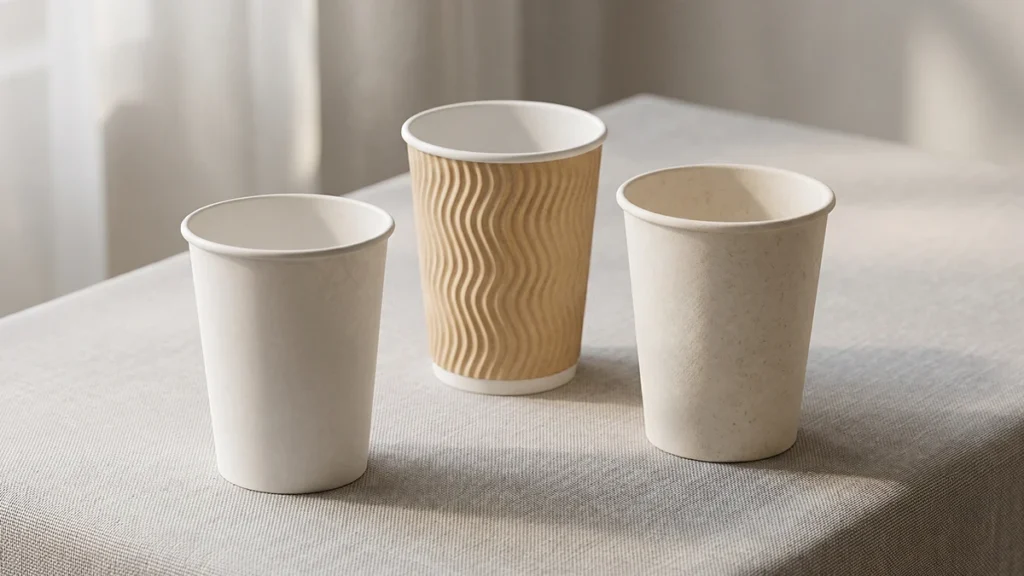
Main Plastic-Free Cup Materials and Their Properties
Standard paper cups typically rely on a thin polyethylene (PE) lining to prevent leaks, which disqualifies them from true plastic-free classifications. Modern plastic-free cups replace petroleum-based polymers with natural fibers and aqueous barrier coatings.
Aqueous-Coated Paperboard
Water-based dispersion coatings replace traditional PE or PLA linings directly on virgin or recycled wood pulp paperboard. This structure allows the cup to enter standard paper recycling streams in many regions without needing specialized separation equipment.
- Rigidity and Texture: Offers high wall stiffness and a smooth, natural paper feel on the exterior, while the interior has a subtle matte finish.
- Thermal Performance: Handles hot beverages like brewed coffee and tea well, though double-wall or ripple-wall construction is needed to prevent hand burns.
- Cold Beverage Limits: Prolonged condensation from iced drinks can soften the unlined outer paperboard unless both sides receive barrier treatment.
Sugarcane Bagasse (Molded Fiber)
Bagasse is the fibrous residue left behind after juice extraction from sugarcane stalks. Manufacturers press this pulp under high heat and pressure into rigid, self-supporting cup shapes without adding plastic liners.
- Rigidity and Texture: Features thick, sturdy walls with a slightly fibrous, matte surface that provides a natural grip.
- Thermal Performance: Withstands high heat without warping or releasing odors, making it reliable for hot soups, espresso, and takeaway tea.
- Cold Beverage Limits: Naturally resists moisture for short to medium durations, though extended soaking over several hours can gradually soften the fiber matrix.
Bamboo Pulp and Bamboo Fiber
Harvested from fast-growing bamboo grass, bamboo pulp is formed into either molded fiber cups or rolled paperboard cups paired with water-based barrier coatings.
- Rigidity and Texture: Delivers superior tensile strength compared to standard wood pulp, resulting in firm rim stability that holds lids securely.
- Thermal Performance: Performs consistently across hot and warm beverages, maintaining structural integrity under thermal stress.
- Cold Beverage Limits: Works well for cold drinks when treated with an interior and exterior aqueous moisture barrier.
Wheat Straw and Reed Fiber
Agricultural byproducts like wheat straw and natural reeds are pulped and molded into biodegradable drinkware. These materials utilize post-harvest crop waste rather than dedicated timber resources.
- Rigidity and Texture: Exhibits moderate-to-high stiffness with an organic, speckled appearance that signals sustainability to end consumers.
- Thermal Performance: Suitable for hot beverages and room-temperature liquids without softening immediately upon contact.
- Cold Beverage Limits: Best suited for immediate consumption rather than multi-hour cold storage, as condensation slowly penetrates untreated outer surfaces.
Material Comparison Matrix for Procurement
Evaluating material trade-offs side by side helps procurement teams match cup specifications to menu requirements and regional waste infrastructure.
| Material Type | Rigidity & Rim Strength | Heat Resistance | Cold & Condensation Resistance | Surface Texture | Primary End-of-Life Pathway |
| Aqueous-Coated Paper | High (with proper GSM) | High (Hot drinks) | Moderate (Needs double-sided coating) | Smooth paper finish | Standard paper recycling / Compostable |
| Sugarcane Bagasse | Very High | Very High | Moderate | Slightly fibrous, matte | Home & industrial composting |
| Bamboo Fiber / Pulp | High | High | Moderate to High | Smooth to lightly textured | Compostable / Recyclable (coated) |
| Wheat Straw Fiber | Moderate to High | High | Low to Moderate | Natural, speckled grain | Home & industrial composting |
Strategic Sourcing: When to Choose Plastic-Free Cups
Transitioning an entire product catalog at once can strain budgets and operational workflows. Procurement managers typically achieve better results by aligning material choices with specific operational triggers.
- Regulatory Compliance Zones: Prioritize plastic-free options when supplying jurisdictions with strict Single-Use Plastics (SUP) directives that penalize PE-lined or PLA-lined drinkware.
- Hot Beverage Programs: Deploy aqueous-coated paper or molded bagasse cups for coffee shops, quick-service restaurants, and corporate catering where drinks are consumed within 30 to 60 minutes.
- Closed-Loop Venues: Select certified home-compostable bagasse or wheat straw cups for stadiums, festivals, and corporate campuses that manage on-site organic waste collection.
- Brand Positioning Initiatives: Use unbleached bamboo or textured agricultural fiber cups when foodservice clients want visible, tactile proof of environmental commitment.
Advantages and Disadvantages Compared to Traditional Plastics
Moving away from conventional polypropylene (PP), polyethylene terephthalate (PET), and PE-lined paper involves clear commercial trade-offs.
Key Advantages
- Zero Microplastic Shedding: Hot liquids in plastic-lined cups can release microscopic polymer particles, whereas pure plant-fiber and water-based barrier cups eliminate this concern.
- Simplified Waste Sorting: Uncoated molded fiber cups can go directly into organic composting bins alongside food scraps, reducing contamination fees for venues.
- Future-Proof Supply Chain: Sourcing compliant plastic-free inventory protects distributors from sudden municipal bans, import tariffs, and plastic packaging taxes.
Key Disadvantages
- Higher Unit Cost: Raw material processing and lower production speeds typically make plastic-free cups 15% to 40% more expensive per unit than standard PE-lined paper or PP cups.
- Shorter Shelf Life and Storage Sensitivity: Plant-fiber cups absorb ambient humidity if stored in damp warehouses, requiring strict moisture-controlled storage conditions.
- Limited Clarity and Lid Compatibility: Unlike clear PET cold cups, fiber-based cups are opaque, and slight dimensional variations in molded fiber rims require careful matching with compatible fiber or paper lids.
For distributors and foodservice brands looking to validate material performance before bulk ordering, Reliancepak supplies FDA- and EU-compliant eco-friendly drinkware with free sample testing and custom OEM/ODM options.
Frequently Asked Questions
Are PLA-lined paper cups considered plastic-free?
No. Polylactic acid (PLA) is a bioplastic derived from corn starch or sugarcane, but it remains a polymer regulated under many single-use plastic directives and requires industrial composting facilities to break down.
Do plastic-free cups hold iced beverages without leaking?
Yes, provided they feature a double-sided aqueous barrier coating or dense molded fiber construction. However, they are best suited for immediate service rather than multi-hour refrigeration, as heavy exterior condensation will eventually soften the fibers.
How should wholesale buyers store plant-fiber and aqueous-coated cups?
Store cartons in a dry, well-ventilated warehouse away from direct floor contact and high humidity. Follow a strict first-in, first-out (FIFO) inventory rotation to maintain optimal rim rigidity and barrier performance.
Can plastic-free disposable cups be customized with brand logos?
Yes. Aqueous-coated paper and bamboo paperboard cups accept standard flexographic and offset printing with food-safe, water-based inks, while molded bagasse cups typically rely on custom embossing or printed sleeves.