
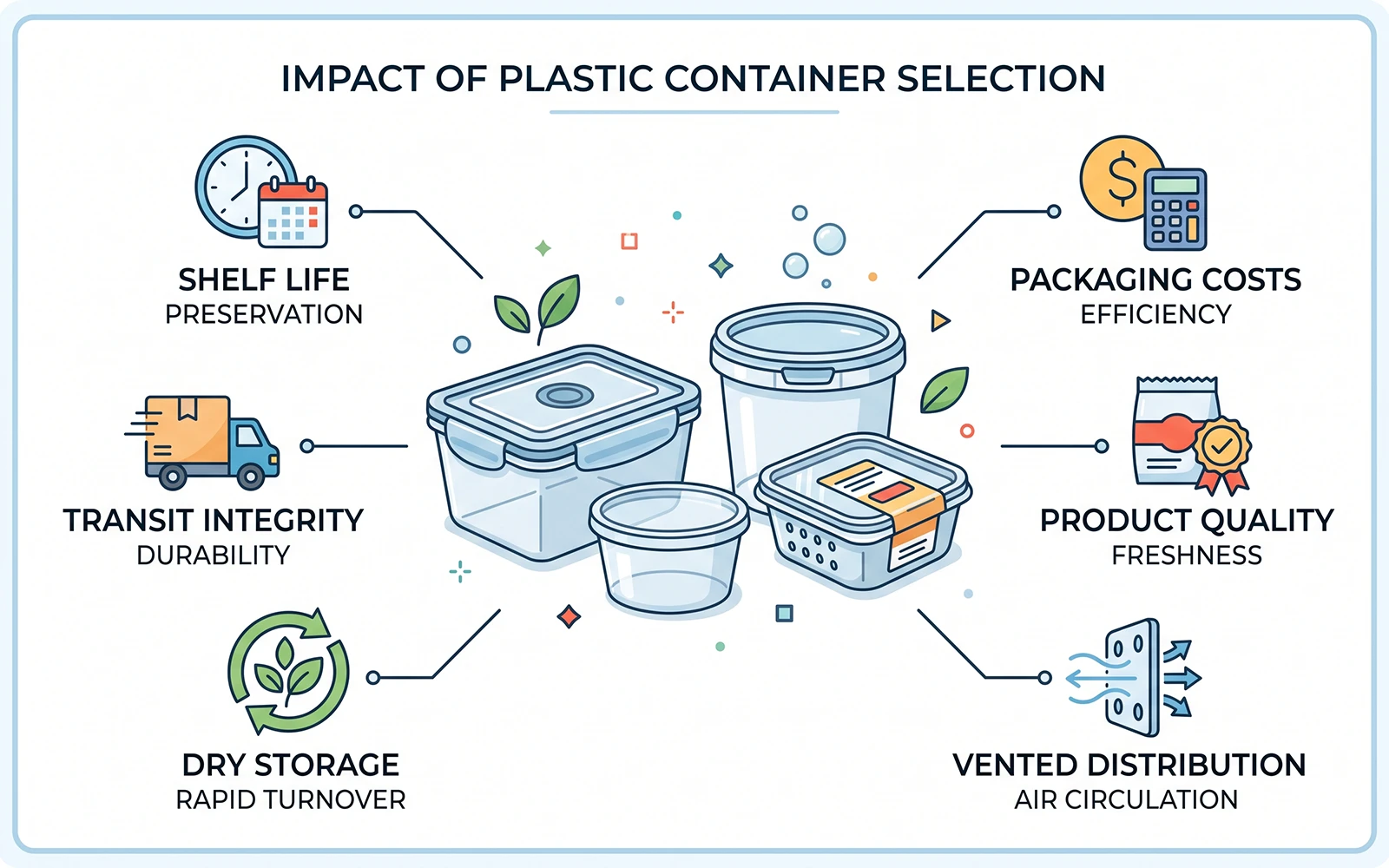
Selecting the correct plastic container specification directly affects product shelf life, transit integrity, and overall packaging costs for commercial food operations. While airtight units isolate perishable goods from external environmental factors, non-airtight alternatives provide economical solutions for dry storage, rapid turnover, and vented distribution.
Understanding the functional boundaries of each sealing mechanism allows procurement managers and food processors to optimize packaging expenditure without compromising product quality.
Key Sealing Mechanisms in Commercial Plastic Packaging
Commercial airtight containers utilize continuous elastomeric gaskets, ultrasonic welds, or precision interference fitments to prevent gas and moisture exchange. These barrier designs isolate the package headspace, curbing oxidation and stabilizing internal relative humidity for sensitive food formulations.
Non-airtight formats rely on standard snap-fit lids, friction closures, or intentionally vented perimeter tabs. These configurations allow controlled vapor escape or ambient equalization, serving applications where hermetic isolation is unnecessary.
Methods for Verifying Seal Integrity
Packaging engineers and quality assurance teams determine barrier performance through standard testing protocols:
- Hydrostatic Inversion Testing: Packaging technicians fill the container with liquid, secure the lid mechanism, and apply sustained inverted pressure to detect fluid migration past the closure profile.
- Optical Profiling: Operators inspect the silicone or thermoplastic elastomer (TPE) gasket channel under magnification to identify voids, micro-fissures, or seat misalignments.
- Differential Pressure Decay: High-throughput facilities measure internal vacuum or positive pressure decay over a set interval to quantify micro-leak rates across the mating surfaces.
Operational Roles of Non-Airtight Containers
Non-airtight containers serve high-volume roles across the foodservice supply chain, balancing material cost with functional utility.
Food operations use non-vented and semi-vented plastic containers for immediate handling cycles:
- Prepared Meal Staging: Short-cycle food prep environments use standard snap-lock units where ingredients turn over within 24 to 48 hours.
- Dry Goods Distribution: Low-hygroscopic bulk goods—such as intact grains, nuts, and dry pasta—maintain structural stability without hermetic protection.
- Ventilated Hot Foods: Heated food products require perimeter steam release to prevent condensation buildup that degrades texture before consumption.
- Industrial Sorting: Packaging lines utilize economical polypropylene containers to batch hardware, raw ingredients, and secondary assembly parts.
Technical Comparison: Airtight vs. Non-Airtight Containers
The following matrix compares primary performance metrics for commercial plastic containers across typical industrial and foodservice applications:
| Performance Dimension | Airtight Plastic Containers | Non-Airtight Plastic Containers |
| Barrier Integrity | Impermeable seal against moisture vapor, oxygen, and ambient contaminants | Permeable closure allowing ambient vapor exchange |
| Primary Mechanism | Co-molded TPE/silicone gaskets, locking hinges, or inductive seals | Friction rims, standard snap lids, or vented cap systems |
| Degradation Control | Limits aerobic oxidation and microbial spoilage | Minimal defense against ambient humidity and air exposure |
| Unit Cost Profile | Higher tooling investment and multi-material production costs | Lower material cost per unit; optimized for high-volume procurement |
| Ideal Applications | Wet food distribution, ground coffee, dairy products, and extended supply chains | Fresh produce ventilation, immediate takeout meals, dry bulk staging |
Spoilage Dynamics and Barrier Performance
Exposure to ambient oxygen accelerates lipid oxidation, breaking down volatile aroma compounds and creating off-flavors in prepared foods. In commercial settings, uncontrolled headspace air exposure turns dairy items rancid, darkens cut produce, and degrades nutrient profiles.
Moisture migration presents a parallel operational risk. Unsealed environments allow dry powders to cake, while moisture loss in wet foods causes structural shrinkage and unpalatable texture changes. Hermetically sealed plastic formats stabilize internal atmosphere conditions, extending transit radius and retail display life.
Product Categories Requiring Hermetic Packaging
Certain food categories depend on airtight containment to maintain regulatory compliance and consumer safety:
- Aromatic Roasted Goods: Whole bean and ground coffee release carbon dioxide while remaining sensitive to oxygen ingress, requiring hermetic packaging with degassing valves.
- Hygroscopic Powders: Industrial baking ingredients, whey isolates, and starch blends demand zero moisture penetration to avoid compaction and mold growth.
- High-Lipid Deli Meats: Sliced proteins spoil rapidly under aerobic conditions, making modified atmosphere or hermetic container sealing necessary for cold-chain safety.
Procurement Criteria for Enterprise Buyers
Procurement specialists balance multiple material and structural parameters when sourcing plastic containers for B2B supply lines:
- Resin Selection: Verify base resins (such as polypropylene or high-density polyethylene) comply with FDA 21 CFR or EU 10/2011 food-contact standards.
- Structural Geometry: Evaluate stacking shoulder strength, rim rigidity, and nesting density to optimize pallet fill and container stability during transit.
- Automation Compatibility: Verify that lid profiles match automated denesting, filling, and capping machinery without jamming feeding tracks.
- Environmental Thermal Range: Confirm the polymer compound withstands target temperature extremes, ranging from blast-freezing environments to commercial microwave re-thermalization.
Sourcing Commercial Food Containers with Reliancepak
Reliancepak operates 9 advanced production lines, supplying certified plastic packaging solutions for international distributors, processing plants, and enterprise buyers. Sourcing programs include custom mold design, OEM/ODM production, and certified food-grade materials tailored to international compliance mandates.
To evaluate closure integrity and material compatibility for your automated packaging operations, contact our technical sales team at admin@bereliance.com for technical documentation and production samples.
For detailed material properties and production machinery specifications, review our analysis on airtight containers for food packaging.
Frequently Asked Questions
Can standard non-airtight containers be modified for vacuum sealing?
No. Standard non-airtight containers lack the structural wall thickness and continuous gasket channels required to maintain negative pressure without collapsing or losing seal integrity.
What resin is most commonly used for airtight food containers?
Polypropylene (PP) is the primary choice due to its high fatigue resistance, chemical stability, and compatibility with flexible sealing gaskets.
How do temperature fluctuations affect airtight container seals?
Thermal cycles cause plastic materials and internal gases to expand and contract, which can compromise the seal profile if lid tolerances are not engineered for the application.