
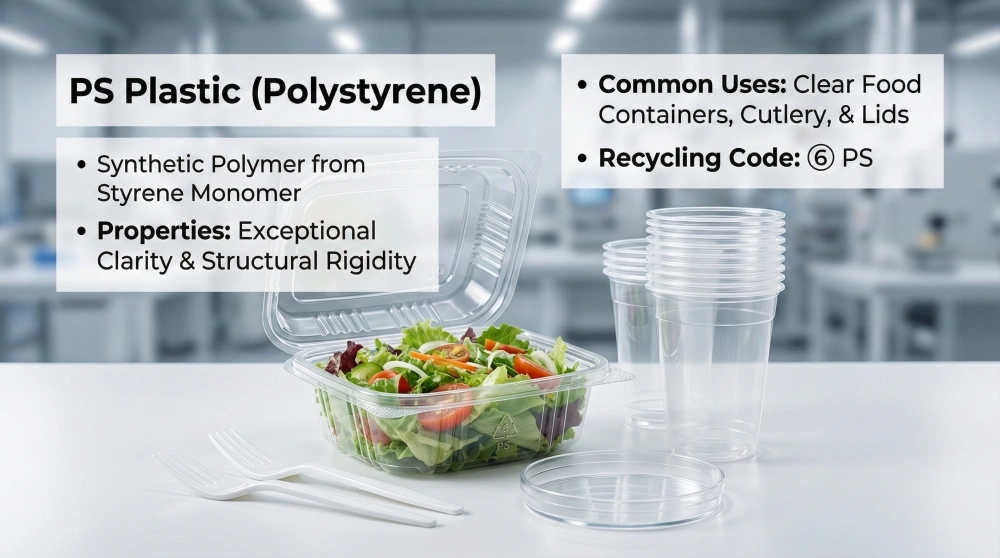
PS plastic, or polystyrene, is a versatile synthetic polymer made from the polymerization of styrene monomer that serves as a cornerstone material in the global packaging and insulation industries. Characterized by its exceptional clarity, structural rigidity, and cost-efficiency, PS plastic is predominantly utilized in the production of disposable food containers, protective electronics packaging, and laboratory equipment.
Finding a reliable supply of high-quality food packaging often feels like a balancing act between maintaining strict hygiene standards and managing overhead costs. You face the constant pressure of ensuring your containers don’t crack under pressure or fail international safety audits, which can lead to costly product recalls or damaged brand reputations. This guide provides a definitive breakdown of ps plastic characteristics, safety certifications, and industrial applications to help you make informed procurement decisions for your distribution or food processing business.
Why Is PS Plastic a Preferred Material for Global Food Packaging?
PS plastic remains a top choice for global food packaging due to its unique combination of aesthetic transparency and moisture resistance. Its ability to be molded into precise shapes allows manufacturers to create everything from crystal-clear cups to rigid hinged containers that protect food integrity during transit.
Structural Integrity and Visual Clarity
Here’s the deal: appearance is a significant factor in consumer purchasing decisions. PS plastic offers a glass-like transparency that showcases the freshness of salads, deli items, and desserts, which directly impacts retail sales performance.
- Rigid construction prevents the crushing of delicate food items during stacking and transport.
- The material naturally resists moisture, preventing paper-based labels from becoming soggy or the plastic itself from warping.
- Its lightweight nature reduces shipping costs compared to glass or metal alternatives.
Diverse Manufacturing Capabilities
Wait, there is more to this material than just transparency. PS plastic can be processed through injection molding, vacuum forming, or extrusion, making it adaptable to a wide range of custom designs required by large-scale food producers.
- High dimensional stability ensures that lids fit securely every time, preventing leaks.
- The material can be easily tinted or colored to match specific brand aesthetics for wholesale clients.
- It maintains a smooth surface finish that is ideal for printing logos or nutritional information directly onto the packaging.
| Feature | Performance Level | Benefit for B2B Buyers |
| Transparency | High (Glass-like) | Increases product visibility and consumer trust |
| Rigidity | High | Protects contents during multi-layer stacking |
| Moisture Resistance | Excellent | Extends shelf life and maintains structural form |
| Cost Efficiency | Very High | Lowers per-unit cost for high-volume orders |
The physical properties of polystyrene make it an indispensable asset for businesses requiring a blend of presentation and protection.
Key Takeaway: PS plastic provides a cost-effective, high-clarity solution that ensures food products remain visible and protected throughout the supply chain.
How Safe Is PS Plastic for Direct Food Contact?
PS plastic is safe for direct food contact when used within its tested temperature parameters and manufactured under strict regulatory oversight. Leading global authorities, including the FDA and EU food safety agencies, have cleared polystyrene for use in food service, provided the material meets specific migration limits and purity standards.
Regulatory Compliance and Certifications
You should know that not all polystyrene is created equal. For international trade, especially in regions like Europe or North America, ensuring your supplier holds valid food-grade certifications is the only way to mitigate legal and health risks.
- FDA compliance confirms that the styrene migration levels are well below safety thresholds set for human consumption.
- EU 10/2011 regulations ensure the material is tested for specific migration of additives into different types of food stimulants.
- Regular batch testing by third-party labs like SGS or Intertek provides the transparency needed for large-scale enterprise procurement.
Temperature Sensitivity and Usage Limits
The real story lies in how the material reacts to heat. While PS plastic is excellent for cold and room-temperature applications, it has a lower melting point compared to materials like polypropylene, which dictates its specific use cases.
- Standard polystyrene should generally not be used in microwave ovens unless explicitly labeled as microwave-safe.
- The material performs best for cold storage, salads, dairy products, and room-temperature dry goods.
- Exceeding the recommended temperature range can cause the plastic to soften, potentially affecting the seal or structural shape of the container.
| Parameter | PS Plastic Specification | Safety Note |
| FDA Status | Approved for food contact | Must meet specific purity grades |
| Heat Resistance | Low to Moderate | Not recommended for high-heat fatty foods |
| Chemical Stability | High (with acids/bases) | Stable for most common food types |
| BPA Content | BPA-Free | Naturally does not contain Bisphenol A |
Understanding the safety boundaries of PS plastic prevents quality discrepancies and ensures that your end-users receive a reliable product.
Key Takeaway: Compliance with international food-grade standards is non-negotiable for PS plastic, making supplier certification the most critical factor in your procurement process.
How Does PS Plastic Compare to Other Common Polymers?
PS plastic stands out for its rigidity and clarity, whereas other polymers like PP (Polypropylene) or PET (Polyethylene Terephthalate) offer different advantages such as heat resistance or superior impact strength. Choosing the right material depends entirely on the specific requirements of your food product and your distribution environment.
PS vs. PP: Rigidity vs. Heat Resistance
The situation is quite simple: if you need a container that stays stiff and looks clear, you choose PS; if you need to heat the food inside the container, you choose PP.
- PS is brittle but offers better structural support for stacking compared to the more flexible PP.
- PP can withstand microwave heat and hot-fill processes, while PS is restricted to cold or ambient temperatures.
- PS generally offers a more “premium” feel due to its hardness and gloss.
PS vs. PET: Clarity and Impact Strength
Make no mistake, both materials look great on a shelf, but they behave differently under physical stress.
- PET is more impact-resistant and less likely to crack if dropped, making it a favorite for beverage bottles.
- PS is often easier and cheaper to process into complex shapes like hinged lids or multi-compartment trays.
- Both materials offer excellent gas barrier properties, though PET is slightly superior for carbonated liquid retention.
| Material | Primary Strength | Best Application |
| PS Plastic | Rigidity & Clarity | Deli trays, cutlery, lids |
| PP Plastic | Heat Resistance | Microwaveable meals, hot soup |
| PET Plastic | Toughness | Water bottles, fruit punnets |
Comparing these materials helps you avoid paying for features you don’t need while ensuring your packaging meets functional requirements.
Key Takeaway: Select PS plastic when visual display and structural rigidity are your priorities, but consider PP or PET if heat resistance or high impact strength is required.
What Are the Most Common Industrial Applications for PS Plastic?
PS plastic applications span from the medical field to heavy-duty industrial shipping, but it is in the food service and electronics sectors where the material truly dominates. Its ability to be foamed (EPS) or used in its solid form (GPPS/HIPS) provides a range of densities and protective qualities.
Food Service and Retail Packaging
Here is the bottom line: the majority of disposable cutlery and clear food lids found in global franchises are made from PS plastic.
- Disposable cups and plates for the catering industry benefit from the material’s low production cost and hygienic single-use nature.
- Egg cartons and poultry trays often utilize the foamed version of polystyrene for cushioned protection.
- Vending machine cups and dairy containers use high-impact polystyrene (HIPS) for added durability.
Laboratory and Medical Equipment
The utility of ps plastic extends far beyond the kitchen. Its high clarity and ability to be sterilized make it a staple in scientific environments.
- Petri dishes and test tubes require the absolute transparency that only high-grade PS provides for accurate visual monitoring.
- Diagnostic components and housing for medical devices rely on the material’s dimensional stability.
- Single-use medical trays ensure a sterile environment for surgical instruments.
| Industry | Specific Use Case | Material Type |
| Food Service | Hinged take-out boxes | GPPS / OPS |
| Electronics | Protective “peanuts” & blocks | EPS (Foamed) |
| Medical | Culture plates | Medical Grade PS |
| Retail | Cosmetic displays | HIPS |
The versatility of polystyrene across different industries proves its reliability as a functional material for diverse business needs.
Key Takeaway: From catering to clinical labs, the adaptability of PS plastic allows for specialized solutions that balance performance with economic efficiency.
What Is the Environmental Outlook for PS Plastic?
PS plastic is technically recyclable, though the infrastructure for its collection and processing varies significantly by region. As global sustainability standards tighten, the industry is shifting toward more efficient recycling technologies and the development of alternative materials that mimic the benefits of traditional polystyrene.
Recycling Challenges and Solutions
The truth of the matter is that while PS can be melted down and reused, its low density—especially in foamed form—often makes transportation to recycling centers expensive.
- Many industrial sectors now use densifiers to compress PS foam into ingots, making it easier to transport and recycle into products like picture frames or crown molding.
- Mechanical recycling of solid PS is becoming more common in Europe and parts of Asia for non-food applications.
- Advancements in chemical recycling are beginning to allow polystyrene to be broken back down into its original styrene monomers for true circularity.
Alternatives and the Future of Polystyrene
The market is moving quickly. For businesses in regions with strict plastic bans, exploring bio-based alternatives or hybrid materials is becoming a standard part of procurement strategy.
- PLA (Polylactic Acid) is a popular bio-plastic alternative for cold food packaging, though it comes at a higher price point.
- RPET (Recycled PET) is increasingly used for lids that were traditionally made from PS.
- Sustainable sourcing now involves looking for suppliers who use post-industrial waste to create new PS products.
| Sustainability Factor | Current Status | Future Outlook |
| Recyclability | Possible but infrastructure limited | Increasing chemical recycling |
| Carbon Footprint | Lower than glass/metal | Improving via renewable energy in plants |
| Biodegradability | Non-biodegradable | Integration of bio-based additives |
Navigating the environmental landscape requires a partner who understands both the functional necessity of plastic and the growing demand for green solutions.
Key Takeaway: While environmental challenges exist, the path toward a circular economy for PS plastic is being paved by better densification technology and chemical recycling innovations.
Selecting the Right Business Partner
Selecting the right ps plastic supplier is about more than just finding the lowest price; it is about ensuring your business has a stable, compliant, and professional partner. At Reliancepak, we combine factory-direct manufacturing with a deep understanding of international food-grade standards to provide you with high-quality polystyrene solutions that protect your products and your reputation. Whether you need custom-designed food containers or bulk supplies for a distribution network, our 9 production lines and EU/FDA certified materials are ready to meet your demands.
Would you like to see how our PS plastic products perform in your specific environment? Contact us today for a free sample and a professional consultation on your packaging needs.
Our vision is to provide the global food industry with packaging that is not only functional and safe but also increasingly integrated into a sustainable, circular economy.
FAQ
Can PS plastic be used for hot coffee or tea?
No. Standard ps plastic has a relatively low heat distortion temperature. While it is commonly used for lids, the cup itself for hot beverages is usually made from paper or heat-resistant PP to avoid warping and potential chemical migration.
How do I identify PS plastic on a product?
Yes, you can look for the resin identification code. PS plastic is labeled with the number “6” inside the recycling triangle, often accompanied by the letters “PS” underneath.
Is ps plastic waterproof?
Yes. Polystyrene is naturally hydrophobic, meaning it does not absorb water. This makes it an excellent barrier for liquid-heavy foods and ensures the packaging remains strong even in humid or wet storage conditions.
Does PS plastic contain BPA?
No. Polystyrene is made from styrene monomers and does not require Bisphenol A (BPA) in its production process, unlike some polycarbonate plastics. This makes it a preferred choice for many food-contact applications.
Can I get custom-printed PS containers for my brand?
Yes. PS plastic has a high surface energy that accepts various printing techniques well. Most professional manufacturers can provide offset or silk-screen printing to help your brand stand out on the shelf.