
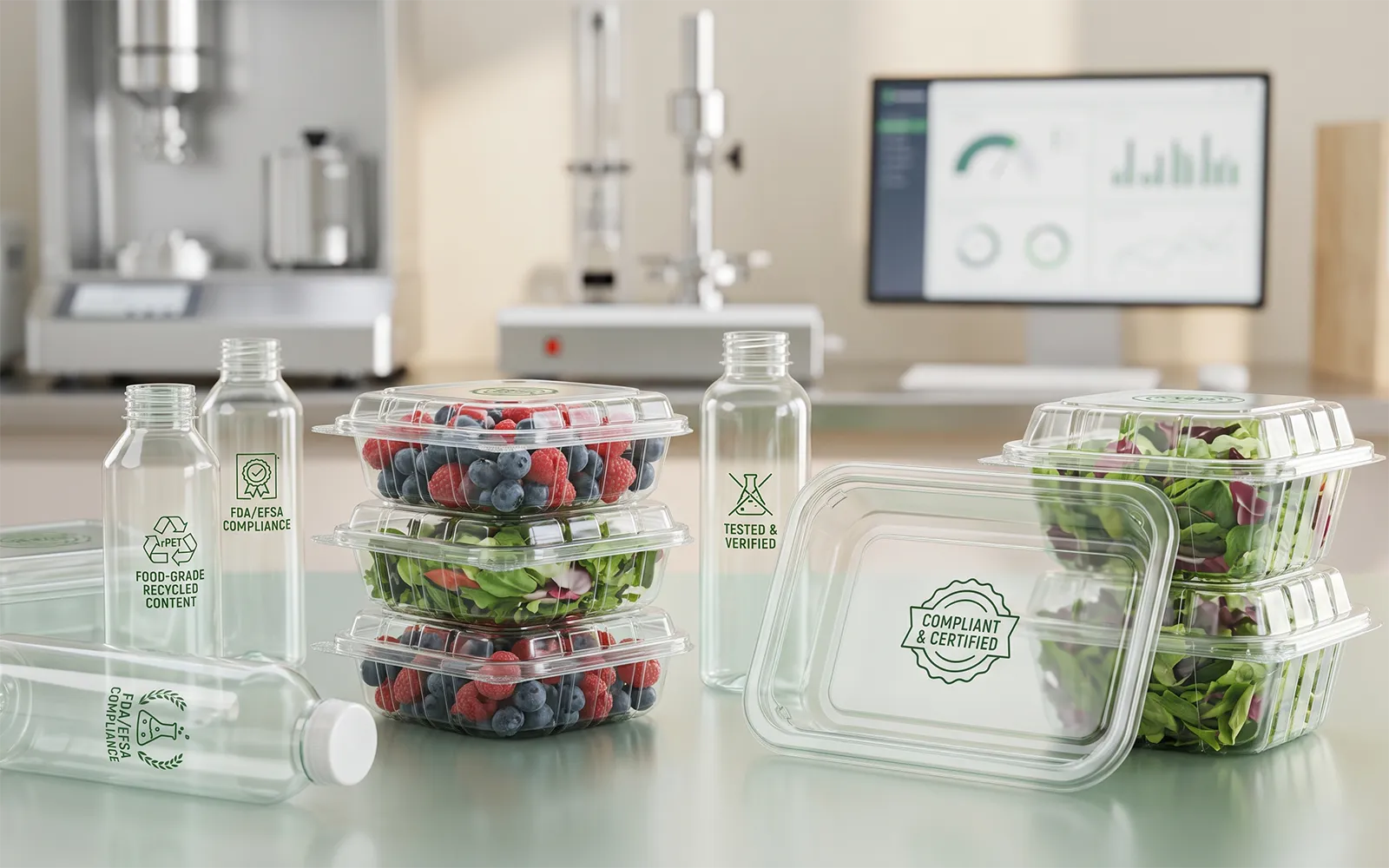
The push toward recycled content in packaging has accelerated rapidly, but food-grade rPET remains one of the most scrutinized materials in the supply chain. Buyers rightfully ask whether recycled plastic can safely contact food — and the answer depends entirely on how the material was reprocessed, tested, and documented.
Food-grade rPET is safe when it meets specific regulatory thresholds. The challenge isn’t the material itself — it’s identifying suppliers who have invested in proper decontamination, validation testing, and third-party certification. For procurement teams evaluating rPET food packaging, understanding the regulatory landscape is non-negotiable.
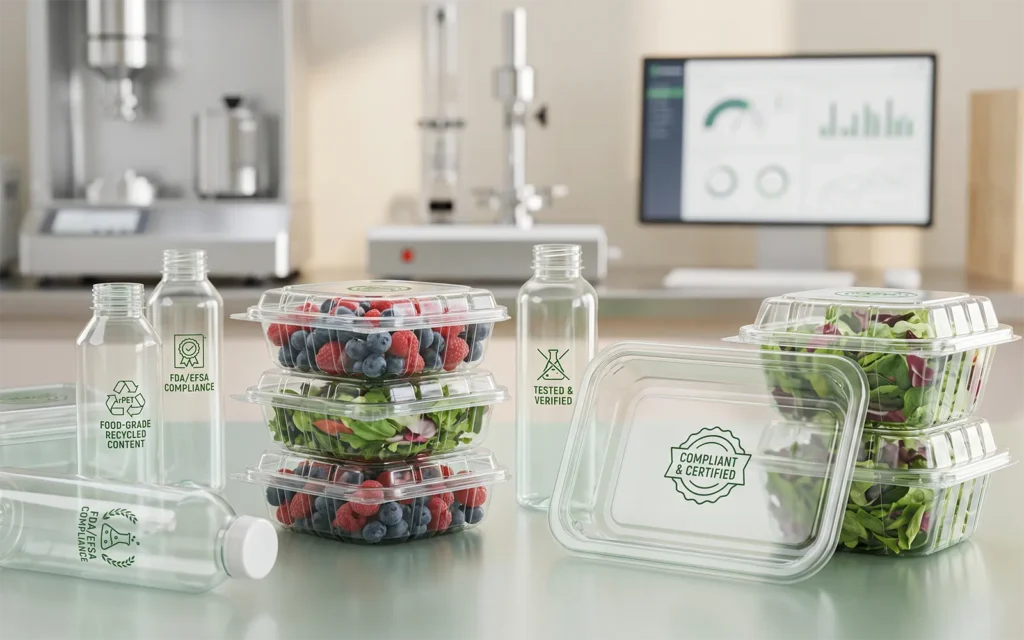
Why rPET Safety Concerns Are Legitimate
Recycled PET originates from post-consumer waste, which means the raw input may have previously contained beverages, cleaning products, or other substances. Without rigorous reprocessing, residual contaminants could migrate from the packaging into food.
This isn’t a theoretical risk. Regulatory agencies in major markets have established specific requirements precisely because the contamination pathway is real. The difference between food-grade and non-food-grade rPET comes down to the decontamination process and the documentation that proves it worked.
For buyers sourcing rPET food containers, trays, or cups, the practical question isn’t whether recycled plastic can be safe — it’s whether the supplier can demonstrate compliance through valid testing and certifications.
Regulatory Frameworks Governing Food-Grade rPET
Different markets enforce different standards, but the underlying principle is consistent: recycled materials must be proven safe for their intended food contact application.
United States — FDA Letter of No Objection
The FDA does not “approve” rPET the way it approves food additives. Instead, it evaluates reprocessing systems through a Letter of No Objection (LNO) process. Suppliers must demonstrate that their washing, sorting, and reprocessing methods effectively remove contaminants to levels below regulatory thresholds.
An LNO is specific to the reprocessing technology and the facility. It does not transfer between companies. If your supplier cannot produce a valid LNO for their specific process, you are exposed to compliance risk.
European Union — EU Regulation 10/2011
The EU framework requires both overall migration limits (OML) and specific migration testing. Under EU 10/2011, plastic food-contact materials must not release substances above 10 mg/dm² for overall migration. Specific migration limits apply to individual substances listed in Annex I.
For rPET specifically, the EU also requires authorization of the recycling process, often through EFSA evaluation. This adds an additional layer compared to the FDA approach.
Other Key Markets
China, Japan, South Korea, and various Southeast Asian countries maintain their own food-contact material regulations. Many reference EU or FDA standards as benchmarks, but local certification may still be required. For export-oriented suppliers, multi-market compliance often means maintaining separate documentation packages.
What Food-Grade rPET Testing Actually Covers
Third-party testing for food-grade rPET evaluates three core areas. Each addresses a different dimension of safety.
Migration Limits
Migration testing measures whether substances transfer from the packaging into food or food simulants at levels exceeding regulatory thresholds. This is the primary safety metric regulators care about. Testing typically uses food simulants (acids, alcohols, fats) that represent different food categories.
Contaminant Removal Verification
This testing confirms that the washing and reprocessing steps effectively eliminate previous contents. Suppliers must demonstrate measurable removal rates for targeted contaminants, often requiring log reduction values that prove the decontamination system works consistently.
Mechanical Integrity
Beyond chemical safety, rPET must maintain its protective function throughout its intended shelf life. This includes barrier properties, structural strength, and seal integrity. Packaging that degrades prematurely could compromise food safety in ways that migration testing alone wouldn’t capture.
Regulatory Standards at a Glance
| Market | Primary Regulation | Key Requirement | Certification |
|---|---|---|---|
| United States | FDA 21 CFR 170-199 | Letter of No Objection | LNO per facility |
| European Union | EU 10/2011 + EFSA | Migration limits + process authorization | EFSA evaluation |
| China | GB 4806 series | National food-contact standards | GB certification |
| Japan | JHOSPA standards | Voluntary + regulatory compliance | JHOSPA mark |
| Southeast Asia | Varies by country | Often references EU/FDA | Local certification |
Compliance Risks When Sourcing rPET
The commercial implications of rPET compliance go beyond regulatory penalties. Supply chain disruptions, product recalls, and reputational damage can far exceed the cost savings of using lower-cost recycled material.
One common risk is sourcing rPET from suppliers who hold LNOs or certifications for one product category but apply the material to a different application. An LNO for beverage bottles does not automatically cover food trays or hot-fill containers. The migration profile changes with application, temperature exposure, and food type.
Another risk is documentation gaps. Some suppliers provide certificates of analysis but cannot produce the underlying test reports, facility audit records, or process validation data. When a regulatory authority requests supporting documentation, a certificate alone may not satisfy the inquiry.
Lead times for compliance verification also matter. Valid migration testing typically takes weeks, and retesting may be required if material composition changes. Procurement teams that compress timelines often find themselves accepting incomplete documentation.
How to Verify Your rPET Supplier Meets Standards
Before committing to a supplier, request specific documentation and verify its validity.
Start with the regulatory certification itself. Confirm that the LNO, EFSA evaluation, or local certificate is current and covers your specific application. Check the issuing authority and expiration date.
Ask for migration test results from an accredited third-party laboratory. The test report should reference the specific food simulants used, the migration conditions (temperature, duration), and the results against applicable limits.
Verify the facility’s reprocessing capabilities. A supplier with a washing line rated for PET flake decontamination is fundamentally different from one who simply brokers recycled material. The decontamination step is where food-grade rPET is actually made safe.
Finally, confirm that the supplier maintains a quality management system relevant to food-contact materials. ISO 22000, FSSC 22000, or BRC certifications indicate operational discipline beyond product-level testing.
When evaluating suppliers for food packaging applications, these verification steps reduce procurement risk and ensure the material you receive matches the compliance claims on paper.
FAQ
Can I use standard recycled PET for food packaging without additional certification?
No. Recycled PET must undergo validated decontamination and pass migration testing before it can be used for food-contact applications. Using non-food-grade rPET for food packaging violates regulations in most markets and exposes you to liability.
How often should rPET suppliers renew their compliance testing?
Testing should be renewed whenever the reprocessing method, source material, or product application changes. Most regulatory frameworks require ongoing compliance, and annual retesting is common practice among reputable suppliers.
What documentation should I request from an rPET food packaging supplier?
Request the regulatory certification (LNO, EFSA evaluation, or equivalent), third-party migration test reports, and evidence of the facility’s quality management system. If the supplier cannot provide all three, evaluate whether the compliance claim is fully substantiated.
Is rPET safe for hot-fill food applications?
It can be, but migration testing must specifically address the elevated temperature conditions. Standard room-temperature migration results do not automatically apply to hot-fill scenarios. Confirm that the supplier’s testing covers your specific use conditions.
Do different food types require different rPET compliance testing?
Yes. Migration testing uses food simulants that correspond to different food categories — acidic foods, fatty foods, alcoholic beverages, and aqueous products each have different migration profiles. The applicable regulatory limits may also vary by food type.