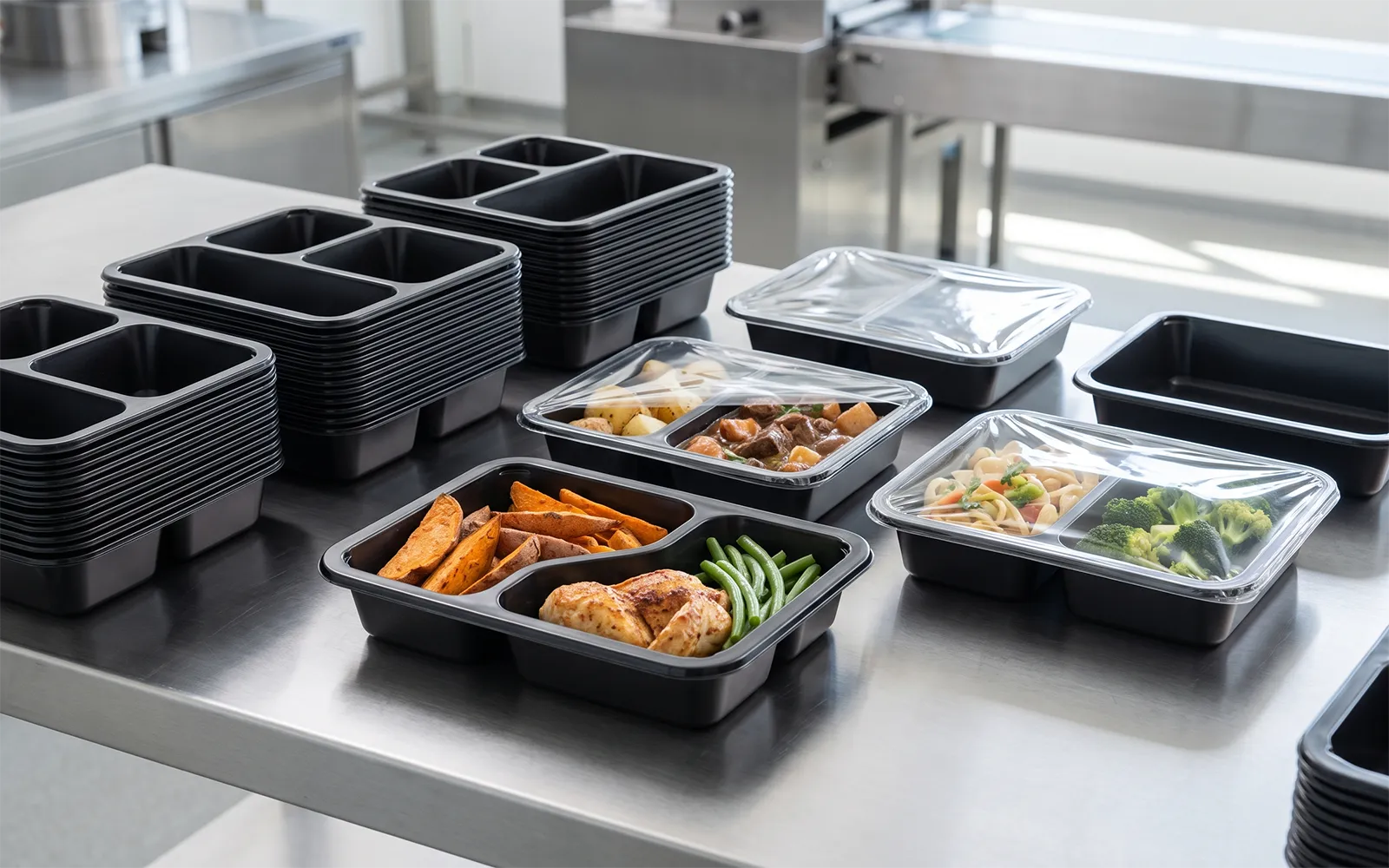
PET food trays and containers for ready meals provide temperature-resistant, food-safe containment that preserves meal freshness across rigorous thermal processing and retail distribution channels. Modern high-volume food processors depend on specialized materials like crystallized PET (CPET) to ensure containers maintain structural integrity during both freezing and high-temperature oven reheating.
Managing thermal stress and tray deformation during retail transport remains a persistent challenge for ready meal producers, as failed packaging directly causes product spoilage and costly retailer chargebacks. Standard polymers warp under elevated temperatures, leading to seal failure and compromised food safety. Implementing targeted PET packaging solutions engineered for specific heat thresholds mitigates these distribution risks while improving line efficiency.
Which PET Materials Work Best for Ready Meal Containers?
Crystallized PET (CPET) and heat-resistant PET formulations offer the necessary thermal stability for dual-ovenable ready meal applications, directly matching different temperature requirements. Standard PET deforms above 70°C, making CPET necessary for oven temperatures reaching 220°C without leaching or structural failure.
Thermal Thresholds and CPET Performance
Engineered CPET trays withstand temperature extremes ranging from frozen storage to high-heat baking. This broad thermal tolerance prevents tray cracking in sub-zero freezers and eliminates structural softening in commercial ovens.
Food Contact Safety and Compliance
Food-grade PET materials comply with strict international migration limits, such as FDA and EU food-contact standards. Food processors must verify that tray formulations maintain chemical stability during intense reheating cycles to guarantee consumer safety.
CPET delivers necessary heat resistance, whereas standard PET remains suitable for cold or ambient applications.
Key Takeaway: Matching PET material grades directly to reheating conditions prevents costly container deformation and protects product integrity across cold-chain distribution.
How Does Tray Design Impact Sealing and Storage Performance?
Tray design impacts performance through precise compartment geometry and consistent rim flange width, which collectively ensure secure lid adhesion and prevent cross-contamination. Rigid sidewall structures maintain shape during vacuum or modified atmosphere sealing processes.
Compartment Geometry and Distribution Integrity
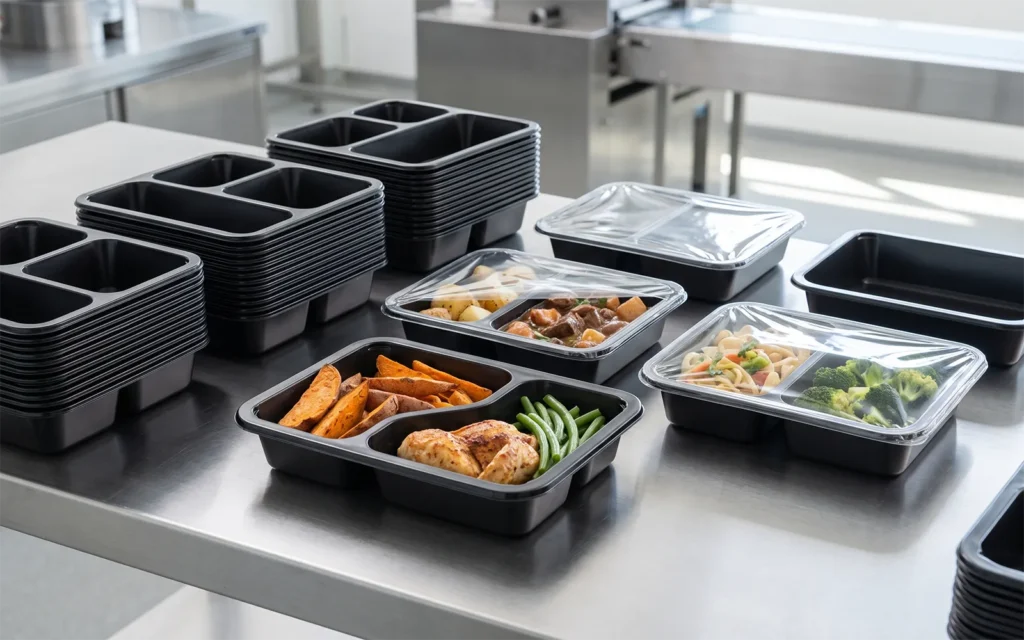
Multi-compartment designs require uniform wall thickness to isolate distinct meal components like proteins, starches, and sauces. Processors require tight thermoforming tolerances so dividers prevent liquid transfer during transit.
Flange Consistency and Lidding Seal Performance
Reliable lidding adhesion relies on flat, uniform tray rims that sustain consistent heat-sealing pressure. Inconsistent flange dimensions introduce micro-leaks, leading to premature food spoilage and seal failures on high-speed packaging lines.
Precise thermoforming tooling ensures dependable lidding seals across multi-compartment layouts.
Key Takeaway: Uniform flange geometry and wall thickness are critical factors that directly prevent seal leaks and maintain ingredient separation in transit.
Reliancepak supplies food processors and wholesale distributors with engineered tray structures, helping facilities resolve thermal deformation and sealing inconsistencies. Request free samples and consult with our technical team to optimize your ready meal line today.
Evolving retail demands continue to push ready meal packaging toward higher thermal resistance, lighter material weights, and improved barrier performance across global distribution networks.
FAQ Section
Can CPET trays be used in both conventional ovens and microwaves?
Yes.
CPET containers are dual-ovenable, enduring conventional oven heat up to 220°C as well as standard microwave reheating without warping or chemical leaching.
How do multi-compartment trays prevent sauce leakage between sections?
Thermoformed dividers maintain uniform wall thickness and height to create physical isolation.
- Precision tooling controls divider geometry.
- Rigid rim flanges secure lidding films.
- Anti-leak sealing trials verify compartment isolation.
What food safety standards must PET ready meal trays meet?
PET ready meal containers must comply with FDA and EU food-contact regulations, ensuring material stability and zero chemical migration during high-temperature heating.
What should I consider when selecting PET packaging solutions for frozen meals?
Verify thermal tolerance for freezer-to-oven transitions, flange uniformity for reliable lidding seals, and compartment geometry to prevent component migration.