Polyethylene terephthalate (PET) is among the most widely used polymers in modern commercial packaging. Due to its structural clarity, gas barrier properties, and tensile strength, brands across beverage, food, and personal care sectors rely heavily on pet packaging solutions.
However, evaluating the true sustainability of these packaging choices requires a clear understanding of how PET is processed after consumer use, what limitations exist during reprocessing, and how global infrastructure impacts real-world recovery.
Overview of PET as a Recyclable Material
PET stands out from many other synthetic polymers because it has a well-established commercial recycling system. Unlike multi-layer plastics that are difficult to separate, mono-material PET containers can be collected, processed, and reintroduced into manufacturing streams with relative efficiency.
This technical recyclability has allowed PET to achieve higher recovery rates than most competing rigid plastics. Even so, transforming a used bottle into a new product relies on a multi-stage mechanical process that requires strict quality control at every phase.
Step-by-Step Breakdown of Mechanical Recycling
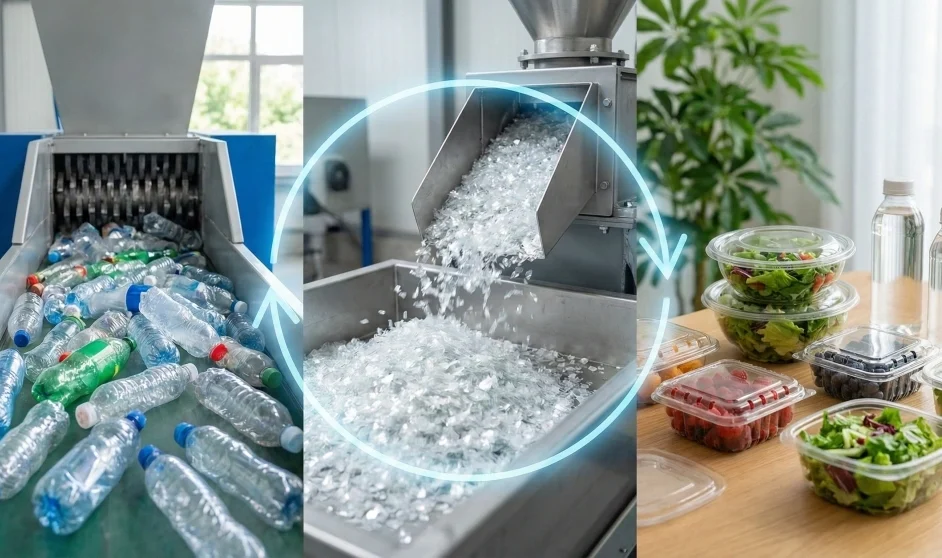
Mechanical recycling remains the primary method for processing post-consumer PET. This approach relies on physical mechanical actions to transform waste into reusable raw material without altering the underlying chemical structure.
Collection and Sorting
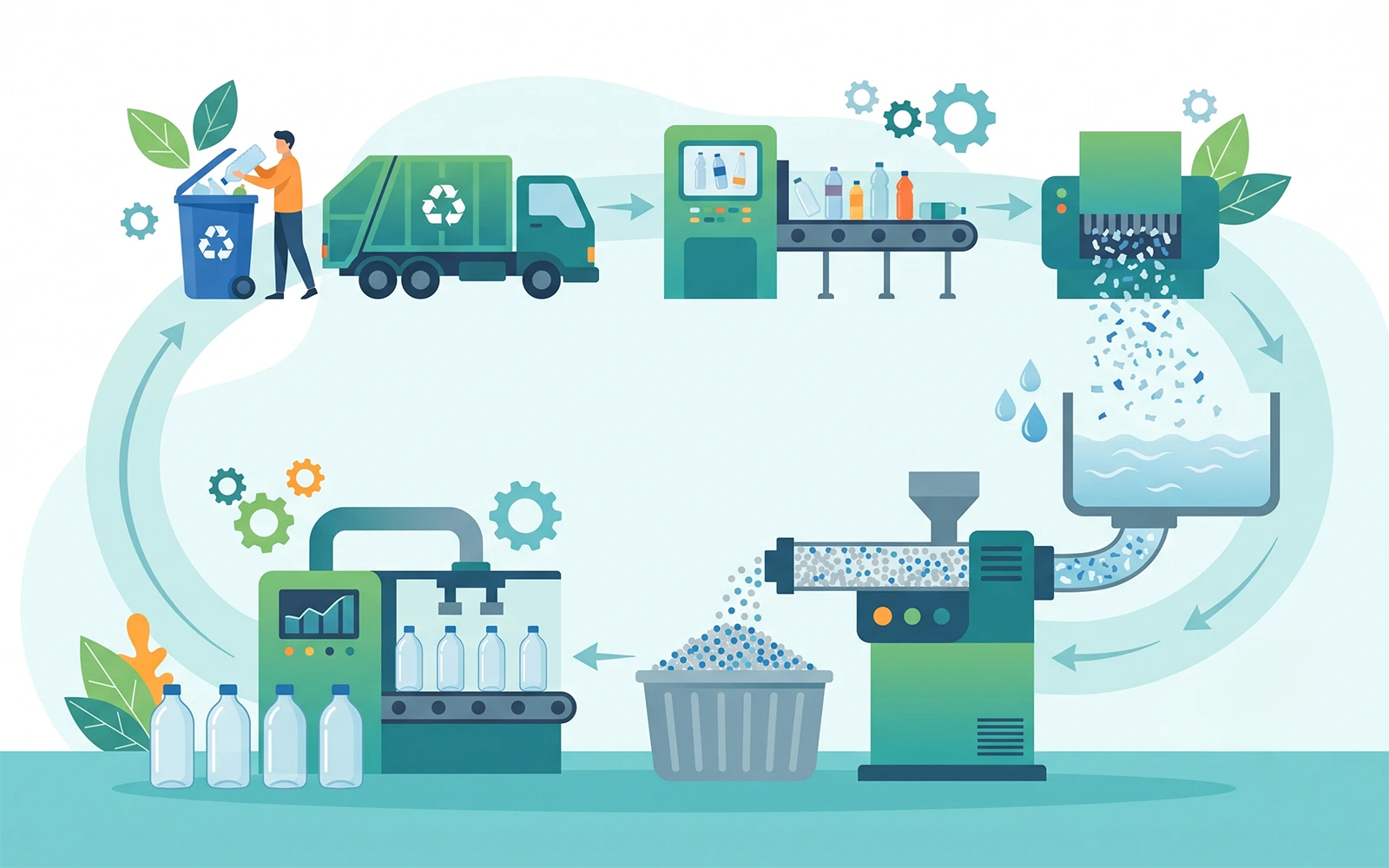
The process begins when used containers are collected through municipal curbside programs, deposit-return systems, or commercial waste streams. Once gathered at a material recovery facility (MRF), automated optical sorters and manual inspection separate PET from non-PET polymers, metals, and paper labels. Proper sorting prevents contamination that can weaken the final recycled resin.
Shredding and Washing
After sorting, the collected containers are ground into small, uniform flakes. These flakes undergo intensive washing in heated water solutions mixed with detergent to remove residual contents, adhesives, and surface dirt. Density separation tanks then isolate the heavy PET flakes from lighter closure materials, such as polypropylene (PP) or high-density polyethylene (HDPE) caps.
Melting and Pelletizing
Once thoroughly dried, the clean PET flakes pass into an extruder. The material is heated to its melting point, filtered through fine mesh screens to capture microscopic debris, and extruded into continuous strands. These strands are cooled in water and cut into uniform recycled PET (rPET) pellets. The resulting pellets can then be supplied to manufacturers to produce new packaging or textiles.
Material Limitations and Degradation Cycles
While mechanical recycling is efficient, it does not allow infinite reprocessing. Each thermal cycle subjects the polymer chains to mechanical shear and heat, causing gradual polymer chain scission.
- Molecular Weight Reduction: Repeated melting reduces the intrinsic viscosity (IV) of the plastic, which measures molecular weight and structural integrity.
- Cycle Limits: Under typical mechanical recycling conditions, PET can be reprocessed roughly 5 to 7 times before the resin loses the structural strength needed for standard applications.
- Resin Blending: To maintain quality standards, manufacturers often blend post-consumer rPET pellets with virgin resin or use solid-state polymerization (SSP) to restore the material’s molecular weight.
Infrastructure Realities Across Global Markets
A material’s theoretical recyclability does not guarantee that it will be recovered. The actual recycling rate of pet packaging solutions depends heavily on regional collection networks and municipal capabilities.
Regions with robust regulations and established deposit-return schemes, such as several European nations and Japan, record high collection and recycling efficiency. In contrast, markets lacking dedicated sorting facilities or consumer collection programs often route recyclable PET directly to landfills or incinerators.
Because of these infrastructure gaps, an item labeled “100% recyclable” may still end up as waste if local facilities cannot process it.
Key Takeaways for Brand Sustainability Messaging
For packaging buyers and brand owners, making credible environmental claims requires looking beyond raw material specifications.
To present accurate sustainability communications:
- Assess Target Markets: Verify whether the regions where products are sold possess functional PET recovery systems.
- Design for Recycling: Choose clear resins, unpigmented containers, and water-soluble adhesives to avoid contaminating recycling streams.
- Avoid Absolute Claims: Frame messaging around verified post-consumer recycled content rather than generic recyclability statements.
Understanding the mechanics and local context of PET recycling allows procurement teams to select effective packaging while keeping brand claims grounded in real-world outcomes.
Frequently Asked Questions (FAQ)
How many times can PET packaging be recycled?
PET packaging can typically be mechanically recycled 5 to 7 times. Over time, repeated thermal processing breaks down the polymer chains, reducing the material’s intrinsic viscosity and structural strength.
What is rPET and how is it used?
Recycled PET (rPET) is the resin produced from post-consumer PET packaging that has been cleaned, melted, and pelletized. It is used to manufacture new packaging containers, strapping, fiberfill, and polyester textiles.
Is all PET packaging automatically recycled?
No. While PET is technically 100% recyclable, actual recycling depends on local collection infrastructure, regional processing facilities, and whether the container is free from heavy pigments, labels, or additives that create contamination.