Food businesses face constant pressure to balance product visibility, shelf life, and regulatory compliance in their packaging choices. Clamshell containers have become a go-to solution for grocery retailers, deli counters, and fresh produce suppliers — but selecting the right food-grade option requires understanding FDA rules, material safety, and sourcing best practices.
What Makes Clamshell Packaging Suitable for Food Applications?
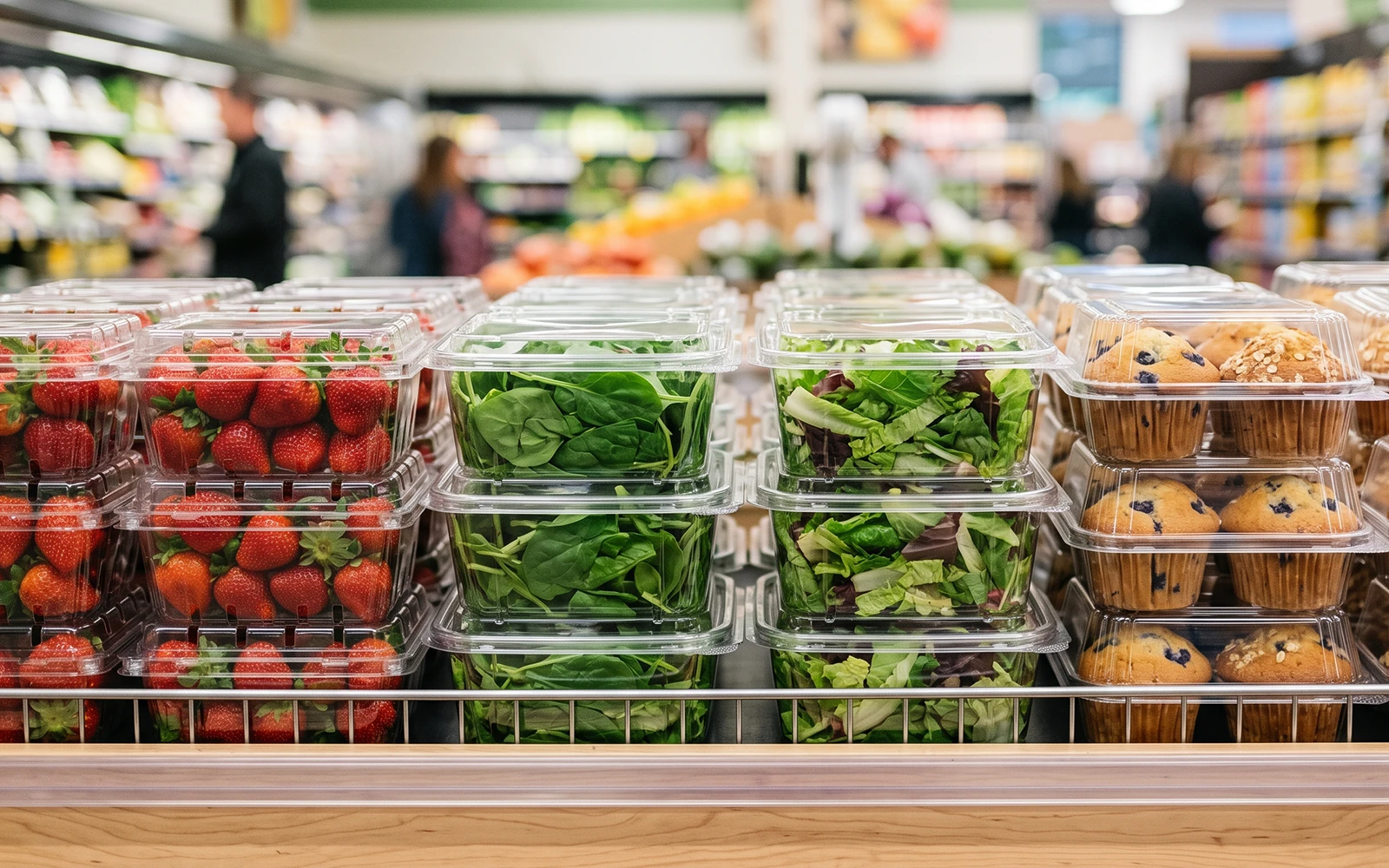
Clamshells offer a rigid, hinged structure that protects delicate items like berries, tomatoes, and bakery goods during transport and display. Their transparent design lets consumers inspect freshness without opening the package, which reduces handling damage and extends shelf appeal.
For food businesses, the dual benefit is clear: product integrity stays intact from warehouse to checkout, while shoppers get the visual confirmation they need before purchasing.
Which Materials Meet FDA Food-Contact Standards?
Not all plastics are created equal when it comes to direct food contact. The FDA regulates packaging materials under 21 CFR, requiring that substances migrating into food remain below established safety thresholds.
| Material | FDA Status | Common Food Applications | Key Advantage |
|---|---|---|---|
| PET (Polyethylene Terephthalate) | Approved | Fresh produce, salads, bakery | High clarity, widely recyclable |
| RPET (Recycled PET) | Approved with conditions | Deli items, prepared foods | Reduced environmental footprint |
| PP (Polypropylene) | Approved | Hot foods, microwaveable meals | Heat resistance up to 250°F |
| PLA (Polylactic Acid) | Approved for cold use | Cold salads, fruit cups | Compostable under industrial conditions |
| OPS (Oriented Polystyrene) | Approved | Bakery, confectionery | Cost-effective, good rigidity |
PET and RPET dominate the fresh food segment because they combine optical clarity with broad regulatory acceptance. If you’re sourcing containers for food applications, our clamshell packaging for food guide covers compliance requirements in detail.
How Do You Verify Food-Grade Certification from Suppliers?
Request documentation before committing to a supplier. Legitimate food-grade packaging manufacturers should provide:
- FDA compliance letters referencing the specific 21 CFR regulation applicable to their material
- Migration testing reports demonstrating that chemical transfer stays within safe limits
- Material Safety Data Sheets (MSDS) covering resin composition and additives
- Third-party lab certifications from accredited testing facilities
A supplier unwilling or unable to share these documents presents a compliance risk. In regulated markets like the United States and the European Union, the responsibility for food-contact safety ultimately falls on the brand owner — not the packaging manufacturer.
What Design Features Impact Food Safety?
Beyond material selection, physical design affects both safety and functionality:
Ventilation holes prevent moisture buildup that accelerates mold growth in fresh produce. The number and placement of vents should match the respiration rate of the specific product — berries need different airflow than leafy greens.
Tamper-evident closures provide consumers with visible assurance that the package hasn’t been opened since sealing. This feature is increasingly expected in retail environments, particularly for ready-to-eat items.
Stacking strength determines whether containers maintain structural integrity during transport and shelf display. Flimsy clamshells crush under weight, exposing food to contamination and creating waste.
How Should You Approach Custom Sourcing for Food Clamshells?
Standard sizes work for many applications, but custom dimensions often deliver better product fit and reduced material waste. When evaluating a packaging partner, consider these factors:
- Minimum order quantities — some manufacturers require large runs that don’t suit seasonal or specialty producers
- Tooling costs — custom molds involve upfront investment, but per-unit savings typically offset this within the first production run
- Lead times — international suppliers may offer competitive pricing but require longer shipping windows; plan accordingly for seasonal demand spikes
- Certification scope — confirm that the specific SKU you’re ordering carries food-grade approval, not just the manufacturer’s general product line
Working with an integrated factory-and-trade supplier can simplify this process. Reliancepak, for example, operates nine production lines covering PET, PP, and eco-friendly materials, with free samples available for evaluation before bulk commitment.
What Are the Common Compliance Mistakes to Avoid?
Several recurring issues trip up food businesses during packaging procurement:
- Assuming all clear plastic is food-safe — decorative or industrial-grade PET may contain additives that fail migration testing
- Ignoring regional regulations — FDA compliance doesn’t automatically satisfy EU Framework Regulation (EC) No. 1935/2004, and vice versa
- Overlooking secondary packaging — cardboard sleeves or labels that contact food surfaces also need food-grade approval
- Skipping re-testing after material changes — if a supplier switches resin sources, previous certifications may no longer apply
A proactive compliance approach costs less than a product recall. Build verification steps into your procurement workflow rather than treating certification as a one-time checkbox.
Frequently Asked Questions
Is PET clamshell packaging safe for direct food contact?
Yes. PET approved under 21 CFR 177.1630 is considered safe for direct food contact by the FDA. It has a long track record in food packaging and shows low migration rates even with acidic or fatty foods.
Can I use the same clamshell for hot and cold foods?
It depends on the material. PP clamshells handle temperatures up to 250°F and work for microwaveable items. PET containers are rated for cold or room-temperature applications only — using them for hot foods can cause deformation and potential chemical migration.
How do I confirm my packaging supplier meets EU standards?
Request documentation showing compliance with EU Framework Regulation (EC) No. 1935/2004 and the specific migration limits in Commission Regulation (EU) No. 10/2011 for plastics. A qualified supplier should provide third-party test reports from an accredited laboratory.
What is the difference between food-grade and food-safe packaging?
Food-grade means the raw material meets regulatory requirements for food contact. Food-safe confirms that the finished, formed container — including any coatings, inks, or adhesives — also complies. Both designations matter for retail-ready packaging.
Do compostable clamshells perform as well as traditional plastics?
PLA-based compostable clamshells work well for cold applications like salads and fruit, but they lack the heat resistance and structural rigidity of PET or PP. They require industrial composting facilities to break down properly and may not suit all supply chains.