Post-consumer PET waste refers to Polyethylene Terephthalate plastic products, primarily beverage bottles and food containers, that have been used by end-consumers and discarded into the recycling stream. This waste serves as the critical feedstock for sustainable packaging, undergoing complex recovery and purification stages to be transformed back into high-quality resin suitable for the food industry.
Procurement directors and sustainability officers often face the challenge of securing a stable supply of high-purity recycled materials in a volatile global market. You might find that while the demand for circular solutions is rising, the quality of the raw input remains inconsistent across different regions. This guide breaks down the industrial infrastructure required to collect and prepare post-consumer PET waste, helping you understand the technical rigor behind the rPET packaging you source for your global distribution.
How is post-consumer PET waste collected on a global scale?
The collection of post-consumer PET waste is the first and most fragmented stage of the recycling loop, relying on a combination of municipal infrastructure, consumer behavior, and financial incentives to ensure a steady flow of material to processing plants.
Municipal and curbside collection systems
In many developed markets, the primary source of feedstock is the curbside recycling bin. Here’s the deal: the efficiency of these systems directly dictates the volume of clear PET available for high-grade applications.
- Single-Stream Recycling: Households place all recyclables in one bin. While convenient for the consumer, it increases the risk of cross-contamination with glass or paper, which complicates the cleaning process later.
- Multi-Stream Recycling: Consumers sort plastic, paper, and metal separately. This typically results in higher-purity post-consumer PET waste that requires less intensive sorting at the facility.
- Material Recovery Facilities (MRFs): Collected waste is transported to these hubs, where initial mechanical sorting takes place to separate PET from other polymers like HDPE or PP.
Deposit Return Schemes (DRS)
One of the most effective methods for recovering high-quality waste is the Deposit Return Scheme. You should know that regions with active DRS programs often see recovery rates exceeding 90%, providing the cleanest possible feedstock for the food industry.
- Financial Incentives: Consumers pay a small deposit at the point of purchase, which is refunded when the empty bottle is returned to a collection point.
- Reverse Vending Machines: These automated systems identify the polymer type and compress the bottle immediately, preventing contamination from external environmental factors.
- Closed-Loop Purity: Because DRS bottles are collected separately from general household waste, they rarely come into contact with oils or chemicals, making them ideal for food-grade processing.
Key Takeaway: The method of collection significantly impacts the “yield” and purity of the resulting resin, with Deposit Return Schemes providing the most reliable feedstock.
What are the technical stages of preparing waste for rPET production?
Once post-consumer PET waste reaches a specialized recycling facility, it must undergo a series of mechanical and chemical preparation stages. These steps ensure that the material is physically and molecularly ready to be re-extruded into new containers.
Sorting and de-baling
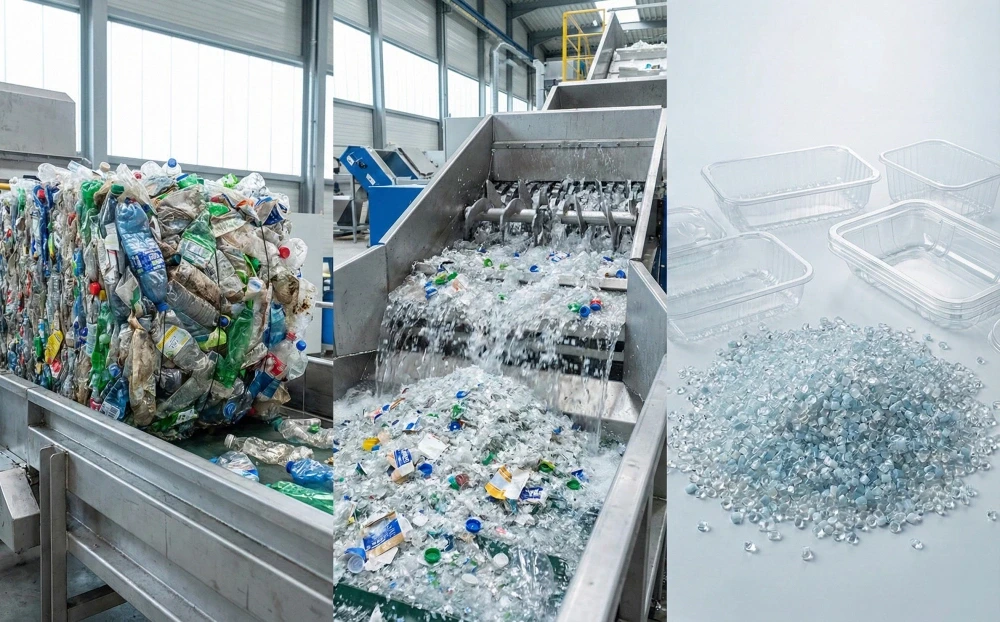
Waste usually arrives in large, compressed bales. The preparation begins with de-baling and a high-precision sorting sequence.
- Trommel Screening: Large rotating drums remove small debris, dirt, and caps that might have survived the initial collection phase.
- Near-Infrared (NIR) Sorting: Advanced optical sensors identify the unique light signature of PET, separating clear bottles from colored ones and excluding non-PET plastics with 99.9% accuracy.
- Metal Detection: Magnetic and eddy-current separators remove any aluminum or steel fragments that could damage production machinery.
Grinding and cold/hot washing
After sorting, the bottles are ground into small fragments known as “flakes.” These flakes are the raw currency of the recycling world, but they require deep cleaning.
- Friction Washing: High-speed agitation removes superficial dirt and organic residues.
- Caustic Hot Wash: Flakes are treated with a hot alkaline solution to dissolve stubborn adhesives and labels. Fact is, this stage is vital for ensuring the final product remains transparent and free from “yellowing.”
- Sink-Float Separation: PET is denser than water and sinks, while polyolefin caps (HDPE/PP) float. This simple but effective mechanical process ensures only pure PET moves to the next stage.
| Preparation Stage | Objective | Result |
| NIR Optical Sorting | Polymer separation | Clear PET stream |
| Hot Caustic Wash | Adhesive removal | Clean, neutral flakes |
| Float-Sink Tank | Cap/Label separation | 99.9% pure PET flake |
Key Takeaway: Preparation is a subtractive process where the goal is to remove 100% of non-PET contaminants to ensure the safety of the final packaging.
How do quality standards affect the preparation of PET waste?
In the B2B supply chain, “recycled” is not enough; the material must be “food-grade.” The preparation of post-consumer PET waste must therefore meet strict regulatory standards to ensure that the final containers are safe for direct food contact.
Addressing the “First Life” contaminants
During its first life, a PET bottle might have been used to store liquids that absorbed into the plastic walls. The preparation process must include a “challenge test” to prove that these contaminants are removed.
- Vacuum Stripping: Flakes are placed in a high-vacuum environment to “pull” volatile molecules out of the polymer matrix.
- Solid State Polymerization (SSP): This process uses heat and vacuum over several hours to restore the molecular weight of the plastic, ensuring it has the strength required for modern rPET packaging.
- Laboratory Validation: Every batch must be tested against FDA or EFSA migration limits to ensure that no harmful substances can transfer into food.
Consistency in the global supply chain
For large-scale distributors, the biggest challenge in sourcing recycled materials is consistency. Look at it this way: your production lines are calibrated for specific material behaviors.
- Viscosity Control: Inconsistent preparation can lead to variations in how the plastic melts and flows, potentially causing defects in your trays or containers.
- Color Stability: High-quality preparation facilities use automated color-correction systems to ensure that even 100% recycled material maintains the clarity consumers expect.
Key Takeaway: Regulatory compliance and technical consistency are the final filters that determine whether post-consumer waste is suitable for the food-service industry.
Reliancepak utilizes advanced 9-line production technology to ensure that the post-consumer PET waste we process is transformed into high-performance, food-safe containers. We suggest contacting our technical team to learn more about our decontamination protocols or to request a sample for your next project.
Frequently Asked Questions
Why is clear PET waste more valuable than colored PET?
Clear PET is the most versatile because it can be dyed into any color or maintained as transparent. Colored PET (such as green or opaque milk bottles) has limited reuse applications and is often downcycled into textiles or industrial strapping rather than being used for new food trays.
Does the label and cap affect the recycling process?
Yes. Labels and caps are usually made of different plastics (PP or HDPE). While these must be removed to maintain the purity of the PET, they are also collected and recycled into other non-food products, contributing to a broader circular economy.
How many times can post-consumer PET waste be recycled?
While it is theoretically possible to recycle PET multiple times, the polymer chains eventually shorten, leading to a loss of strength. However, by blending recycled flakes with a small amount of virgin resin or using SSP technology, the material can stay in the food-grade loop for many cycles.
Is waste from the ocean used for food packaging?
Generally, no. “Ocean-bound” plastic has often been degraded by UV light and salt water, making it unsuitable for the strict decontamination requirements of food-grade containers. Most food-safe rPET comes from controlled consumer recycling streams.
What is a “bale” of PET waste?
A bale is a large, highly compressed block of plastic bottles, weighing up to 500kg. Baling is done at recovery facilities to make transport more efficient and cost-effective for global shipping.