rPET plastic, short for recycled polyethylene terephthalate, is a recycled form of PET used to manufacture bottles, food trays, containers, and other packaging products. For food packaging buyers, it offers a practical way to meet recycled-content requirements without giving up clarity or food-contact safety.
This guide explains how rPET plastic is made, what rPET packaging is used for, how it compares with virgin PET, and what to check before ordering rPET containers in bulk. The goal is to give procurement teams and food service distributors a decision-ready overview rather than a textbook definition.
What Is rPET Plastic?
rPET plastic stands for recycled polyethylene terephthalate. It is produced by collecting, cleaning, processing, and reusing PET materials to manufacture new products. In food packaging, food-grade rPET can be used for trays, containers, bottles, and other applications where applicable food-contact requirements are met.
From a materials perspective, rPET is a recycled thermoplastic polymer based on polyethylene terephthalate. The polymer chain itself is the same family as virgin PET; what changes is the raw material source and the processing route. See our rPET definition and process guide for a deeper breakdown.
The relationship between these terms is easier to see as a hierarchy:
- PET (polyethylene terephthalate), the base polymer
- Virgin PET — produced from petrochemical feedstock
- Recycled PET — recovered from used PET products
- rPET — cleaned, decontaminated, and pelletized recycled PET resin
- rPET packaging — food trays, containers, bottles, and other converted products
- rPET — cleaned, decontaminated, and pelletized recycled PET resin
rPET vs PET: What Is the Difference?
PET is the base polymer; rPET is PET that has been recovered and reprocessed. The differences sit in the raw material origin, the recycled content, and the compliance path required for food contact, not in the basic chemistry. A detailed side-by-side follows later in this article.
How Is rPET Plastic Made?
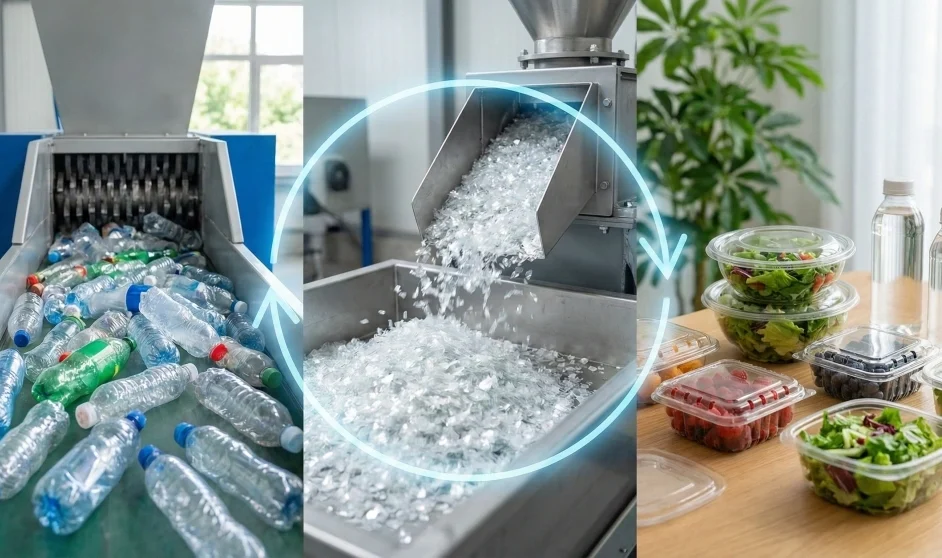
Most food-grade rPET is produced through mechanical recycling, a multi-stage process designed to remove contaminants so the final resin can meet applicable food-contact standards. The rPET recycling process typically follows three stages.
Collection and Sorting
Post-consumer PET, mainly clear beverage bottles, is gathered through deposit schemes and commercial collection streams. Optical sorters separate PET from other plastics such as PVC or HDPE, since cross-contamination directly affects the quality of the recycled polymer.
Washing and Decontamination
The sorted material is ground into flakes and hot-washed to remove labels, adhesives, and residues. Food-grade lines then use high-temperature vacuum decontamination to strip volatile compounds, which is the step that allows the output to qualify for direct food contact under FDA or EU frameworks.
Pelletizing
Clean flakes are melted, filtered, and extruded into uniform pellets. These pellets are the raw material for thermoformed food packaging, injection molding, and bottle production.
What Is rPET Packaging Used For?
rPET packaging replaces virgin PET in most cold and room-temperature food applications. In practice, the product categories below account for the majority of bulk orders we see from distributors and food processors.
rPET Food Trays
Clear trays for berries, salad greens, cut fruit, and bakery items, where visibility drives shelf appeal. rPET trays thermoform well and can be produced with rolled edges or compartments for retail display.
rPET Food Containers
Sealed containers for deli items, cold salads, and grab-and-go meals. Typical requirements include leak-resistant rims and compatibility with flat or domed lids.
rPET Produce and Fruit Packaging
Clamshells and vented trays for fresh produce packaging. Clarity and stiffness matter here, because the pack often doubles as the merchandising unit.
rPET Beverage and Bakery Packaging
Bottles remain the largest single use of rPET globally, while bakeries use clear rPET trays and domes for countertop display. Both rely on the material’s glass-like appearance.
rPET Deli and Prepared Food Packaging
Sealed bowls and compartments for prepared food packaging, often paired with cold-chain distribution where rPET performs well at refrigeration temperatures.
Looking for rPET food trays or containers for wholesale procurement? Ask us about available sizes, recycled content, customization options, and free samples.
What Is rPET Food Packaging?
rPET food packaging is packaging made from recycled PET that has been processed to meet applicable food-contact requirements. In practice, that means the resin comes from a decontamination process certified under a recognized food-contact framework, and the converted packaging is produced on lines that keep food-grade material separate from non-food-grade output. See our rPET food safety guide for the compliance details.
Food-Grade Requirements
Food-contact rPET depends on two things working together: a recycling process approved for food contact (FDA, EU, or equivalent), and quality controls at the converter that prevent contamination during forming and packing.
Common Applications
Recycled PET food packaging covers fresh produce, deli and prepared foods, bakery, and chilled ready-to-eat meals. Food-grade rPET containers and rPET food trays are the formats most frequently requested by wholesale buyers.
Packaging Performance
Food-grade rPET can provide performance comparable to virgin PET in many packaging applications, although properties may vary depending on recycled content, processing conditions, and product requirements. For chilled and shelf-stable cold applications, the practical difference from virgin PET is usually minor.
rPET Packaging Solutions for Different Food Applications
Because requirements differ by application, most buyers do not order a single generic rPET product. The table below maps common food applications to the rPET packaging solutions typically specified for each.
| Application | Typical rPET Packaging Solution |
| Fresh Produce | Clear rPET trays, clamshells, and vented containers |
| Ready-to-Eat Food | Sealed food containers with matching lids |
| Bakery | Clear display trays and domes |
| Deli | Sealed rPET food containers |
| Retail Food | Display-oriented trays for shelf merchandising |
| Food Service | Stackable containers and trays for distribution |
The right specification depends on your product’s weight, moisture, shelf life, and how the pack is displayed. A supplier that can adjust recycled content, dimensions, and sealing style will usually save you a second sourcing round.
How Much Recycled Content Does rPET Packaging Contain?
rPET packaging can contain anywhere from a partial blend to 100% recycled material, depending on requirements for clarity, strength, and cost. While 100% rPET is technically achievable, many manufacturers use a blend of recycled and virgin resin to balance performance against price.
The blend ratio is a supply chain decision, not just a sustainability one. Higher recycled content reduces the carbon footprint associated with the pack, but may affect clarity and color consistency.
- 100% rPET: maximum recycled content, suited to brands with strict sustainability mandates; may show a slight tint.
- 50% to 70% blend: a common middle ground that keeps clarity high while significantly cutting virgin resin use.
- Lower blends: often specified to meet minimum recycled-content rules in markets such as the UK or EU while keeping unit costs stable.
Recycled content claims should be verified through third-party certifications such as GRS, so your own compliance documentation holds up when your customers audit it.
Is rPET Safe for Food Packaging?
Yes, rPET is safe for food packaging when it is produced as food-grade material under an approved food-contact process. The distinction matters: not all recycled PET qualifies for direct food contact, and the approval attaches to the decontamination process, not just the material.
For buyers, the practical checks are straightforward. Confirm that the supplier’s resin is produced under an FDA or EU food-contact framework, request current certificates before large orders, and verify that food-grade and non-food-grade production are physically separated. Our rPET food safety overview covers the verification steps in more detail.
rPET vs PET: Properties, Performance & Durability
Food-grade rPET can provide performance comparable to virgin PET in many packaging applications. Impact resistance, moisture barriers, and stiffness are typically close enough that end users do not notice a functional difference in cold or room-temperature use. That said, properties may vary depending on recycled content, processing conditions, and product requirements, so sample testing remains part of a sound sourcing process.
The visible differences are mostly aesthetic. High-percentage rPET may carry a faint yellow, blue, or grey tint, and occasional specks can appear; neither affects food safety. Additives can neutralize much of the tint where a clear look is required.
| Feature | Virgin PET | rPET |
| Raw Material | Virgin PET resin | Recycled PET |
| Recycled Content | 0% | Varies by specification |
| Transparency | Typically high | Depends on recycled content and processing |
| Food Contact | Application dependent | Food-grade material and process required |
| Appearance | Typically clear | May have a slight tint |
| Typical Uses | Trays, containers, bottles | Trays, containers, bottles |
| Sustainability Profile | No recycled content | Uses recovered PET material |
For a longer discussion of the trade-offs, see our PET vs rPET comparison.
What Are the Benefits of rPET Packaging?
The commercial case for rPET packaging rests on four points, and they compound when regulations tighten in your market.
- Recycled content compliance: helps you meet recycled-content rules and retailer sustainability requirements without changing pack formats.
- Lower carbon footprint: recovering and reprocessing PET generally carries a lower carbon burden than producing virgin resin, though the exact figure depends on the recycling route.
- Comparable performance: for most cold and room-temperature food applications, food-grade rPET performs close enough to virgin PET that no format change is needed.
- Brand positioning: visible recycled packaging supports sustainability claims that consumers and retail buyers increasingly check.
How Much Does rPET Packaging Cost?
rPET packaging typically costs more than virgin PET, mainly because of the logistics and processing behind food-grade recycled resin. Pricing is driven by a few factors rather than one.
- Collection and sorting: every unit of rPET starts as waste that must be collected, transported, and sorted before processing begins.
- Decontamination energy: the hot wash and high-vacuum steps required for food-contact approval add utility costs that virgin production does not carry.
- Supply and demand: large beverage and food brands buy significant volumes of certified resin, so prices for food-grade flakes rise when supply is tight.
- Order volume: as with most packaging, unit pricing improves with quantity and with standardized formats the supplier already produces.
Unlike virgin resin, rPET pricing is not tied to crude oil. The cost structure of rPET packaging reflects recycling infrastructure, which is also why prices vary by region. Many buyers offset the premium through avoided plastic taxes, retailer compliance requirements, and the marketing value of verified recycled content.
How to Choose rPET Containers for Bulk Orders
Moving from material science to purchasing, these are the eight specification points worth fixing before you request quotes for rPET containers.
- Recycled content: decide the percentage you need for compliance and branding, and confirm it can be certified.
- Food-contact compliance: confirm FDA, EU, or equivalent approval for the specific container, not just the resin type.
- Thickness and strength: match wall thickness to product weight and stacking conditions in distribution.
- Clarity: set an acceptable clarity level; higher recycled content may introduce a slight tint.
- Container size and shape: check dimensions against your filling line and retail shelf plan.
- Sealing compatibility: confirm the container works with your lidding film or lid format and sealing equipment.
- MOQ and lead time: align minimum order quantities and production lead times with your inventory cycles.
- Customization: if you need specific compartments, embossing, or dimensions, confirm mold capability and tooling terms early.
How to Source rPET Containers in Bulk?
Sourcing rPET containers comes down to finding a supplier who combines certified food-grade material with stable volume production. The points below separate reliable partners from the rest.
- Certifications first: request current FDA, EU, or GRS documents before sampling, and check they cover the exact product you are buying.
- Factory-direct supply: integrated manufacturers control resin quality through conversion, which reduces the gap between approved samples and bulk production.
- Sample testing: use free samples to test clarity, thickness, and seal integrity in your actual filling and distribution environment.
- Product range: a supplier covering rPET trays, containers, lids, and complementary packaging consolidates shipping and simplifies procurement.
- Delivery stability: ask about production capacity and how lead times hold up during high-demand seasons for recycled resin.
For wholesale buyers, rPET packaging for food service distribution involves the same logic at a larger scale: verified material, proven tooling, and a supplier who can hold specifications across repeat orders.
Need customized rPET food packaging? Send us your required size, capacity, material specification, and estimated order quantity, and our team will come back with a matching proposal and free samples. Reliancepak manufactures food-grade rPET trays, containers, and lids on dedicated production lines with fast global delivery.
Frequently Asked Questions About rPET
Can rPET be recycled again after use?
Yes. rPET can go through the recycling loop multiple times, although some virgin resin may be added in later cycles to maintain mechanical properties. This recyclability is what makes rPET packaging a practical fit for circular-economy targets.
Is rPET safe for hot food applications?
No. Standard rPET, like virgin PET, has a relatively low heat distortion temperature and is designed for cold or room-temperature food. For high-heat applications, C-PET or specialized alternatives are typically more suitable.
How can I tell if a container is made from rPET?
Most rPET containers carry the #1 recycling symbol, often with a post-consumer recycled (PCR) mark or a stated recycled percentage. A slight blue or grey tint can also be a visual indicator, though tint depends on recycled content and processing.
Does rPET packaging have a shelf life?
No. The material is stable under normal warehouse and retail conditions. Stored cool, dry, and away from direct UV exposure, rPET containers retain their physical properties for extended periods.
Can I get custom sizes for rPET food trays?
Yes. Manufacturers with in-house tooling can create molds for specific dimensions, depths, and compartment layouts. This is common for pre-cut vegetables, pastry assortments, and other products that do not fit standard tray formats.