Custom clamshell packaging gives food brands a clear competitive advantage on retail shelves. The hinged, transparent shell protects products while letting consumers see exactly what they are buying — a combination that drives purchase decisions in fresh produce, bakery, and prepared-food categories.
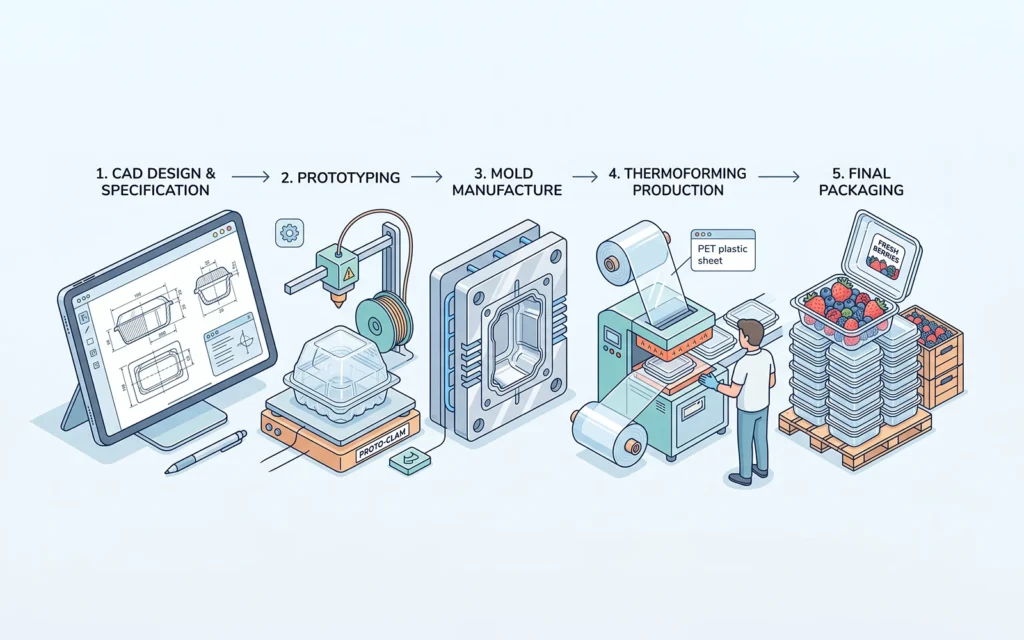
For packaging buyers and food processors, understanding how custom clamshell packaging moves from concept to factory floor helps reduce costs, shorten lead times, and avoid costly redesigns.
Why Clamshell Packaging Fits Food Products
Visibility That Sells
Unlike opaque boxes or wrapped trays, clamshell containers put the product on full display. This matters most for fresh berries, cut fruit, bakery items, and salads where color and freshness influence buying behavior. Retail buyers consistently rank shelf visibility among the top three packaging criteria for perishable goods.
Built-In Protection
The rigid shell structure absorbs stacking pressure during shipping and resists crushing on crowded retail displays. For delicate items like tomatoes, pastries, or pre-made sushi rolls, this physical barrier reduces damage rates compared to flexible film or open trays.
Common Food Applications
Clamshell packaging appears across a wide range of food segments:
- Fresh berries and small fruits
- Pre-cut vegetables and salad mixes
- Bakery goods — muffins, croissants, donuts
- Deli items and prepared meals
- Snack foods and confectionery
Each application demands specific design tweaks in ventilation, cavity depth, and material thickness.
Design Considerations for Custom Clamshell Packaging
Material Selection
The base material shapes everything from product shelf life to recyclability claims. PET (polyethylene terephthalate) remains the most widely used resin for food clamshells due to its clarity, FDA food-contact compliance, and established recycling infrastructure. RPET — made from recycled content — is gaining traction as retailers push for sustainability benchmarks.
Other options include PP (polypropylene) for microwaveable applications and PLA (polylactic acid) for compostable packaging programs. The right choice depends on your product’s temperature requirements, shelf-life targets, and the end-market’s waste processing capabilities.
Cavity Shape and Sizing
A well-designed cavity cradles the product without excess headspace. Too much empty volume invites product movement and bruising; too little makes the shell hard to close. Custom tooling lets you match cavity geometry precisely to your product dimensions — something stock clamshells rarely achieve.
For multi-compartment designs (think fruit trays or bento-style meal kits), partition placement and depth ratios require careful prototyping before committing to production molds.
Ventilation and Freshness Features
Perishable foods need airflow. Strategically placed ventilation holes or micro-perforations regulate moisture and slow condensation buildup inside the shell. The number, size, and location of vents vary by product:
- Berries need more ventilation to prevent mold
- Bakery items need less airflow to maintain texture
- Leafy greens require a balance between moisture retention and breathability
Getting ventilation wrong leads to either premature spoilage or product dryness — both costly outcomes for food brands.
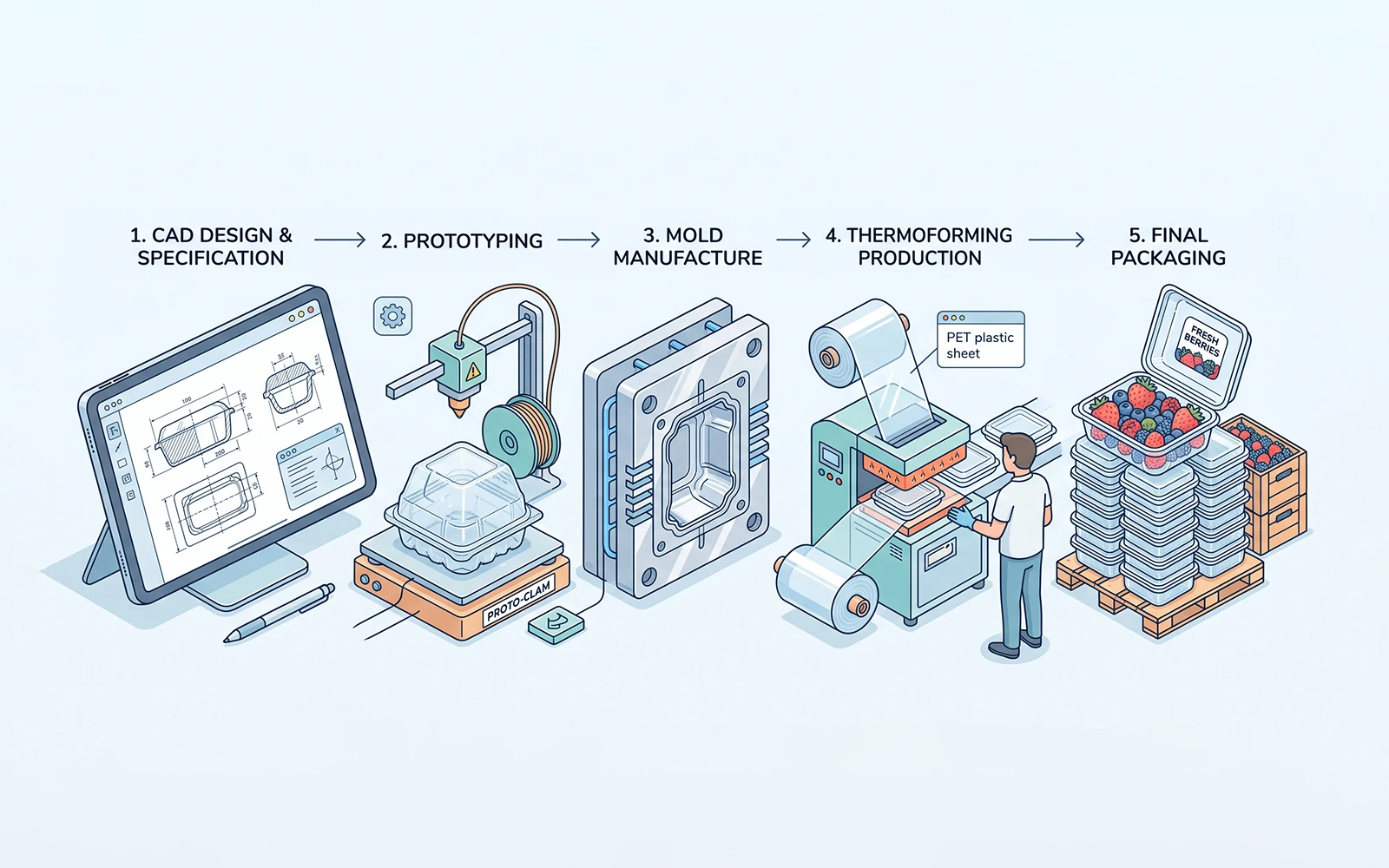
From Prototype to Production
Rapid Prototyping Methods
Before investing in steel tooling, most custom clamshell projects go through a prototyping phase. CNC-machined samples or 3D-printed models let you test fit, evaluate ergonomics, and gather retail feedback. This stage typically takes one to two weeks and prevents expensive mold revisions later.
Sample runs also reveal practical issues: Does the hinge flex enough for repeated opening? Does the snap closure hold during transport? Can your filling line handle the tray orientation?
Tooling and Mold Development
Once the prototype is approved, the project moves to tooling. Aluminum molds suit shorter production runs and faster turnaround. Steel molds cost more upfront but withstand millions of cycles for high-volume food packaging programs.
Tooling lead times range from four to eight weeks depending on cavity complexity and the number of mold cavities. Multi-cavity molds increase output per cycle, reducing per-unit cost at scale.
Manufacturing Process Overview
Thermoforming vs. Injection Molding
The two dominant manufacturing methods for custom clamshell packaging each carry distinct cost and performance profiles:
| Factor | Thermoforming | Injection Molding |
|---|---|---|
| Tooling cost | Lower | Higher |
| Per-unit cost at volume | Moderate | Lower at very high volumes |
| Wall thickness control | Less precise | Highly precise |
| Best for | Mid-volume food trays, produce clamshells | High-volume, tight-tolerance containers |
| Material options | PET, RPET, PP, PS | PET, PP, PS, PLA |
Thermoforming works well for most food clamshell applications where moderate volumes and fast tooling matter. Injection molding becomes cost-justified when annual volumes exceed several million units or when wall-thickness consistency is critical.
Quality Control and Food-Grade Compliance
Food-contact packaging must meet regulatory standards in your target market. In the United States, FDA 21 CFR compliance is mandatory. Exports to Europe require EU Regulation (EC) No 1935/2004 conformity. Other markets — Saudi Arabia, for example — apply their own food-contact material standards.
Reputable manufacturers maintain documented quality systems covering raw material traceability, dimensional inspection, and migration testing. Request these certifications before placing production orders.
Choosing a Packaging Partner for Custom Clamshell Projects
Selecting a supplier for custom clamshell packaging goes beyond comparing unit prices. You need a partner who understands food-grade requirements, offers genuine OEM and ODM capabilities, and can scale production as your business grows.
Reliancepak operates as an integrated factory-and-trade manufacturer with nine production lines dedicated to food packaging containers, including custom clamshells, plastic trays, and disposable food containers. The company serves wholesale buyers across the United States, Europe, the Middle East, and South America, with international food-grade certifications including FDA and EU standard compliance.
Whether you need a small trial run of custom-designed berry clamshells or a full-scale production program for retail distribution, Reliancepak provides free samples, rapid prototyping support, and flexible MOQ arrangements. You can explore the full product range at www.reliancepak.com or reach the team directly at admin@bereliance.com.
FAQs
What is the minimum order quantity for custom clamshell packaging?
It varies by manufacturer and tooling type. Many suppliers set MOQs between 10,000 and 50,000 units for custom molds. Reliancepak offers flexible MOQ options to accommodate both trial orders and large-scale programs.
How long does it take to go from design to finished production?
A typical timeline runs six to twelve weeks: one to two weeks for prototyping and sampling, four to eight weeks for tooling, and one to two weeks for the first production run. Complex multi-cavity designs may extend the schedule.
Are custom clamshells recyclable?
PET and RPET clamshells are widely recyclable in most municipal programs. PP clamshells are recyclable where infrastructure exists. PLA requires industrial composting facilities and is not accepted in standard curbside recycling. Confirm your target market’s waste processing capabilities before selecting material.
Can I get a custom shape that fits my specific food product?
Yes. Custom tooling allows precise cavity geometry matched to your product dimensions, including multi-compartment layouts, branded embossing, and tailored ventilation patterns. This is the primary advantage of custom clamshell packaging over stock options.
What certifications should I look for in a food packaging supplier?
At minimum, verify FDA compliance for the U.S. market and EU Regulation (EC) No 1935/2004 for Europe. ISO 22000 or FSSC 22000 food safety management certification adds further assurance. Ask suppliers for documented migration test reports specific to your product type.