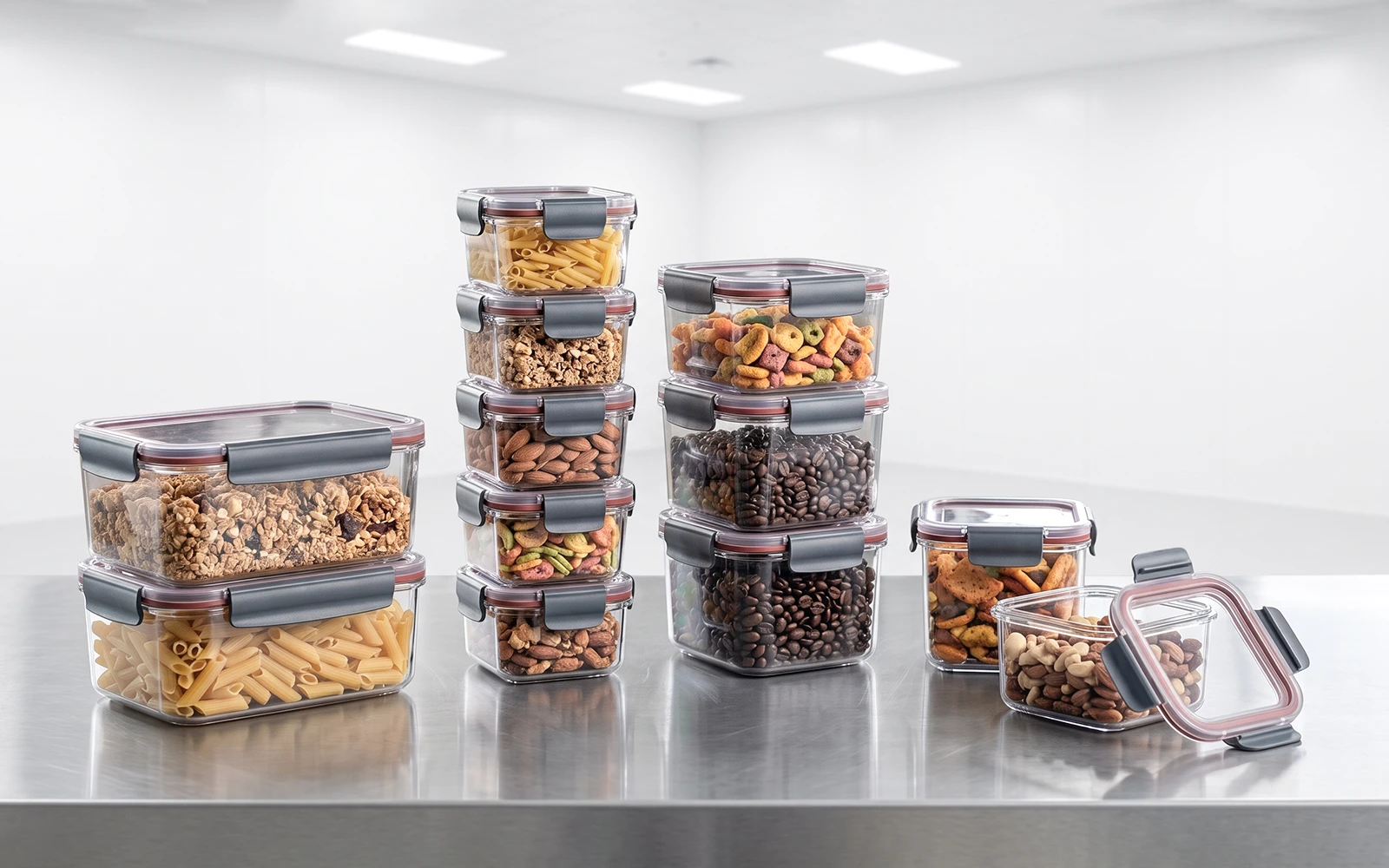
A wholesale airtight container purchase fails in three expensive ways: goods rejected at the border for missing documents, freight budgets blown by poor pallet economics, and seals that pass a hand test but fail on the filling line. A selection process that checks all three before the purchase order is signed costs a few days; discovering them after arrival costs a season.
This guide lays out that process in five steps, focused on the buyer-side decisions. Where a topic has deeper dedicated coverage — test methods, seal architectures, commercial terms — it links to the complete airtight packaging guide for materials, testing, and sourcing rather than repeating it.
Step 1: Write the Barrier Requirement Before Comparing Suppliers
Suppliers can only quote accurately against a specification, not against the word “airtight.” Write your requirement in phase terms — gas-phase barrier, liquid-phase retention, or both — and attach the numbers: target OTR or WVTR class, storage temperature range, and shelf-life claim.
This one habit eliminates most sample-round waste. Containers designed for soup will never keep nuts crisp, no matter how good the lid feels in hand. The measurement side — what OTR and WVTR values mean and which ASTM methods back them — is covered in the airtightness measurement framework in the pillar guide.
Step 2: Treat Compliance Documents as a Gate, Not a Differentiator
For EU and US destinations, certification is pass/fail. Before shortlisting suppliers, require:
- Declaration of Compliance under EU Regulation (EU) No 10/2011 for each plastic material, plus FDA 21 CFR compliance letters for US-bound resin grades
- BRCGS Packaging Materials or ISO 22000 certificate scoped to the actual production site
- Third-party migration reports matched to your food type — aqueous, acidic, or fatty — and use temperature
Check that certificates are current and site-specific: a trading company’s certificate does not cover the factory making your goods. The full compliance document checklist for EU, US, and Gulf imports details what each document should contain and which audit situations it surfaces in.
Step 3: Run the Pallet Math
Freight and warehousing often move total landed cost more than unit price does. Four logistics metrics deserve numbers, not adjectives:
| Metric | What to Require | Cost Impact |
| Top-load strength | Compression test to failure, in kg, per container size | Bottom containers survive full-pallet stacking |
| Nesting ratio | How many empty bases nest per given stack height | Lower inbound freight and warehouse fees |
| Units per pallet | A standardized pallet pattern matched to your market’s pallet size | More sellable units per shipping container |
| Tare weight | Resin thickness balanced against strength requirements | A direct line item in every freight quote |
Two design details are worth checking on physical samples rather than datasheets. Anti-slip lid grooves keep stacks stable during truck transport, and reinforced corners prevent the cracking that turns a full pallet into a write-off. Also confirm the container is engineered for your actual warehouse stacking height, not just a single pallet layer.
Step 4: Buy Only as Much Customization as the Volume Supports
Customization is a capital decision, not a design preference. There are three levels:
- Stock SKU — standard sizes and colors; fastest and cheapest, right for testing a new product line
- Custom color or print — brand differentiation on an existing mold; justified once volume is proven
- Private mold — exclusive geometry fitted to your filling line and shelf strategy; justified at high, stable volume
A new mold typically runs 25–45 days from approved 3D drawings to first samples (T1), plus two additional sampling rounds for fit and seal verification. You can shorten that timeline yourself by submitting a complete technical brief with the RFQ: internal dimensions, fill weight, sealing method, stacking height, and target material. For the commercial mechanics — MOQ tiers, tooling ownership, and amortization options — see MOQ tiers and private mold terms explained in detail.
In-mold labeling (IML) fits at either the custom or private-mold level: the label bonds into the container wall, survives wet and cold storage without peeling, and holds premium graphics that adhesive labels cannot match in cold-chain conditions.
Step 5: Qualify the Supplier on Your Line, Not in a Lab
Stock samples are usually free and arrive by courier within about a week. Custom samples require either a modified existing mold or a T1 shot from the new tool, adding roughly 2–4 weeks. Either way, the test that predicts real-world performance is a production-speed line trial: run the samples through your filler, sealer, and case packer, then complete a full pallet stack trial. A container that seals beautifully by hand can still fail on a line running 60 cycles per minute.
One vetting question separates capable factories from the rest: ask how they handle a failed seal-integrity check mid-run. Batch traceability, retention samples per production lot, and a defined corrective-action process tell you how the next defect gets handled — before it becomes yours.
FAQ
How do I verify a container’s stackability rating?
Ask the manufacturer for compression test data showing top-load to failure in kilograms for your specific container size. Confirm the test reflects your real warehouse stacking height rather than a single pallet layer.
Is it better to source from a factory or a trading company?
An integrated manufacturer-trader usually offers the shortest feedback loop between your line trial results and mold or process adjustments. Whichever you choose, verify that certificates are scoped to the actual production site, not just the sales entity.
What should go into the technical brief for a custom mold?
Five items: internal dimensions, fill weight, sealing method, stacking height, and target material. Submitting these with the RFQ prevents fit and seal issues from being discovered during sampling rounds instead.
Are free samples available before committing to a wholesale order?
Yes for stock SKUs — typically free and shipped by courier within about a week. Custom samples add roughly 2–4 weeks because they require a modified mold or a first shot from new tooling.
Can I order airtight containers with a private mold?
Yes, typically from around 50,000–100,000 pieces or with tooling amortized into per-piece pricing above an agreed volume. Request both quote structures at your realistic volume and compare total cost before deciding.