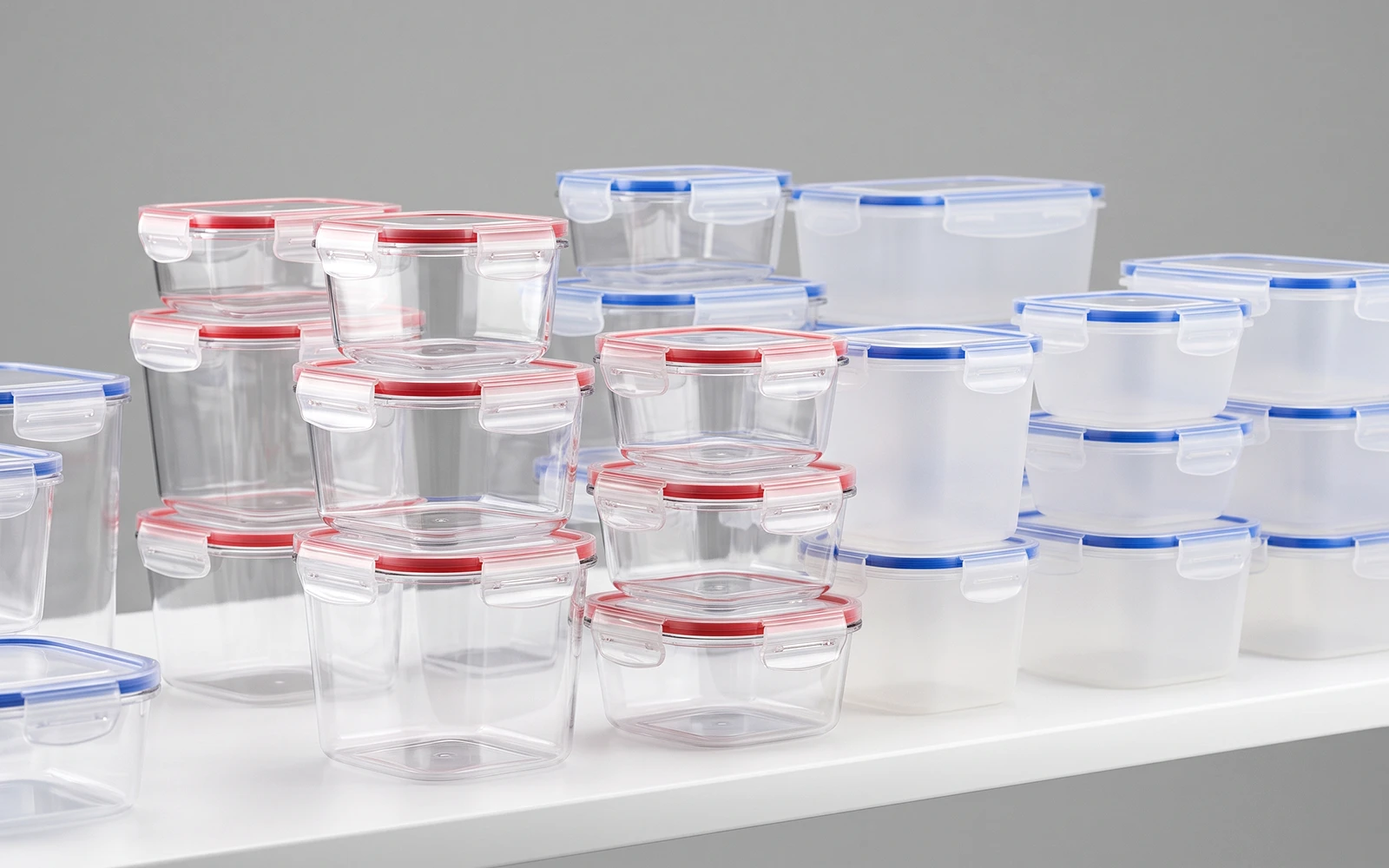
An airtight container is a packaging vessel engineered to limit gas and moisture exchange between the food inside and the outside environment to a near-zero level. In practice, that means a controlled gasket or induction seal, a material grade chosen for its oxygen transmission rate, and dimensional tolerances tight enough that lid and base compress the seal uniformly across thousands of production runs.
If you source packaging for a food plant or a distribution network, the practical question is not “is it airtight?” but “how airtight, measured how, and certified by whom?” This guide walks through the measurable parameters, the compliance documents European and US importers will ask for, and the commercial terms — MOQ tiers, tooling timelines, sampling — that determine how fast you can actually move from inquiry to a container on your filling line.
Why Airtight Performance Is Measured, Not Claimed
Oxygen drives oxidation of fats and oils, discoloration of fresh-cut produce, and the staling of dry goods. Water vapor drives the opposite problem: moisture gain in crackers and powders, moisture loss in chilled foods. An airtight container addresses both, but the degree of protection differs sharply by material and seal design — and those differences are quantifiable.
Packaging laboratories measure gas barrier performance using standardized methods: oxygen transmission rate (OTR) under ASTM D3985, and water vapor transmission rate (WVTR) under ASTM F1249. When you receive a quotation from any supplier, ask for test values expressed in these units rather than adjectives like “excellent” or “high barrier.”
| Parameter | What It Measures | Typical Range (Packaging Grades) | Test Method |
| OTR | Oxygen passing through the material | PET: roughly 1–3 cc/m²/day; PP: substantially higher, often tens of cc/m²/day depending on grade and thickness | ASTM D3985 |
| WVTR | Moisture vapor passing through | PET and PP: low single digits g/m²/day at 23°C / 50% RH; foil laminates near zero | ASTM F1249 |
| Seal integrity | Leak rate through the closure zone | Pass/fail against a defined vacuum or pressure decay threshold | Vacuum chamber or pressure decay test |
| Top-load compression | Stack strength in the distribution chain | Defined per container size; test to failure in kg | Compression test |
The shelf-life consequence is direct. For dry snacks and coffee-style products, moving from a snap-lid container to a gasketed airtight format typically extends the sell-by window from days to weeks or months — the exact multiple depends on the product’s fat content and the storage temperature, so it should be validated by real-time or accelerated shelf-life testing rather than assumed from a supplier’s datasheet.
Airtight, Leak-Proof, or Neither: Matching the Barrier to the Product
A frequent source of failed packaging projects is assuming these three terms describe the same thing. They don’t, and the difference shows up at molecular scale: oxygen molecules are far smaller than liquid molecules, so a container that holds soup without dripping can still pass enough oxygen to turn the nuts inside rancid.
Before committing to a format, it helps to review how airtight, leak-proof, and non-airtight containers differ in real distribution scenarios, because the right choice depends on your product’s failure mode, not the container’s price tag.
- Non-airtight (snap-on lid): Dust and debris protection only. Suited to same-day or next-day consumption — deli salads, bakery items sold within 24–48 hours.
- Leak-proof: Blocks liquid passage through geometry and surface tension. Correct for soups, sauces, and marinated proteins where spill prevention during transport is the priority.
- Airtight: Adds a compressed gasket or interference fit to block gas and vapor. Correct for dry goods, powders, coffee, nuts, and any SKU with a multi-week or multi-month shelf-life claim.
A simple specification habit: write your requirement in phase terms — gas-phase barrier, liquid-phase retention, or both — in your RFQ. Suppliers can then quote the correct seal architecture on the first pass instead of iterating through samples that were never designed for your failure mode.
Sealing Architectures: Gaskets, Locks, and Induction Seals
The seal, not the body material, is where most airtight claims succeed or fail. There are three industrial approaches, each with a different cost and performance envelope. For a deeper mechanical comparison, see gasket materials and induction sealing methods compared for food packaging.
Compression gaskets with mechanical locks. A silicone or TPE gasket is compressed by a four-hinge locking lid, a twist-lock thread, or a snap-lock rim. Silicone gaskets tolerate roughly −40°C to 200°C in service and survive repeated wash cycles, which makes them the default for reusable containers and cold-chain totes. Over-molded TPE seals cost less at volume and bond directly to the lid, though their thermal window is narrower than silicone’s.
Hollow-core gasket geometry. A hollow profile compresses more readily than a solid one, maintaining contact pressure even when the base warps slightly after filling or pallet stacking. This detail matters more than gasket material in many failure investigations.
Induction heat sealing. An aluminum foil liner is bonded to the container rim by electromagnetic induction, producing a tamper-evident, essentially hermetic barrier that stays intact until the consumer peels it. This is the standard choice for factory-filled sauces, powders, and oils in single-use retail packaging, and it runs inline on automated filling lines at industrial speeds.
| Seal Method | Reusability | Temperature Tolerance | Typical Application |
| Silicone gasket + lock lid | Reusable, hundreds of cycles | ~−40°C to 200°C | Reusable totes, cold chain, wholesale containers |
| Over-molded TPE seal | Reusable to semi-reusable | Narrower than silicone | Volume food containers, cost-sensitive lines |
| Induction foil seal | Single-use | Limited by body material | Factory-sealed sauces, powders, oils |
One caution for line planning: induction sealing requires the foil liner, the container rim, and the sealing head power to be matched. If you plan to run induction seals, confirm with the supplier that the container rim geometry is qualified for induction before you book line trials.
Material Selection: PP, PET, and Aluminum Compared
Material choice sets the ceiling on barrier performance before any seal is added. The full trade-off analysis is covered in PP, PET, and aluminum trade-offs for specific food categories; the summary below gives you the numbers that drive most sourcing decisions.
Polypropylene (PP) is the workhorse for hot-fill and microwave applications. It withstands continuous service temperatures around 100–120°C, resists oils and acids, and carries a melting point near 160°C. Its gas barrier is weaker than PET’s, so airtight PP formats rely on the seal system rather than the material wall.
PET delivers the strongest combination of clarity and gas barrier among commodity plastics, with OTR values typically in the low single digits (cc/m²/day, 23°C). Its limitation is thermal: PET softens well below 100°C and is not suitable for hot-fill or microwave use. For chilled and ambient dry goods where shelf appeal matters, it is usually the correct answer.
Aluminum is an absolute barrier to light, oxygen, and moisture, and it survives retort processing. It is opaque, fully recyclable, and priced accordingly — which is why it dominates airline catering trays, retort lidding, and premium meal-prep formats rather than general wholesale containers.
| Property | PP | PET | Aluminum |
| Max service temperature | ~100–120°C | ~60–70°C before deformation | Very high; retort-capable |
| Clarity | Translucent | Glass-like | Opaque |
| OTR (relative) | Moderate to high | Low | Effectively zero |
| Microwave use | Yes (lid off) | No | No |
| Typical cost position | Low | Low to moderate | Highest |
A note on frozen distribution: PP stays flexible at deep-freeze temperatures, while PET grows brittle and cracks more readily under impact. If your cold chain runs below −18°C, PP or PP/EVOH barrier structures are worth quoting before defaulting to PET.
Compliance Documents You Will Be Asked For
For export into the EU, the US, and the Gulf states, certification is no longer a differentiator — it is a gate. Distributors and food plants should build the following checklist into supplier qualification, and request copies of current certificates rather than screenshots.
- BRCGS Packaging Materials certification: The audit standard most European retailers expect their packaging suppliers to hold. Verify the certificate scope covers the actual production site, not just the trading company.
- ISO 22000 (or FSSC 22000): Food safety management for the manufacturing environment. This covers HACCP-based process control on the production floor.
- EU Regulation (EC) No 1935/2004 + (EU) No 10/2011 Declaration of Compliance (DoC): For food-contact plastics sold into the EU, the supplier must issue a DoC confirming compliance with migration limits — including the 10 mg/dm² overall migration limit under EU 10/2011. This document travels with the goods and is a customs and retailer audit item.
- FDA 21 CFR compliance: For US-bound goods, confirm the resin grades comply with 21 CFR 177.1520 (polypropylene) and 177.1630 (PET), or request FDA-compliance letters for the specific grades used.
- Migration test reports: Third-party laboratory reports for overall and specific migration, performed under the conditions matching your product type (aqueous, acidic, fatty) and use temperature.
Risk control extends beyond paper. A capable supplier should offer batch traceability, retention samples per production lot, and a defined corrective-action process. When evaluating a new factory, ask how they handle a failed seal-integrity check mid-run — the answer tells you more about their quality system than any certificate.
Reliancepak’s export markets — including Spain, France, the Netherlands, Austria, Saudi Arabia, Malaysia, Peru, and the United States — each carry slightly different documentation expectations. Confirming the document package for your destination at the quotation stage avoids the common situation where goods arrive but the DoC or migration report format doesn’t satisfy the importer’s audit.
Commercial Terms: MOQ Tiers, Private Molds, and Sampling
This is the part most packaging articles skip, and the part that consumes the most procurement time. Three commercial levers determine your total cost and timeline.
Tiered MOQ. Wholesale plastic packaging is usually quoted in tiers, and the pricing gaps between them can be significant:
| Order Tier | Typical MOQ Range | What You Get | Price Position |
| Stock SKU (standard size, standard color) | Often 1 pallet to ~10,000 pcs | Fastest lead time, existing tooling | Lowest |
| Custom color / custom print | Commonly 20,000–50,000 pcs | Brand differentiation on existing mold | Mid |
| Private mold (fully custom geometry) | Typically from ~50,000–100,000 pcs or amortized tooling | Exclusive dimensions and design | Highest, priced against tooling |
Exact thresholds vary by factory and container size, so treat these as planning ranges and request written tier pricing early in negotiation.
Private mold development. A new mold typically runs 25–45 days from approved 3D drawings to first samples (T1), depending on cavity count and complexity. Budget two additional sampling rounds for fit and seal verification before mass production. What speeds this up on your side: a complete technical brief — internal dimensions, fill weight, sealing method, stacking height, and target material — submitted with the RFQ rather than discovered during sampling.
Sampling. Stock samples are usually free and ship by courier within about a week. Custom samples require either a modified existing mold or a T1 shot from the new tool, adding 2–4 weeks. Test samples against your actual filling line, not just in a lab: run them through your filler, sealer, case packer, and a full pallet stack trial. A container that seals beautifully by hand can still fail on a line running 60 cycles per minute.
For a structured vetting process — including pallet efficiency, nesting ratio, and supplier audits — see a wholesale sourcing checklist covering stackability, pallet economics, and supplier qualification.
A Procurement Comparison Table You Can Copy into Your RFQ
Use this table to compare suppliers on equal terms. Any vendor who cannot fill in a row without hedging is telling you something useful.
| Evaluation Item | What to Require | Why It Matters |
| OTR / WVTR data | Test values with method (ASTM D3985 / F1249) and material thickness | Separates real barrier from marketing copy |
| Certificates | Current BRCGS Packaging Materials + ISO 22000, site-scoped | Retailer and customs gate for EU/US import |
| DoC | EU 1935/2004 + 10/2011 Declaration of Compliance, per material | Mandatory for EU food-contact plastics |
| Migration reports | Third-party lab, conditions matched to your food type | Audit evidence for your own customers |
| Seal method | Gasket material, lock type, or induction liner spec | Determines shelf life and line compatibility |
| Line trial | Sample run on your filling/sealing line at production speed | The only test that predicts real-world performance |
| MOQ tiers | Written tier pricing: stock / custom / private mold | Reveals the true cost of customization |
| Tooling quote | Mold cost, lead time, ownership terms, amortization options | Private mold decisions are capital decisions |
| Lead time | Per tier, including first article and mass production windows | Planning input for your launch calendar |
| After-sales | Defect policy, retention samples, corrective-action process | Determines how a failure becomes expensive |
Reliancepak runs integrated manufacturing with multiple food-grade production lines, which shortens the feedback loop between your line trial results and mold or process adjustments. If you have a specification in hand — dimensions, fill weight, target shelf life, destination market — the fastest route is to send it to the technical team and request samples matched to it, rather than starting from a catalog page.
FAQ
What information do I need to provide before requesting samples?
Three things: your product’s storage conditions (temperature range, frozen/chilled/ambient), the filling method (manual, semi-auto, or inline sealing at a stated cycles-per-minute rate), and the target shelf life. With those, the supplier can send a sample matched to your barrier requirement instead of a generic catalog item that will fail your line trial.
Can airtight containers run on my existing filling and sealing line?
Yes in most cases, but it must be verified, not assumed. Rim diameter, flange width, and container height tolerances all affect sealer head compatibility. The standard procedure is a line trial with production-speed samples; a competent supplier will offer this before you commit to volume, and will adjust the mold if the first trial shows mismatch.
Which documents do I need to import food-contact containers into the EU?
At minimum: a Declaration of Compliance under Regulation (EU) No 10/2011 for each plastic material, supported by migration test reports, plus the supplier’s BRCGS or ISO 22000 certificate for your own retailer audits. Without a valid DoC, your goods are non-compliant for EU food-contact use regardless of their physical quality.
How long does a private mold take, and is the tooling cost mine?
Typically 25–45 days from approved drawings to first samples, plus 1–2 revision rounds. Tooling cost ownership is negotiable: some buyers pay the mold fee upfront and own the tool, others amortize it into per-piece pricing above an agreed volume. Both structures are common; ask for both quotes so you can compare total cost at your realistic volume.
Is a higher MOQ always the way to a lower unit price?
Generally yes, but with diminishing returns. Price drops steeply from stock MOQ to the first custom tier, then flattens — a second price break at, say, triple the quantity may save only a few percent. Compare tier pricing against your warehousing cost and cash-flow position; ordering two tiers up is not automatically the better deal.