Cleaning plastic containers sounds like a five-minute job. In a busy food business, it rarely is. Between the soaking, the scrubbing, the tomato stains that cling on, and the odor that never quite disappears, washing containers quietly eats into labor hours, water, and floor space.
This guide covers the right way to clean and reuse plastic containers, when cleaning stops paying for itself, and why food manufacturers and distributors increasingly turn to single-use plastic packaging for hygiene-critical products.
Why Cleaning Costs More Than It Seems
Every tray, tub, and deli container that comes back needs to be rinsed, scrubbed, sanitized, drained, dried, and stacked before it’s usable again. In a commercial kitchen or processing line, that’s not one task — it’s a workflow, and it carries real costs.
- Labor hours. Someone handles every container twice — once dirty, once clean.
- Water and chemicals. Washing and sanitizing consume utilities on every cycle.
- Floor space. Dirty stock, clean stock, and drying racks all need room.
- Inspection. A worn or scratched container needs checking before every reuse.
None of this means reusable containers are a mistake. It simply means their true cost is higher than the sticker price — and it’s worth measuring honestly before assuming washing is the cheaper route.
The Question Nobody Asks: Should You Clean It at All?
Every wash cycle stresses the plastic itself. Hot water, sanitizing chemicals, and abrasive scrubbing slowly wear the surface. Once plastic develops fine scratches, those grooves become spots where bacteria and residue can hide — even after a wash that looks perfect.
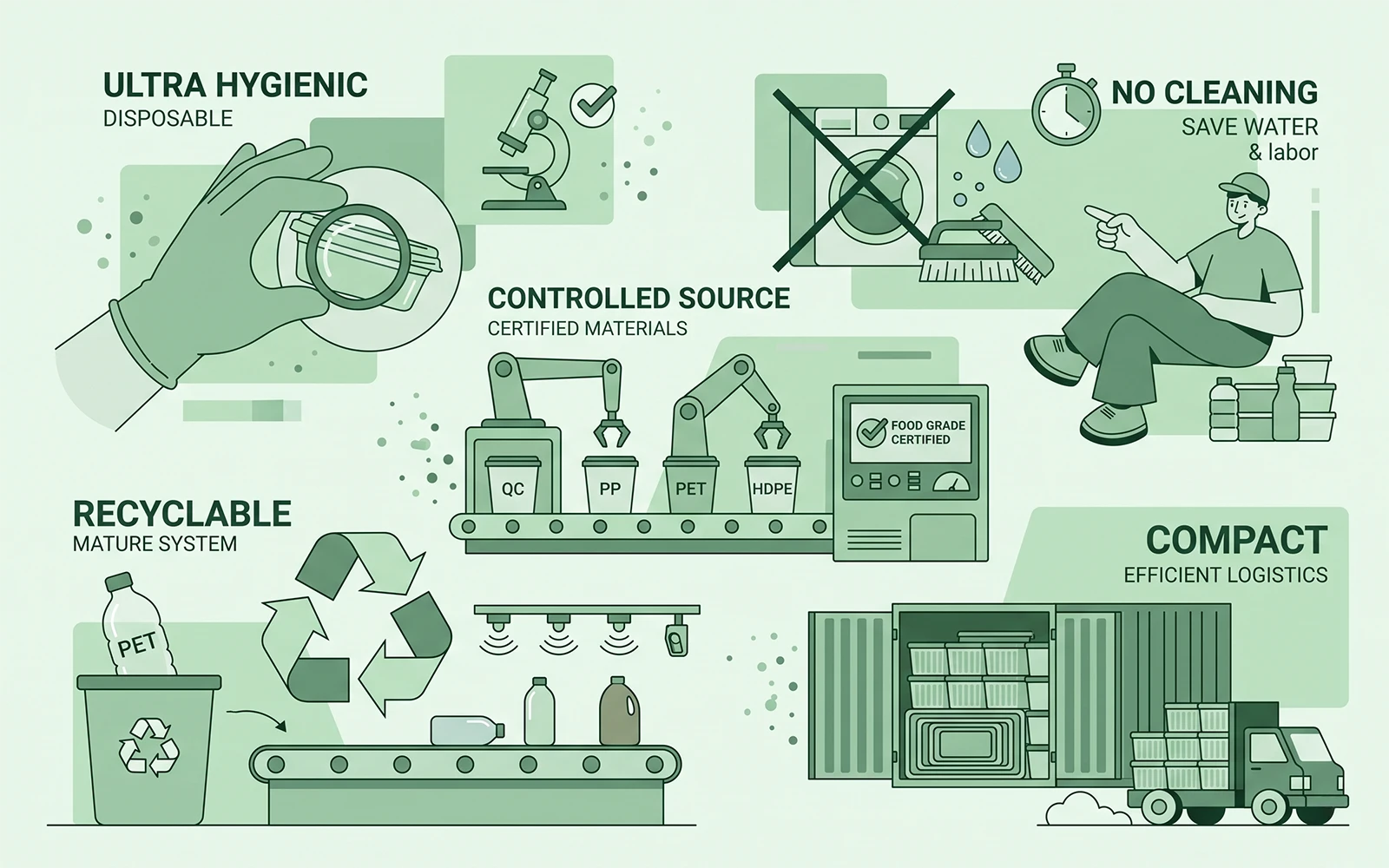
This matters more in some settings than others. For dry goods and long-term storage, a durable container can serve for years. For ready-to-eat food, baked goods, or anything with fat or protein, the stakes are higher. A single-use container removes the cleaning variable entirely: the product touches a fresh, verified surface every time.
From a food-safety standpoint, that’s an attractive position. Instead of depending on your team’s washing discipline, you remove the risk at its source.
What Single-Use Plastic Packaging Is Actually Made Of
A lot of the skepticism around single-use plastic comes from an outdated mental picture. The materials on the market today are more controlled than many buyers assume.
The most common food-contact plastics — PP, PET, and HDPE — are dense, stable polymers designed for direct contact with food. Food-grade grades are produced against recognized food-contact standards, including FDA requirements in the U.S. and the EU’s food-contact regulations.
Production matters too. Containers made on dedicated lines from controlled resin come out with consistent wall thickness and clean surfaces — fewer crevices, fewer places for bacteria to hold on. That consistency is why bakeries, deli counters, and food plants trust them for hygiene-critical runs.
Recycling completes the picture. PET and HDPE sit among the most widely recycled plastics globally. Clear, single-material containers sort easily, and in many markets they’re collected and reprocessed rather than discarded. How much actually gets recycled depends on local collection infrastructure — but the material itself is designed to be recoverable.
How Reliancepak Fits Into a Smarter Packaging Decision
Once single-use packaging looks like the right call for part of your operation, sourcing becomes the practical question. Reliancepak supplies food-grade trays, containers, cups, and paper packaging to wholesalers, distributors, food plants, and farm owners across markets including the U.S., Europe, Southeast Asia, and South America.
Buyers typically choose us for a handful of consistent reasons:
- Factory-direct supply. An integrated factory and trading operation with nine production lines keeps pricing and lead times predictable.
- One-stop sourcing. Trays, deli containers, cups, and boxes from fewer suppliers — simpler purchasing and logistics.
- Custom OEM/ODM. Sizes, materials, and branding adapted to your specification.
- Compliance-ready materials. Food-grade options with FDA and EU standard compliance, including recyclable PET.
- Samples before commitment. Free samples let your team test before ordering at scale.
For a quick comparison, here’s how reusable and single-use containers stack up across the dimensions that matter in a commercial kitchen:
| Dimension | Reusable containers | Single-use plastic packaging |
|---|---|---|
| Hygiene control | Depends on cleaning discipline | Fresh surface on every use |
| Labor | Washing, sanitizing, drying | None in the wash-up stage |
| Water and chemicals | Consumed every cycle | Not part of the process |
| Storage footprint | Room for dirty and clean stock | Compact and often stackable |
| Recycling | Depends on material and local streams | PET and HDPE widely collected |
That’s not an argument that reusable containers are wrong. For some jobs they’re clearly the sensible choice. It’s a reminder to base the decision on your actual operation — not on the assumption that washing is automatically cleaner or greener.
Clean What’s Worth Cleaning, and Choose Wisely for the Rest
Most operations end up with a mix. Heavy-duty totes and long-term storage bins can be cleaned and reused for years. Hygiene-critical lines — ready-to-eat food, baked goods, deli and dairy — are where single-use packaging tends to win.
This article isn’t here to turn you against cleaning. It’s here to ask the question most cleaning guides skip: what does the wash cycle actually cost you, and is a fresh container sometimes the more responsible choice — for hygiene, for labor, and even for the waste stream?
If you’re evaluating single-use packaging, talk to a supplier who understands food-grade materials and compliance. Reliancepak offers free samples and factory-direct pricing, which makes the comparison concrete before you commit.
Frequently Asked Questions
Is it safe to reuse plastic food containers?
Yes — provided the container is food-grade, intact, and properly cleaned. Retire any container that shows scratches, warping, or lingering odors. Fatty and high-protein foods leave more residue, so those get the strictest attention.
Does repeated washing damage plastic containers?
Yes, gradually. Heat, sanitizers, and abrasive scrubbing wear the surface down over time. Once plastic develops scratches or cloudiness, it holds onto residues more easily — which is why hygiene-critical uses often favor a fresh container.
Are single-use plastic containers recyclable?
Yes, in many cases. PET and HDPE are among the most widely collected plastics in municipal recycling programs. Clear, single-material containers sort cleanly and are reprocessed in many markets, though collection depends on local systems.
How can I tell whether a plastic container is food-grade?
Check the resin code and the supplier’s documentation. Food-grade containers typically carry a code (1 for PET, 2 for HDPE, or 5 for PP) and come with food-contact compliance details. If the certification isn’t clear, ask for documentation before use.
When should a food business switch to single-use packaging?
When washing becomes a bottleneck, hygiene risk is high, or your current containers show wear. Many operators keep reusable containers for storage and switch to single-use for ready-to-eat or customer-facing items — a hybrid approach that balances cost, hygiene, and waste.