
rPET packaging consists of plastic containers or films that incorporate post-consumer recycled material, though the actual percentage of recycled content can vary from 30% to 100% depending on technical and economic factors. While “100% recycled” is the industrial gold standard, many food-grade applications utilize blended resins to balance structural integrity with environmental goals.
Procurement managers often face conflicting information regarding the actual “green” credentials of their inventory. You might find that while your sustainability report requires 100% recycled content, your logistics team reports concerns over material clarity or brittleness. This guide clarifies the technical reality of recycled content levels and the certification frameworks that verify these claims for global food distribution.
Does rPET packaging always contain 100% recycled material?
The short answer is no; rPET packaging is frequently a blend of recycled resin and virgin PET. The specific ratio is determined by the end-use application, the quality of the recycling stream, and the regional plastic tax thresholds that your business must navigate.
Understanding the blending ratio
In the manufacturing world, “rPET” is an umbrella term. Manufacturers often mix post-consumer recycled (PCR) flakes with virgin plastic to ensure the final product meets specific performance metrics.
- 30% rPET Content: This is the common entry-level threshold, often driven by legislation like the UK Plastic Packaging Tax. It provides a significant carbon reduction without altering the appearance of the container.
- 50% – 70% rPET Content: A mid-range balance used by brands wanting to showcase a stronger commitment to circularity while maintaining high-speed production efficiency.
- 100% rPET Content: The most advanced option, where the entire container is derived from recycled sources. This requires high-purity feedstock and “super-cleaning” technology.
Technical barriers to 100% content
Achieving total recycled content isn’t just a matter of choice; it’s a matter of chemistry. You should know that every time PET is recycled, the polymer chains can shorten slightly, which may affect the “Intrinsic Viscosity” (IV) of the plastic.
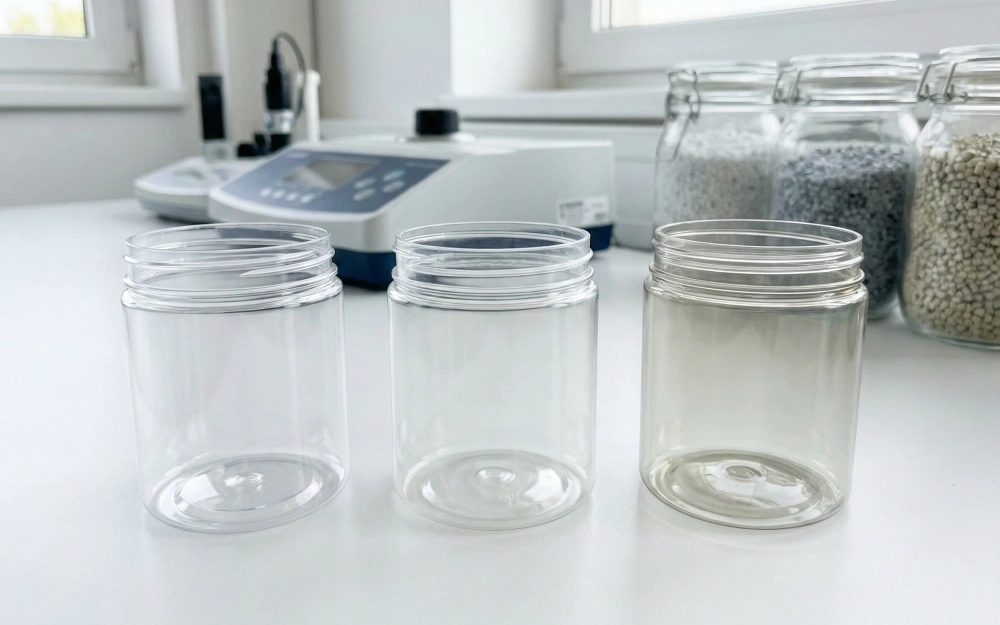
- Color Consistency: 100% recycled batches may exhibit a very slight yellow or grey tint compared to the blue-white clarity of virgin resin.
- Brittleness: Higher percentages of recycled content can sometimes lead to a more brittle structure, requiring adjustments in the thermoforming pressure.
- Supply Availability: The global demand for high-quality, food-grade PCR flakes often exceeds supply, making 100% rPET a premium-priced choice.
| Content Level | Common Use Case | Environmental Impact |
|---|---|---|
| 30% rPET | General retail produce | Tax compliance / Baseline |
| 50% rPET | Beverage bottles | Moderate CO2 reduction |
| 100% rPET | Premium eco-brands | Maximum circularity |
Key Takeaway: While 100% content is achievable, many high-volume distributors suggest a blended approach to maintain a balance between cost, aesthetics, and performance.
How is the recycled content in rPET packaging certified?
To prevent “greenwashing,” international regulatory bodies have established strict auditing processes to verify that a container actually contains the percentage of recycled material claimed on the label. This is a primary concern for those learning What is rPET Plastic? and how to source it reliably.
Chain of Custody (CoC) models
Certification is based on tracking the material from the moment a consumer drops a bottle into a recycling bin until it reaches your warehouse as a new tray.
- Identity Preserved: The highest level of tracking, where the recycled plastic is kept separate from virgin plastic throughout the entire factory.
- Mass Balance: A common industrial method where the total volume of recycled resin entering a factory is balanced against the total volume of rPET products leaving it.
- RecyClass & GRS: The Global Recycled Standard (GRS) provides third-party verification that the recycled content and social/environmental practices meet international norms.
Food safety and decontamination certificates
For B2B buyers in the food sector, the “recycled” claim is secondary to “food safe.” You must ensure your supplier holds valid decontamination certifications.
- EFSA (European Food Safety Authority): Validates that the recycling process removes 99.9% of potential contaminants.
- FDA (Food and Drug Administration): Issues “Letters of No Objection” (LNO) for specific recycling technologies used to create food-contact rPET.
- Migration Testing: Periodic laboratory tests that confirm no chemicals are leaching from the recycled plastic into the food product.
Key Takeaway: Never accept “recycled” claims without seeing GRS, EFSA, or FDA certification documents; these are the only guarantees of material truth and safety.
What is the reality of sourcing 100% rPET packaging?
Sourcing 100% recycled containers involves navigating a different set of supply chain dynamics compared to virgin plastic. The reality involves managing price volatility and ensuring that the physical properties of the pack don’t compromise your automated packing lines.
Price premiums and market volatility
The price of rPET is often “decoupled” from the price of oil. While virgin plastic prices drop when oil is cheap, rPET prices stay high because of the fixed costs of collection, sorting, and cleaning.
- Fixed Processing Costs: Cleaning post-consumer waste is labor and energy-intensive regardless of global oil markets.
- Demand Surges: As more multinational corporations pledge to use 100% recycled content, the competition for the same pool of high-quality flakes drives prices up.
Performance on the production line
If you are switching from virgin PET to 100% rPET, your operations team might need to recalibrate their equipment.
- Seal Integrity: Recycled sheets might have slightly different heat-sealing properties.
- Stacking Strength: High-recycled content trays may require slightly thicker walls to match the top-load strength of virgin alternatives.
- Tooling Adjustments: The way the plastic “flows” into the mold can vary, sometimes requiring minor tweaks to vacuum pressure or mold temperature.
| Sourcing Factor | Virgin PET | 100% rPET |
|---|---|---|
| Price Stability | Tied to oil prices | Tied to collection rates |
| Clarity | Crystal clear | Subtle tinting possible |
| Regulatory Risk | Potential future taxes | Exempt from plastic taxes |
Key Takeaway: Transitioning to 100% rPET requires a partnership with a manufacturer that has the technical 9-line capacity to adjust production parameters for recycled resins.
Reliancepak suggests consulting with our technical team to determine the optimal recycled content percentage for your specific food application. We provide the certification and manufacturing scale necessary to support your transition to 100% rPET packaging without compromising on safety or logistics efficiency.
Frequently Asked Questions
Is 100% rPET as strong as virgin plastic?
Yes, in most food packaging applications. While there is a slight molecular difference, modern 9-line extrusion technology allows manufacturers to produce 100% rPET trays that meet or exceed the performance requirements for retail stacking and transport.
Why do some rPET containers look slightly blue?
A blue tint is often added to the resin during the “super-cleaning” process. This masks the natural yellowing that occurs when plastic is heated and recycled multiple times, resulting in a cleaner, more premium look for the consumer.
Can rPET be recycled again?
Absolutely. rPET packaging is fully recyclable and can be put back into the recycling stream. However, after several cycles, the polymer may eventually need to be downcycled into non-food items like polyester fiber for clothing or strapping.
How does rPET content affect my export costs?
Many countries in the EU and elsewhere offer tax exemptions for packaging that contains high levels of recycled content. Sourcing 100% rPET can significantly lower your “landed cost” in these regions by avoiding environmental levies.
Can I mix different types of recycled plastic?
No. To maintain food-grade certification, rPET must not be mixed with other recycled polymers like HDPE or PP. The stream must remain pure PET to ensure the chemical safety and physical clarity of the final product.