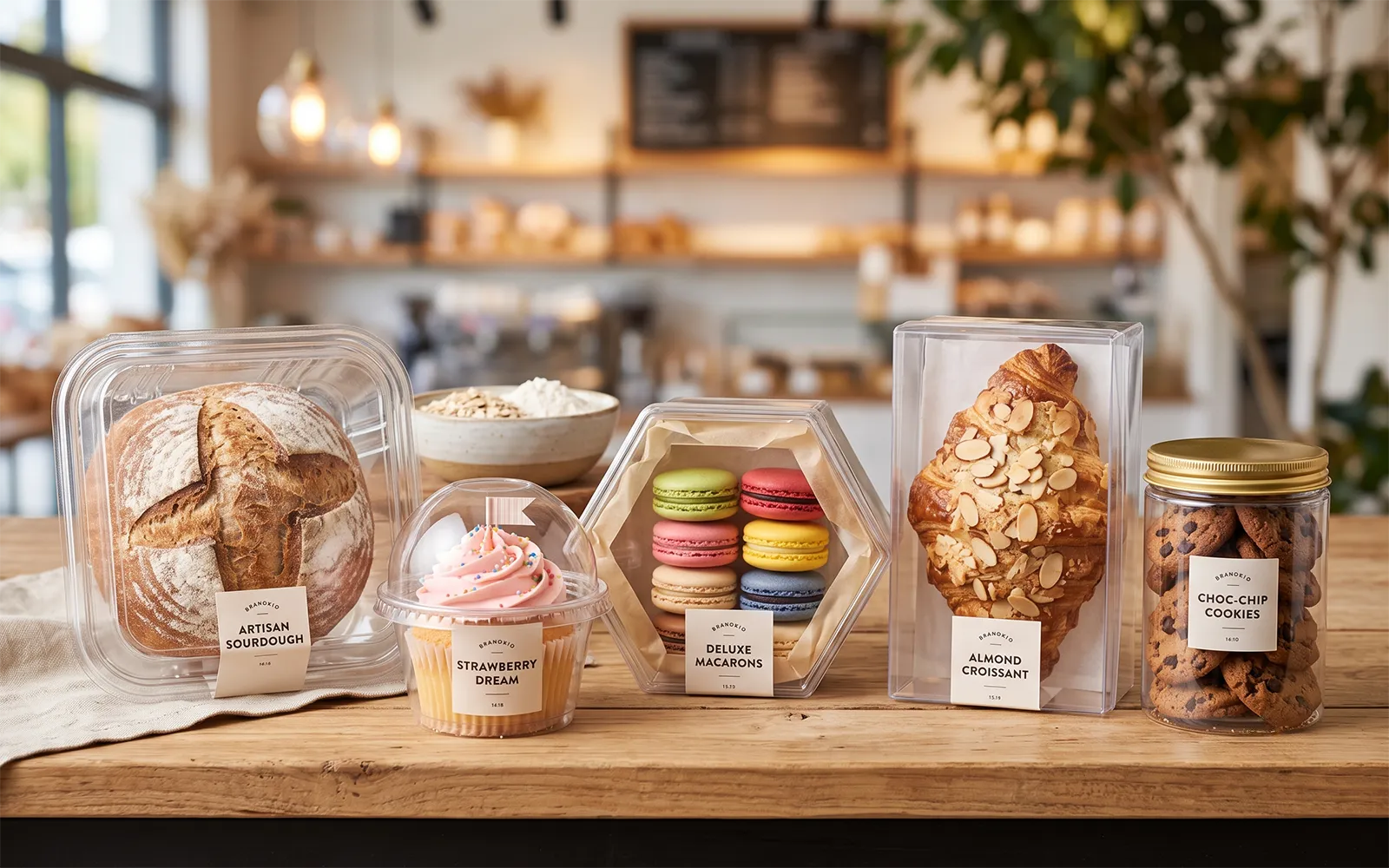
Walk through any bakery aisle and you will notice something: the packaging is doing far more than holding the product. It is preserving freshness, presenting the product for impulse purchase, surviving stacking and transport, and staying compliant with food safety regulations across multiple markets. PET (polyethylene terephthalate) has become the default material for bakery containers and clamshells because it manages these competing demands better than most alternatives.
This article covers the practical side of sourcing PET packaging solutions for bakery applications — the material science that matters, the design decisions that affect performance, and the procurement factors that impact your bottom line.
Why PET Dominates Bakery Packaging
PET brings a combination of properties that make it particularly well-suited to bakery use.
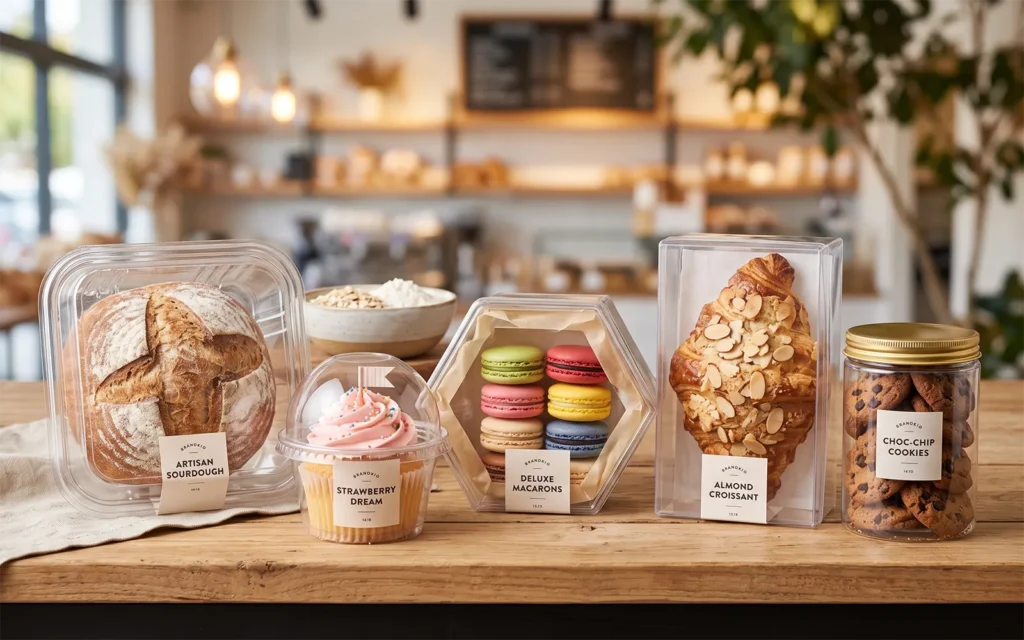
Optical clarity is the most obvious. In retail, customers buy with their eyes — a clear clamshell that shows the product directly drives conversion in a way that printed boxes or fogged plastics cannot. But clarity alone is not enough. PET also offers impact resistance that survives the handling of retail logistics without cracking, which is not something you can rely on with materials like polystyrene.
There is also the oil-and-grease factor. Baked goods — croissants, butter cakes, pastries — contain fats that can degrade lower-grade plastics over time. PET resists this chemical interaction well. Containers remain clear and structurally sound even when holding oil-based products for extended periods.
From a compliance standpoint, PET is well-established. It meets FDA and EU food-contact regulations, which matters if you are exporting to multiple regions. Your supplier should be able to provide documentation for both standards without pushback.
Clamshell Design: Engineering for Bakery Use
The clamshell format dominates retail bakery because it balances accessibility with protection. But the performance of a clamshell depends on engineering decisions that are easy to overlook.
Hinge Geometry and Durability
The hinge is the most stressed point in any clamshell design. It must survive repeated opening and closing — in some retail environments, dozens of cycles over the product’s shelf life — without cracking or losing its snap-shut functionality.
During thermoforming, the material thickness at the hinge line must be controlled precisely. Too thin, and the hinge fails in the field. Too thick, and the lid fights the user. Experienced thermoforming suppliers control this through mold design and temperature profiling. It is a detail that separates consistent-quality packaging from the rest.
Visibility and Anti-Fog Performance
Bakery is largely an impulse category. Cloudy packaging kills impulse sales.
The challenge is that warm bakery items release moisture after packing. Trapped against a cold PET surface, that moisture condenses into fog — turning a clear clamshell into an opaque one. Anti-fog coatings applied to the interior surface of the clamshell prevent this by breaking the surface tension of water droplets. It is an option worth discussing with your supplier, particularly if you pack items that are still warm.
Moisture Control and Freshness Management
This is where PET packaging requires some technical nuance for bakery applications.
Bakery products sit at the center of a moisture trade-off. You need to prevent moisture loss — that is what makes bread go stale and pastries turn tough. But seal the package too tightly, and trapped moisture creates condensation, which clouds the packaging and accelerates mold growth. PET’s moisture barrier properties can be tuned through material formulation and wall thickness to find the balance point for each product category.
| Product Type | Primary Risk | Typical PET Wall Thickness | Recommended Features |
|---|---|---|---|
| Breads and rolls | Staling from moisture loss | 0.30–0.40 mm | Standard seal, minimal venting |
| Pastries and croissants | Grease migration, drying | 0.35–0.50 mm | Small ventilation holes |
| Cakes and muffins | Condensation, mold | 0.40–0.55 mm | Anti-fog coating |
| Cookies and biscuits | Low moisture concern | 0.25–0.35 mm | Standard seal, thinner gauge |
These ranges are guidelines, not specifications. The right wall thickness for your application depends on product weight, distribution method, and required shelf life. A supplier with technical experience — rather than a catalog-only approach — will help you match material grade to actual product needs rather than offering a generic option.
For wholesale buyers managing multiple product lines, there is a legitimate operational trade-off here. Standardizing across a narrower range of wall thicknesses simplifies inventory and mold management, even if it means slightly over-engineering some packages. The material-cost increase is often smaller than the operational cost of managing ten different SKUs.
Logistics: Stackability and Shipping Efficiency
If you are buying bakery packaging in wholesale volumes, shipping economics matter as much as product appearance.
Stackable clamshell designs — where the lid and base nest together when closed — can reduce per-unit shipping volume by 15 to 30 percent compared to non-stackable alternatives. For full-container-load shipments, that difference translates into real freight savings.
Three logistics factors worth verifying with any potential supplier:
- Nesting ratio. How many empty clamshells fit per cubic meter? Higher ratios reduce return-logistics and warehousing costs.
- Stacking strength. Filled clamshells must support the weight of units stacked above them during palletized transport. PET’s stiffness gives it an advantage here over thinner bio-based or polypropylene alternatives.
- Temperature range. PET performs reliably across standard supply-chain temperatures, but if your distribution involves refrigerated transport or hot-fill scenarios, confirm the specific grade’s performance range with your supplier.
Selecting a PET Packaging Supplier for Bakery Products
For B2B buyers, the lowest unit price is rarely the lowest total cost. Supplier selection for PET bakery packaging comes down to a few practical factors.
Certifications are non-negotiable. If your products cross borders, your packaging supplier must provide FDA and EU food-contact compliance documentation. Without it, customs delays or compliance rejections become a real risk. Suppliers like Reliancepak provide food-grade PET packaging with international certifications — worth confirming this documentation is available before moving to production.
Customization capability matters. Bakery products come in non-standard shapes. A supplier with in-house thermoforming and mold development experience can produce clamshells that fit your specific products, reducing wasted void space and improving protection. Off-the-shelf molds can work for standard items, but custom tooling often pays for itself through reduced product damage.
MOQ and lead time alignment. PET clamshell tooling requires mold investment, and suppliers vary significantly in their minimum order quantities. Some suppliers with flexible production setups can accommodate smaller trial runs before scaling to full production. Reliancepak, with 9 production lines, offers the capacity to handle both pilot orders and high-volume wholesale commitments. Ask about current capacity utilization — a supplier running near full capacity may struggle with lead times during peak bakery seasons.
Frequently Asked Questions
What PET thickness works best for bakery clamshells?
0.30–0.50 mm covers most bakery applications. Thinner gauges suit dry goods like cookies. Heavier or moisture-sensitive items like layer cakes typically need 0.40–0.55 mm. Your product weight and distribution method determine the optimal range.
How do I prevent condensation inside clear PET bakery containers?
Condensation occurs when warm products release moisture inside a sealed container. Options include adding small ventilation holes, applying an anti-fog coating, or extending the cooling period before packing. Each approach has trade-offs between shelf life and visual clarity.
Are PET bakery clamshells recyclable?
Yes. PET is resin code #1 and is widely accepted in municipal recycling programs. For buyers with sustainability targets, PET offers better end-of-life recovery than multilayer or mixed-material packaging. Check local recycling infrastructure to confirm acceptance in your target markets.
What certifications should my PET packaging supplier have for export?
For US markets, require FDA food-contact compliance documentation. For EU markets, require EU Regulation 10/2011 compliance. Additional certifications such as BRC or ISO 9001 indicate stronger quality management systems. Always request documentation before production begins.
Can I get custom molds for non-standard bakery products?
Yes, but mold costs vary significantly based on complexity — typically from a few thousand to tens of thousands of dollars. The investment makes sense when volume is sufficient to amortize the tooling cost. Many suppliers also offer stock molds that can be adapted with minor modifications.