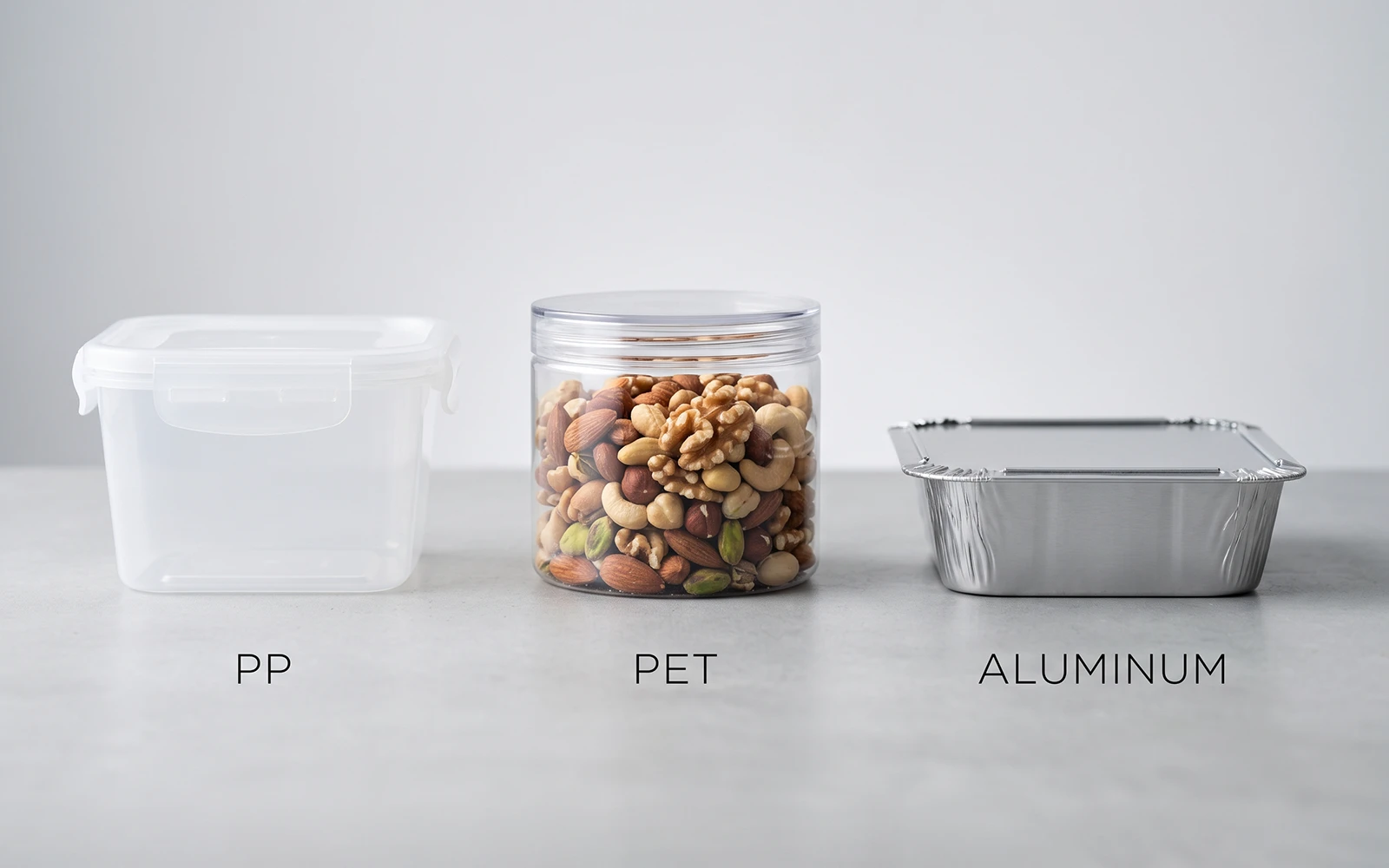
Material choice sets the ceiling on airtight performance before any seal is added. Polypropylene (PP), PET, and aluminum each cover a different band of the temperature, barrier, and cost range — so the right answer depends less on ranking materials against each other and more on what you are packing and how it travels.
This guide stays on that single decision: which material fits hot-fill, microwave, frozen, retail dry goods, and retort applications, and where each one fails. For the groundwork — how airtightness is measured in OTR and WVTR terms, and how gasket and induction seal systems actually deliver the barrier — the complete airtight packaging guide covers measurement, seals, and sourcing.
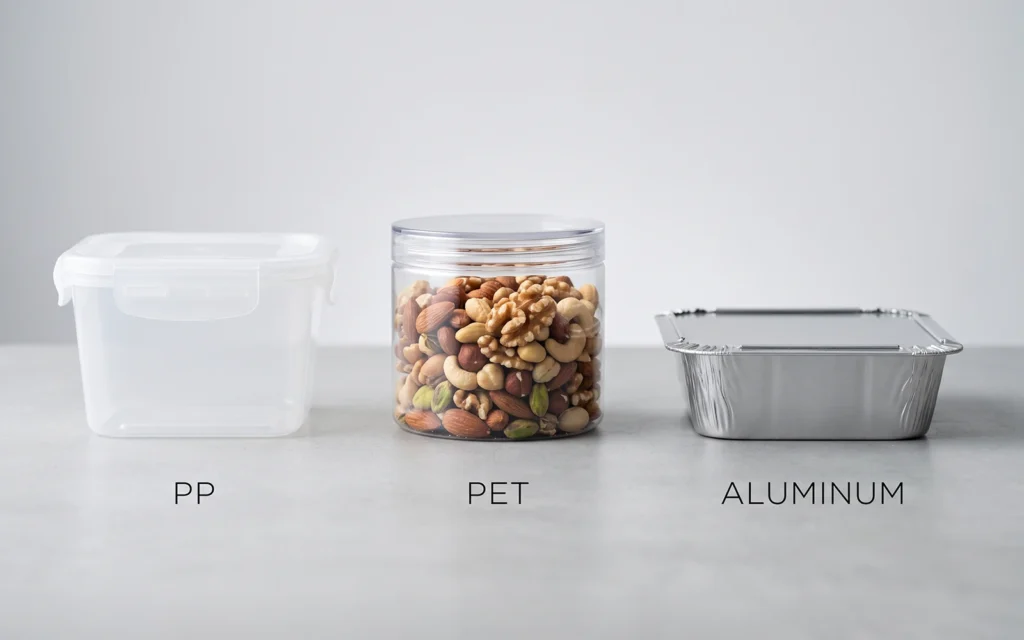
The Short Answer: Match Material to Food Category
If you only need a starting point for supplier conversations, this table covers most sourcing situations:
| Food Category | First-Choice Material | Reason |
| Hot-fill soups and sauces (fill temp above 70°C) | PP | Continuous service around 100–120°C; PET deforms well below 100°C |
| Microwave-reheat meal prep | PP | Microwave-safe body (lid removed); resists warping under heat |
| Frozen distribution below −18°C | PP or PP/EVOH | Stays flexible; PET grows brittle and cracks under impact |
| Retail nuts, snacks, coffee, powders | PET | OTR in the low single digits (cc/m²/day, 23°C); glass-like clarity |
| Chilled ready meals where visibility sells | PET | Clear walls with an adequate gas barrier at chilled temperatures |
| Retort, long-life, and light-sensitive oils | Aluminum | Absolute barrier to light, oxygen, and moisture; retort-capable |
Two rows in this table deserve a closer look, because they are the ones buyers get wrong most often: the frozen row and the hot-fill row.
PP: When Temperature Decides the Choice
Polypropylene is the workhorse for anything that touches heat on its way to the consumer. It withstands continuous service temperatures around 100–120°C, carries a melting point near 160°C, and shrugs off the oils and acids in sauces, curries, and marinades without leaching or degrading. It also stays flexible at deep-freeze temperatures, which is why frozen programs rarely quote anything else.
The trade-off is the wall itself: PP’s gas barrier is weaker than PET’s, often running in the tens of cc/m²/day depending on grade and thickness. An airtight PP format therefore depends on the closure, not the material — which makes the seal specification the part of your RFQ worth the most attention.
PET: When Shelf Life and Shelf Appeal Coincide
PET offers the strongest gas barrier among commodity plastics, with OTR values typically in the low single digits at 23°C. For oxygen-sensitive retail products — nuts, coffee, snack powders — that difference shows up directly in crispness and aroma retention over a multi-month shelf life.
Clarity is the second reason buyers pick it. Glass-like walls let consumers inspect product quality without breaking the seal, and the material carries high-clarity in-mold labeling well for premium SKUs.
The limitation is strictly thermal. PET deforms around 60–70°C, so it is excluded from hot-fill and microwave use, and it grows brittle in deep-freeze distribution — a dropped case at −18°C cracks more readily than the same case in PP. Within chilled and ambient dry goods, though, it is usually the correct answer.
Aluminum: When Nothing Less Than a Full Barrier Works
Aluminum blocks light, oxygen, and moisture completely, and it survives retort sterilization. The opaque wall also protects fat-rich products from light-induced rancidity — a failure mode no clear plastic can address. It is fully recyclable, which carries weight with European retail buyers.
What limits its use is price. Aluminum is priced accordingly, which is why it dominates airline catering trays, retort lidding, and premium meal-prep formats rather than general wholesale containers. For an ambient dry good with a normal shelf-life claim, it is usually paying for barrier you do not need.
Pair the Material With the Right Seal
A stronger material does not compensate for a weak closure. A PP container with a properly specified gasket or induction foil liner will outperform a high-barrier wall closed with a loose snap lid, because oxygen leaks through the seal zone far faster than through any of these material walls. Treat material and seal as two separate line items in your RFQ, and verify both against your actual filling line before committing to volume.
FAQ
Is PET or PP better for long-term snack storage?
PET, in most cases. Its lower oxygen transmission rate keeps nuts and snacks crisp longer than PP can. The exceptions are thermal: if the snacks are hot-filled, microwaved, or stored deep-frozen, PP takes over.
Can PET containers be used for hot-fill products?
No. PET deforms at roughly 60–70°C and will lose seal integrity during filling. Use PP for hot-fill up to about 100–120°C, or aluminum where retort processing is involved.
Which material should I use for frozen meal distribution?
PP, or a PP/EVOH barrier structure if you need added oxygen protection. PET grows brittle below −18°C and cracks under impact, while PP stays flexible across the deep-freeze range.
Is aluminum worth the higher unit price?
Only when you need what plastics cannot deliver: a light barrier for fat-rich products, retort capability, or maximum shelf life for premium positioning. For standard ambient dry goods, it is usually over-engineering.
Does the material alone determine airtight performance?
No. The seal system does most of the work, and real performance should be backed by OTR and WVTR test values with stated methods rather than adjectives. That measurement and testing framework is laid out in the airtight packaging guide.