
An air tight container is defined by its ability to maintain a hermetic seal, preventing the ingress of oxygen and moisture through specialized mechanical or material barriers. Unlike standard storage, an air tight container utilizes specific engineering principles—such as compression force and gasket deformation—to ensure the internal atmosphere remains isolated from external environmental fluctuations.
You are likely managing a high-volume food distribution or processing operation where even a minor seal failure leads to significant financial loss. When your customers report stale snacks or spoiled produce, the culprit is often a misunderstanding of sealing mechanics rather than the plastic material itself. This guide breaks down the technical sealing methods that ensure your bulk packaging investments actually deliver the shelf-life protection your brand promises.
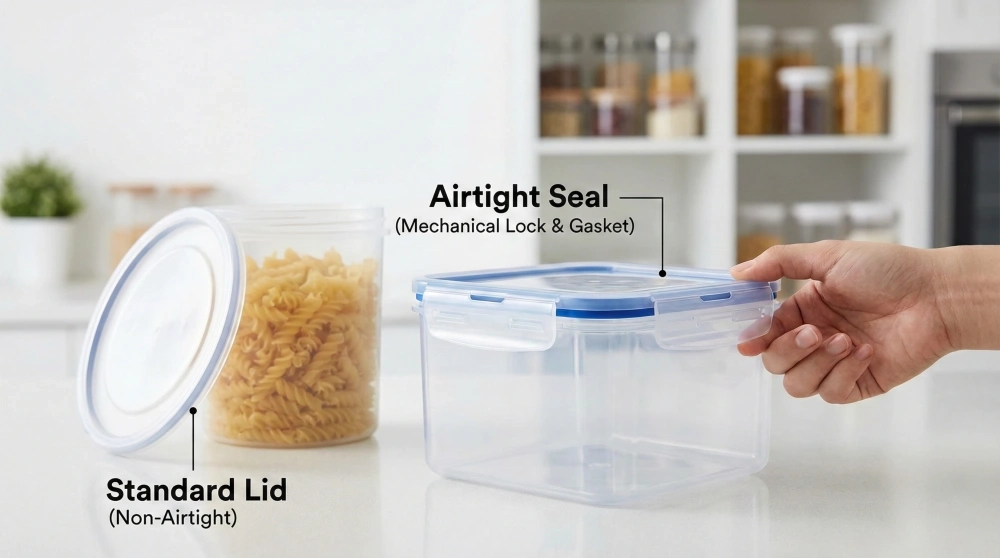
How Do Mechanical Locking Systems Create a Seal?
Mechanical locking systems create an air tight container environment by applying consistent, downward pressure onto a sealing surface to eliminate microscopic gaps. These systems rely on physical force to compress a flexible barrier, ensuring that the lid and base function as a single, impenetrable unit.
Here’s the deal. A simple snap-on lid relies on friction, which can fail under temperature changes, whereas a mechanical lock ensures the seal remains intact during the rigors of global shipping.
Multi-Hinge Latches
Latches located on all four sides of a lid provide the most uniform distribution of pressure across the perimeter.
- Distributes force evenly to prevent lid warping
- Ensures the gasket is compressed to its optimal thickness
- Provides a tactile and audible confirmation of a secure seal
Threaded Twist-Locks
Threaded systems utilize the mechanical advantage of a screw to generate high compression levels between the lid and the rim.
- Ideal for round containers carrying powders or fine grains
- Resistant to internal pressure buildup from temperature fluctuations
- Minimizes the risk of accidental opening during palletized transport
| Locking Type | Pressure Uniformity | Primary Application |
| 4-Hinge Latch | High | Rectangular Meal Prep |
| Twist-Lock | Very High | Dry Bulk Storage |
| Snap-Fit | Moderate | Short-term Deli Trays |
Key Takeaway: Mechanical locks are the preferred choice for B2B buyers who require reusable or high-durability packaging that maintains airtight integrity across multiple uses.
Why Is Gasket Technology Vital for Airtightness?
Gasket technology acts as the interface that compensates for the natural imperfections and rigidity of plastic in an air tight container. By using a soft, elastomeric material between two hard surfaces, the gasket fills every void, creating a molecular-level barrier against gas exchange.
You might suggest that any rubber-like ring works, but the chemical composition of the gasket determines whether it stays airtight or becomes brittle over time.
Silicone vs. TPE Gaskets
The choice between Silicone and Thermoplastic Elastomers (TPE) depends on your specific food processing temperatures and budget.
- Silicone offers superior thermal stability for hot-fill applications
- TPE can be over-molded directly onto the lid to prevent gasket loss
- Both materials must meet EU and FDA food-grade certifications for safety
Hollow-Core Engineering
Modern high-performance seals often utilize a hollow-core design rather than a solid strip.
- Requires less force to achieve a complete seal
- Adapts better to slight manufacturing tolerances in the container body
- Maintains elasticity longer than solid gaskets under constant compression
| Gasket Material | Temperature Range | Durability Level |
| Silicone | -40°C to 230°C | Premium / Long-term |
| TPE | -20°C to 100°C | Standard / Industrial |
| Foam | Limited | Disposable / Low-cost |
One simple analysis shows that gasket failure is the leading cause of “leaky” airtight containers in wholesale environments.
Key Takeaway: Investing in high-quality gasket materials like silicone is essential for maintaining food safety standards and reducing customer returns due to spoilage.
Can Single-Use Packaging Achieve True Airtightness?
Single-use packaging achieves an air tight container status through induction or heat sealing, which fuses a barrier film directly to the container’s rim. This method provides a tamper-evident, hermetic seal that is unmatched for long-term retail shelf stability.
The real secret is that while latched lids are convenient, a fused foil or film seal provides the lowest possible Oxygen Transmission Rate (OTR).
Induction Sealing Methods
Induction sealing uses electromagnetic heat to bond a foil liner to the mouth of a plastic container without direct contact.
- Creates a 100% barrier against moisture and oxygen
- Prevents leaks during the high-vibration environment of sea freight
- Acts as a primary security feature for wholesale food processing
Heat-Sealing Films
Heat sealing involves applying direct heat to a plastic film, melting it onto the tray’s flange for a permanent bond.
- Commonly used for CPET and PP trays in ready-meal industries
- Allows for Modified Atmosphere Packaging (MAP) to extend shelf life
- Highly cost-effective for 9-line high-speed production environments
| Sealing Method | Barrier Level | B2B Benefit |
| Induction Foil | Absolute | Leak-proof & Tamper-evident |
| Heat Seal Film | High | MAP Compatible / Low Cost |
| Friction Fit | Low | Easy Access / No Machinery |
This technical approach ensures that products remain factory-fresh until the very moment they are opened by the end-user.
Key Takeaway: For long-distance export to regions like Europe or the US, induction or heat sealing provides the highest level of atmospheric security for sensitive food products.
Securing Your Supply Chain with Reliable Sealing Solutions
Selecting the right air tight container is a strategic decision that impacts the entire lifecycle of your food product. From the precision of mechanical latches to the material science of silicone gaskets, every component must work in harmony to prevent oxidation and moisture damage. Reliancepak combines factory-integrated manufacturing with professional customization to ensure your packaging meets EU and FDA standards while maximizing shelf life.
We suggest you test our sealing performance with free samples to find the perfect fit for your specific food processing needs.
Reliancepak is committed to delivering reliable, food-grade packaging that empowers global distributors to scale with confidence and quality.
FAQ
Can I get a custom color for the silicone gaskets?
Yes. As a factory-integrated provider, Reliancepak offers professional customization for gaskets to match your brand identity while maintaining food-grade compliance.
How do I know if a seal is EU/FDA certified?
You should request official laboratory migration test reports and certificates of compliance from your supplier to ensure the sealing materials are safe for direct food contact.
Does a leak-proof seal always mean the container is airtight?
No. While a leak-proof seal stops liquids, gas molecules like oxygen are much smaller and can still penetrate a seal that is not specifically engineered to be airtight.
What is the lead time for mass-produced airtight containers?
Reliancepak offers fast delivery due to our 9 production lines, typically satisfying wholesale orders for major markets like Malaysia, Spain, or the US within standard industry windows.
Can these sealing methods withstand high-altitude shipping?
Yes, but you must choose a container with a flexible gasket or a pressure-resistant mechanical lock to handle the atmospheric pressure changes during air or mountain transport.