
Most airtight failures are not traced back to the plastic. They happen at the closure, where two molded surfaces are meant to meet under load and stay that way through filling, stacking, sea freight, and — on reusable formats — hundreds of wash cycles. This article covers the three industrial routes to airtight performance: mechanical locks, compression gaskets, and fused induction or heat seals. For the measured side of the same subject — barrier test values, compliance documents, and commercial terms — see the complete airtight packaging guide to materials, testing, and sourcing.
Where Airtight Seals Fail First
Most field complaints trace to one of three mechanisms, and none of them involve the container wall.
- Compression loss. An elastomer under constant load takes a permanent set; contact pressure at the rim drops and gas exchange resumes.
- Geometry drift. Hot filling or a stack load warps the rim by fractions of a millimeter — enough to open a gap the gasket can no longer bridge.
- Bond failure. On fused seals, an oil film or powder dust keeps the seal layer from wetting out against the container.
Each mechanism points to a different fix: a firmer gasket, a wider rim flange, or a change in filling sequence.
Mechanical Locks: Converting Hand Force into Even Compression
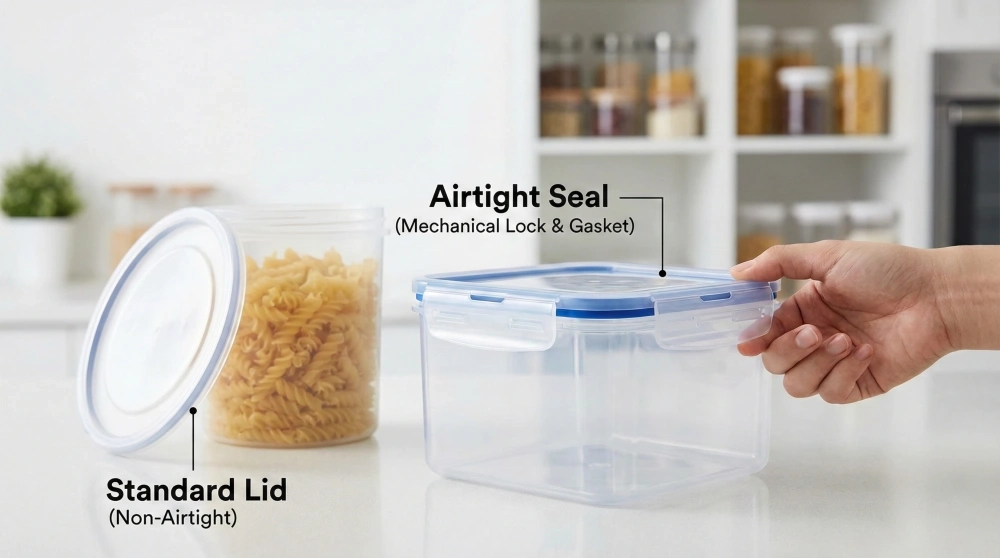
A lock holds the gasket in compression at a predictable value from corner to corner, and keeps holding it after the container is dropped, stacked, and re-closed. That target is normally written as a proportion of gasket thickness rather than “as tight as possible,” since over-compression flattens an elastomer and hastens the permanent set that ends a seal’s service life.
Four-hinge latch
Latches on all four sides spread load along the full perimeter, which is why the geometry dominates rectangular formats. Even pressure keeps the gasket near its target compression instead of over-squeezing the corners and starving the long edges.
Twist-lock thread
A thread trades speed for mechanical advantage, converting modest hand torque into high, repeatable compression. It suits round containers of powders, grains, and liquids. The weak point is cross-threading on manual lines: a lid seated half a turn off feels tight and still leaks.
Snap-lock rim
Retention force comes from interference between lid skirt and rim bead, so gasket compression is a by-product of lid geometry rather than something you can dial up without retooling. Treat snap-fit as a short-haul format.
| Lock architecture | Compression uniformity | Best-fit format | Re-closure durability |
| Four-hinge latch | High, along the full perimeter | Rectangular bulk and meal-prep formats | Hundreds of cycles |
| Twist-lock thread | High, concentrated at the thread | Round dry bulk, powders, liquids | Hundreds of cycles |
| Snap-lock rim | Set by lid geometry, not adjustable | Short-haul trays, same-day service | Limited by fatigue at the bead |
Gasket Materials and Cross-Section
The gasket is where container tolerance gets absorbed, and two inputs narrow the choice more than any other: the fill temperature and the wash regime. What remains to decide is material and cross-section.
Silicone
Silicone holds elasticity from roughly −40°C to 200°C and tolerates repeated wash cycles without hardening, which is why it is the default for reusable totes and cold-chain containers. It costs more per part and is harder to over-mold reliably, so it usually arrives as a separate ring an operator has to seat.
TPE over-molding
Bonding the seal directly to the lid removes two familiar assembly failures: a gasket that falls out during washing, and one refitted the wrong way round. Unit cost drops at volume, and the trade-off is a narrower thermal window than silicone’s. On chilled and ambient lines, that trade is often worth taking.
Hollow-core geometry
A hollow profile compresses at lower force than a solid strip of the same footprint, because it deflects inward as well as downward. That allows a lighter lid, a lighter latch, and more tolerance for rim warp — the hollow gasket keeps contact pressure on a base that has shifted after hot filling or pallet stacking.
Induction and Heat Sealing: Bonded, Not Compressed
Compression seals are removable by design. Fused seals are not, and that is the point: the barrier becomes part of the package rather than a joint between two parts.
Induction foil liners. An aluminum foil disc backed with a polymer layer sits inside the cap. Passing under an induction coil, the foil heats, the polymer melts, and the liner welds to the rim; the seal is tamper-evident until the consumer peels it. The constraint is matching — foil grade, rim geometry, and sealing-head power have to be qualified together, or you get a closure that looks bonded and fails a vacuum decay check.
Heat-sealed films. Direct-contact sealing melts a film onto a tray flange, which is how CPET and PP ready-meal trays are closed. Because tooling controls temperature, pressure, and dwell, the route is compatible with modified atmosphere packaging and runs inline. The dominant failure input is contamination: sauce or protein on the flange breaks the bond locally, and the leak surfaces weeks later as a rejected pallet.
Each system trades closure force, reusability, and line complexity differently.
| Seal system | How the barrier forms | Reuse profile | Line requirement |
| Silicone compression gasket | Elastomer held in compression by a latch, thread, or rim | Reusable, hundreds of cycles | None; manual or semi-automatic closing |
| Over-molded TPE seal | Bonded elastomer compressed by the same lid mechanism | Reusable to semi-reusable, shorter service window than silicone | None; suited to high-volume filling |
| Induction foil liner | Polymer layer welded to the rim by eddy current in the foil | Single-use, destroyed on opening | Induction sealer matched to rim and liner |
| Heat-seal film | Film melted onto the tray flange under controlled temperature, pressure, and dwell | Single-use | Inline tray sealer; MAP-capable |
Sealing Support for Export Programs
Reliancepak runs integrated manufacturing with multiple food-grade production lines, which shortens the loop between a line-trial result and a mold or process adjustment. Gasket material, lock geometry, and tooling can be specified as one system rather than sourced from three suppliers and reconciled on the filling line — send a fill weight, target shelf life, and destination market, and samples come back matched to the closure type and gasket you specify.
FAQ
Does a container need a gasket to be airtight?
Not always, but anything with a multi-week shelf-life claim usually does. A precisely molded lid can create an interference fit that blocks dust and slows moisture movement, yet molded plastic does not conform to a mating surface the way an elastomer does.
Why does an airtight container stop sealing after repeated washing?
Compression set. Heat, detergent, and constant load remove an elastomer’s ability to spring back, so contact pressure falls below what the lid geometry assumes. Mineral deposits on the gasket and warp from hot wash cycles drive the same outcome faster.
Is silicone always the better gasket choice?
No. Silicone wins on thermal range and wash durability, which matters for reusable and cold-chain formats. On chilled or ambient single-use lines, over-molded TPE usually performs adequately at a lower unit cost and removes a manual assembly step.
Can induction sealing work with a screw-cap or twist-lock container?
Yes. Induction liners are standard with threaded caps on jars and bottles holding sauces, powders, and oils. The condition is dimensional: the rim needs a flat, uninterrupted sealing surface, and liner diameter and foil grade must match both cap and sealer.
Why does a hollow-core gasket seal with less force?
Because the profile flexes inward as well as compressing vertically, so the same closure force produces more deflection in the sealing zone. That lowers the torque or latch effort required and keeps the gasket in contact once the base has warped slightly.