
Thermoforming is a specialized manufacturing process where recycled polyethylene terephthalate (rPET) sheets are heated to a pliable temperature and formed into specific shapes using a mold. This technique is the primary method for producing clear, rigid containers such as deli trays, clamshells, and lids, offering a balance of structural integrity and environmental sustainability for the food industry.
Navigating the transition from virgin plastics to recycled alternatives often presents technical challenges regarding material consistency and clarity. You might face concerns about whether recycled sheets can withstand high-speed production lines or meet the aesthetic demands of premium food brands. This guide provides a technical overview of how advanced molding techniques optimize the performance of recycled resins, ensuring your transition to sustainable packaging is both efficient and reliable.
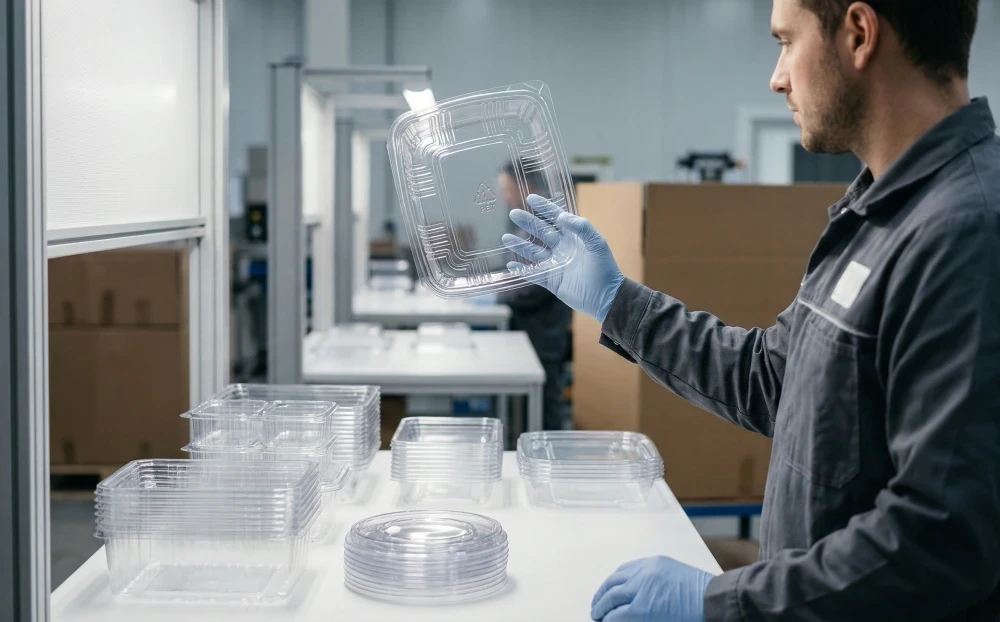
How does thermoforming transform rPET into food containers?
Thermoforming transforms rPET by subjecting extruded plastic sheets to a controlled thermal cycle followed by mechanical or vacuum-assisted shaping. Unlike injection molding, which uses molten resin, this process works with solid-state sheets, making it ideal for large-surface-area items with thin walls, such as produce punnets and bakery trays.
The stages of the molding cycle
Here’s the deal. The success of the process depends on precise temperature control to prevent the polymer from becoming too brittle or too fluid.
- Heating: The rPET sheet passes through infrared or ceramic heaters until it reaches its softening point.
- Forming: Pressure or vacuum forces the softened sheet against a precision-machined mold to capture the desired geometry.
- Trimming: Excess material is cut away from the finished part; notably, in closed-loop systems, this “skeletal waste” is immediately reground and fed back into the extrusion process.
| Stage | Technical Requirement | Impact on Quality |
| Pre-heating | Uniform heat distribution | Prevents localized thinning |
| Mold Cooling | Rapid heat transfer | Ensures dimensional stability |
| Plug Assist | Mechanical stretching | Controls wall thickness distribution |
By maintaining tight tolerances during these stages, manufacturers can produce high-clarity containers that perform identically to those made from virgin materials.
Key Takeaway: The efficiency of this molding process allows for high-volume production of lightweight containers, significantly reducing material usage while maintaining food-grade safety standards.
Why is rPET preferred for thermoformed food trays?
The preference for rPET in these applications stems from its exceptional gas barrier properties and its ability to maintain high transparency even after multiple recycling loops. When evaluating the circular economy for plastic containers, it becomes clear that this material offers the most mature infrastructure for collection and reprocessing available today.
Material performance advantages
The reality is that food processors require packaging that protects the product while remaining cost-effective and visually appealing.
- Clarity and Gloss: It provides a “crystal-clear” view of the food, which is essential for consumer trust in the retail sector.
- Impact Resistance: The material is inherently tough, preventing cracks during transportation or when stacked on refrigerated shelves.
- Chemical Inertness: It does not react with oils or acidic foods, ensuring that the flavor profile of the contents remains unchanged.
| Property | rPET Performance | Benefit to Food Factory |
| Oxygen Barrier | High | Extends product shelf life |
| Moisture Barrier | Excellent | Prevents dehydration of fresh produce |
| Heat Resistance | Up to 70°C | Suitable for cold and ambient fill |
Utilizing recycled sheets for these applications helps reduce the carbon footprint of the final product without sacrificing the protective functions required for perishable goods.
Key Takeaway: Choosing recycled resins for rigid trays allows companies to meet sustainability targets while benefiting from a material that is technically superior in barrier protection.
What are the technical challenges of molding recycled PET?
Molding recycled PET requires more rigorous process control than virgin resin due to potential variations in the material’s intrinsic viscosity (IV) and moisture content. If these variables are not managed, the resulting containers may suffer from uneven thickness, “orange peel” textures, or reduced structural strength.
Overcoming process variability
It gets better. Modern machinery has evolved to handle the specific nuances of post-consumer resins.
- Moisture Control: rPET is hygroscopic; therefore, the sheets must be properly dried or processed in vented extruders to prevent hydrolysis, which weakens the polymer.
- IV Stabilization: Advanced systems monitor the “melt flow” in real-time to adjust heating parameters, compensating for any fluctuations in the recycled feedstock.
- Contamination Filtering: High-finesse melt filtration during the extrusion of the sheet ensures that the final thermoformed part is free from aesthetic defects or structural weak points.
| Challenge | Cause | Solution |
| Web Sag | Overheating recycled sheets | Precision IR sensor monitoring |
| Brittleness | Low Intrinsic Viscosity | Solid-state polycondensation (SSP) |
| Haze | Improper cooling rates | Optimized water-cooled mold cycles |
Addressing these technical hurdles through advanced engineering ensures that the final packaging meets the strict compliance standards required by international food safety authorities.
Key Takeaway: Technical success in recycling depends on sophisticated monitoring equipment that can adapt to the natural variations found in post-consumer materials.
The integration of recycled resins into high-speed molding processes represents a significant milestone in sustainable manufacturing. By mastering the technical requirements of this material, the food industry can move toward a more resilient and environmentally responsible supply chain.
FAQ
Is thermoformed rPET safe for direct food contact?
Yes. When the material undergoes professional decontamination and extrusion, it receives certification from bodies like the FDA or EFSA, confirming it is safe for direct contact with food.
How much recycled content can be used in a tray?
Many modern containers use 100% recycled content. However, some designs utilize a “ABA” structure where the recycled layer is sandwiched between two thin layers of virgin or highly purified PET.
Can these containers be recycled again?
Yes. One of the greatest strengths of this material is that it is fully recyclable. Thermoformed trays can be collected and re-processed into new sheets or fibers.
Does the recycling process change the color of the plastic?
While a slight blue or grey tint may occur after many cycles, advanced filtration and the use of “optical brighteners” allow manufacturers to maintain a high degree of transparency.
Is thermoforming more efficient than injection molding?
For thin-walled food containers like salad bowls and lids, it is generally faster and more cost-effective because it allows for multi-cavity production from a single continuous sheet.