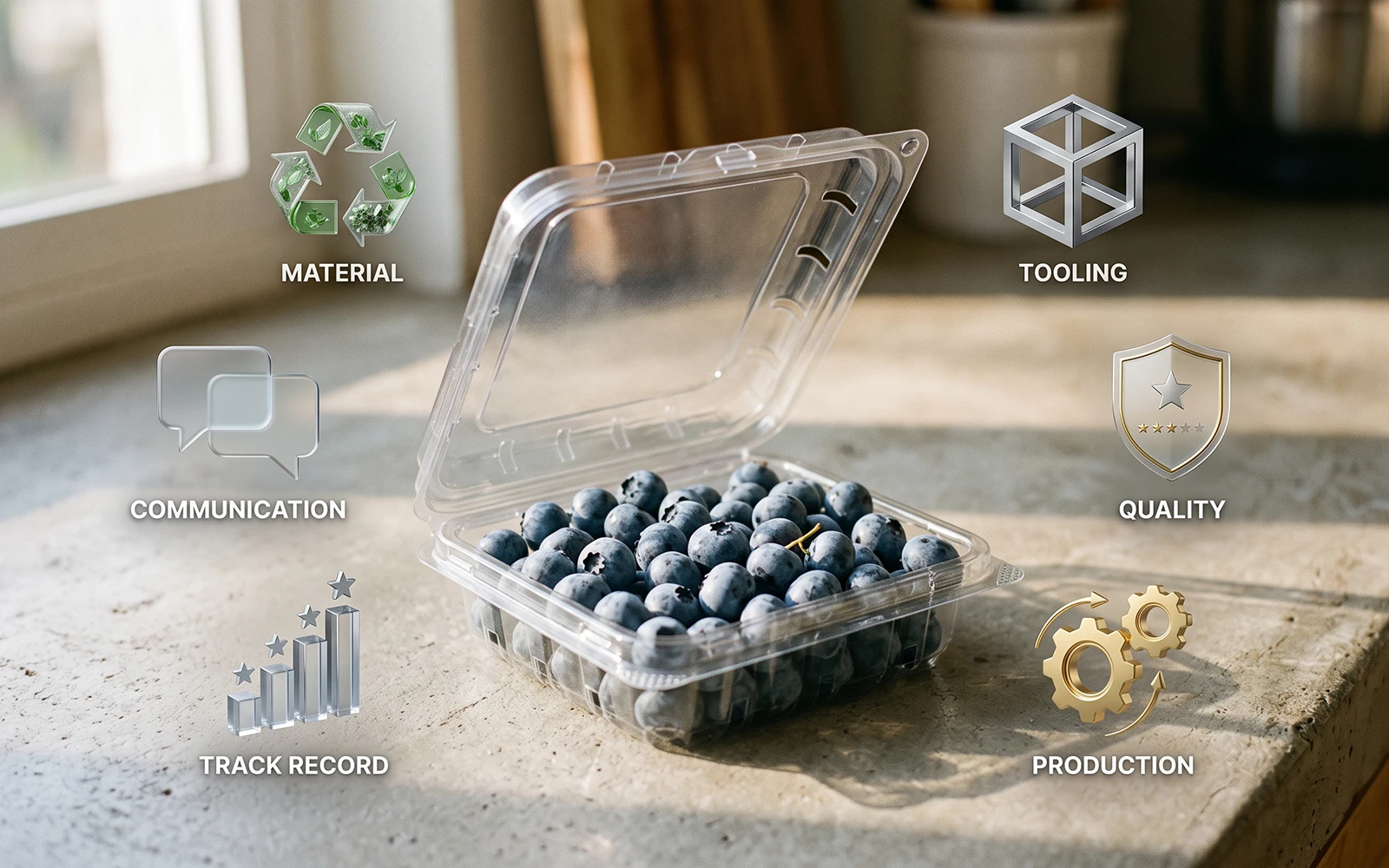

Buying clamshell packaging wholesale is less about picking a shape and more about aligning material, tooling, and freight with how your product actually moves through retail. When those three line up, reorders run quietly. When one falls out of step, you absorb the cost in cracked hinges, rejected pallets, or a container that lands after the season has already started.
This guide covers the checks that matter before you commit to a bulk order of food-grade clamshells.
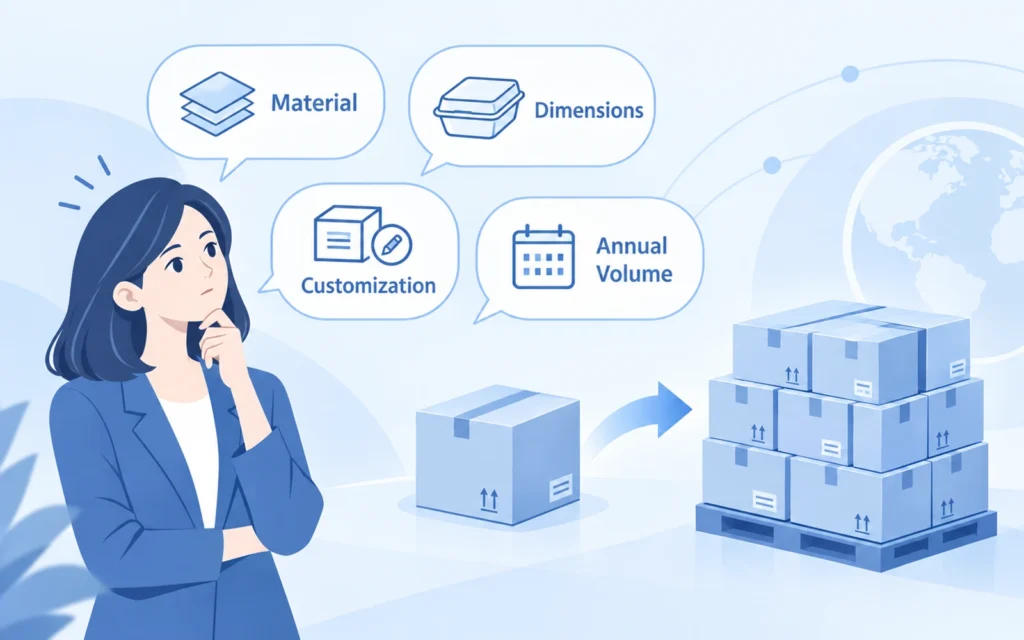
Start With the Product, Not the Price List
Suppliers quote faster when your specification is complete. A fill weight and a product photo rarely cover it. Document the product temperature at the moment of packing, the load the container carries when stacked on a shelf, and the sales channel, because a clamshell built for refrigerated berries behaves differently from one holding warm bakery items.
Specifications Worth Locking Before You Request a Quote
- Outer dimensions and cavity depth — include flange width, since it affects lid closure and any sealing step.
- Resin and recycled content — state whether you need virgin PET, RPET, PLA, or PVC, and what recycled percentage your label claim requires.
- Ventilation or barrier needs — fresh produce usually needs airflow; greasy or moist foods often need the opposite.
- Printing and labeling — direct print, applied labels, or a plain lid with a sleeve.
- Annual volume and order pattern — one large release versus monthly draws changes the tooling conversation entirely.
Material Selection Sets the Rest of the Order
Resin choice drives clarity, heat behavior, and the recycling message printed on your pack. It also decides whether your existing lidding or sealing line still runs without adjustment.
| Material | Clarity | Heat behavior | Typical food use | Buyer consideration |
|---|---|---|---|---|
| PET | High, glass-like | Moderate; can distort under sustained heat | Cold foods, produce, bakery | Strong all-rounder for retail display |
| RPET | Slightly lower than virgin PET | Similar to PET | Same categories, sustainability-led lines | Confirm recycled content documentation |
| PLA | Good | Softens at lower temperatures than PET | Short-shelf-life cold items | Composting claims depend on local infrastructure |
| PVC | Good | Better dimensional stability in some formats | Deli, confectionery | Facing restrictions in several markets |
Specifications vary by supplier and by market regulation, so treat the table as a working framework rather than a fixed datasheet. Ask for the resin grade and any migration test reports before you approve artwork.
Tooling, MOQ, and Lead Time Realities
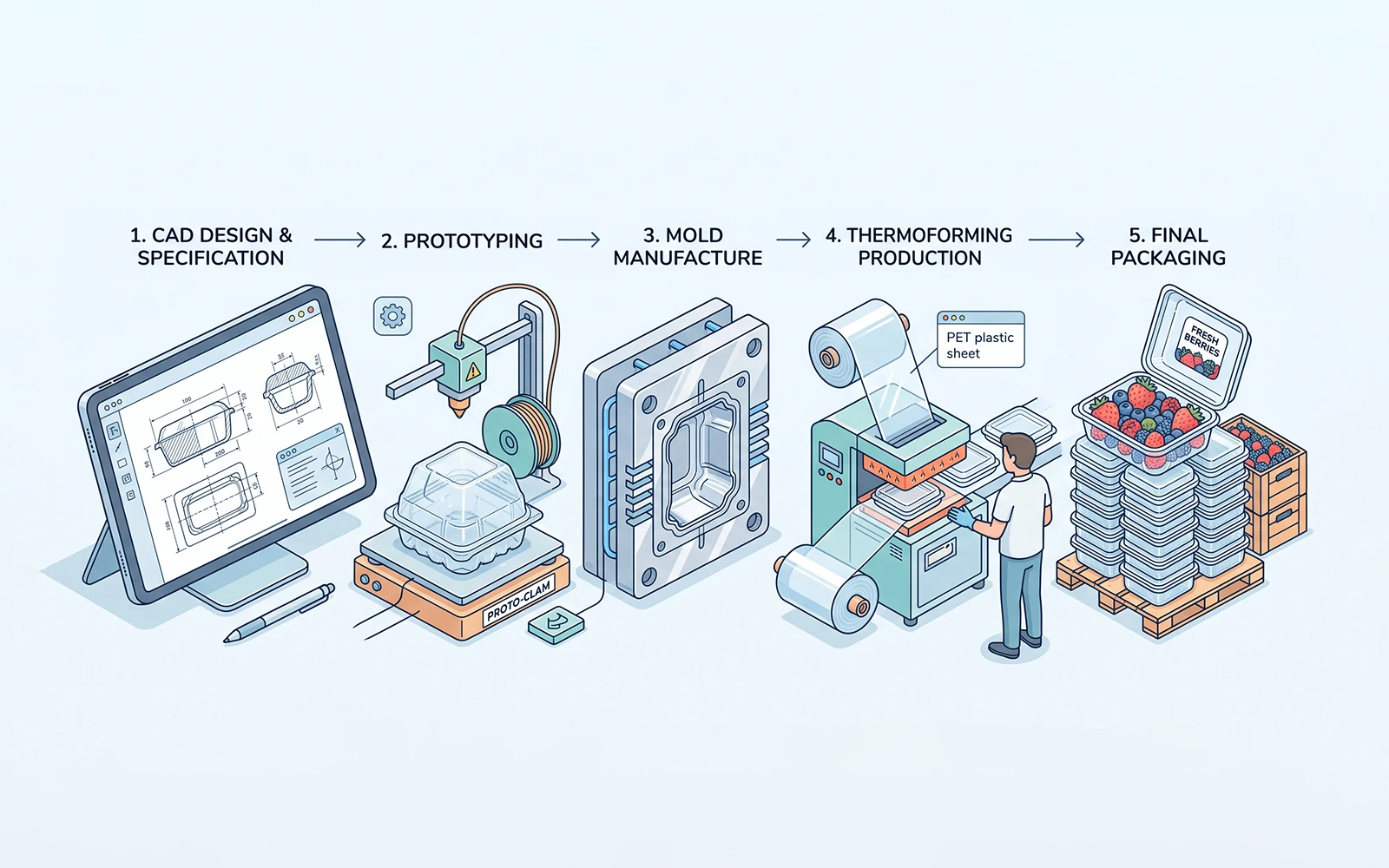
Wholesale buyers normally choose between two paths: an existing stock mold, or a custom tool built to your dimensions.
Stock molds carry lower upfront cost and shorter lead times, but you accept the cavity the supplier already runs. Custom tooling delivers the fit you want, usually with a higher minimum order quantity to justify the build. Mold cost and lead time both depend on cavity count and complexity, so ask for them as separate line items instead of one blended price.
- Confirm whether tooling is a one-time charge and who holds ownership of the mold.
- Ask how MOQ applies to mixed-size orders placed in the same material.
- Request a production schedule, not only a lead time, so you can see where your run sits.
Freight Performance Is a Packaging Decision
Clamshells are bulky by nature, and nesting ratio is the figure that decides container utilization. A shell designed to nest deeply can lower freight cost per unit considerably compared with a shallow-nesting alternative.
Carton compression strength matters too. Stacked pallets in a humid warehouse lose rigidity, and thin-wall clamshells near the bottom of a load may deform before they reach a shelf. Ask how the supplier packs, which carton grade they use, and whether they can provide a pallet pattern drawing.
Vetting a Wholesale Supplier
Sample quality and production quality are not always the same thing. Request samples pulled from a production run rather than a hand-finished prototype, and ask which resin grade that sample used.
For food-contact packaging, look for documented compliance with the rules your destination market enforces, such as FDA requirements in the United States or EU food-contact regulations. Reliancepak supplies plastic trays, disposable food containers, and eco-friendly packaging on a B2B wholesale basis, with free samples, custom OEM/ODM work, and food-grade materials produced across nine production lines. Buyers hunting specialized or hard-to-find items often pair them with standard stock to keep supplier count down.
FAQ
What is the typical minimum order quantity for clamshell packaging wholesale?
Most suppliers set MOQs per size and per material rather than per purchase order, so a mixed order can still clear the threshold when each line meets its own minimum. Ask for the MOQ in writing before you commit to sampling.
Can I order custom clamshells built to my own dimensions?
Yes. Custom tooling is standard practice in wholesale, though it typically adds a one-time mold cost and extends lead time. Stock molds stay the faster route when your dimensions sit close to an existing size.
Are clamshell containers food-safe by default?
No. Food safety depends on the specific resin grade and the additives used, not on the shape of the container. Request migration test documentation and confirm compliance with your destination market’s regulations.
How do I reduce damage during bulk shipping?
Three steps cover most of it:
- Confirm nesting ratio and carton grade before production starts.
- Request a pallet pattern drawing and review stack height.
- Run a trial shipment on the first order before scaling volume.
Does recycled content affect performance?
It depends on the grade. RPET performs close to virgin PET in many food applications, though clarity and color consistency can shift slightly. Confirm the recycled percentage and its documentation before finalizing label claims.