
For strategic procurement officers, the transition from virgin plastics to recycled alternatives is not merely a sustainability pledge; it is a complex logistical and technical migration. As global regulations tighten and consumer demand for circularity grows, selecting a reliable partner for high-volume supply requires a rigorous auditing process that spans material science, factory capacity, and international compliance.
Navigating the volatile recycled resin market demands more than just price comparisons. You must ensure that your supplier can maintain a consistent gauge, molecular purity, and structural integrity across thousands of shipping units. This guide outlines the professional criteria used to evaluate manufacturers of rPET packaging solutions, ensuring your supply chain remains resilient, compliant, and cost-effective.
1. Verifying Technical Infrastructure and Production Scale
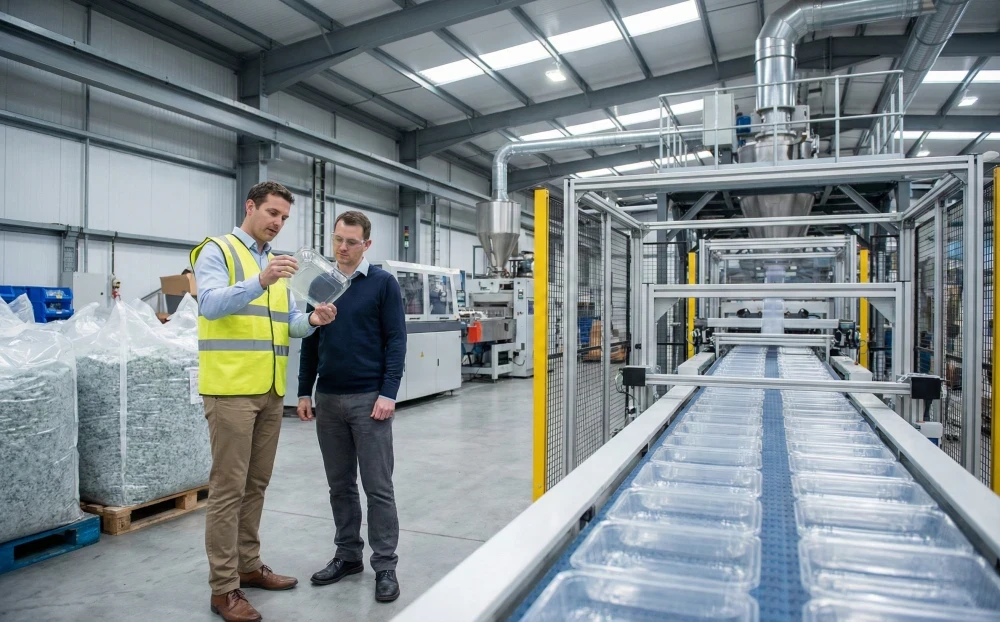
The first pillar of evaluation is the manufacturer’s internal capacity. Procurement teams must look beyond the sales brochure to understand the actual machinery driving the production. A supplier with limited or aging equipment cannot guarantee the stability needed for large-scale retail distribution.
The Importance of Integrated 9-Line Production
In the packaging industry, a 9-line production setup represents a benchmark for high-volume efficiency and technical versatility.
- Operational Redundancy: Multiple lines ensure that a mechanical failure on one machine does not result in a total delivery delay.
- Material Versatility: High-end lines are better equipped to handle the specific thermal sensitivities of recycled polymers, preventing the “yellowing” or “brittleness” often found in lower-grade outputs.
- Customization Speed: Integrated facilities can pivot between standard produce trays and custom-embossed deli containers without the long lead times associated with smaller operations.
Quality Control and Batch Consistency
Because recycled feedstock is naturally more variable than virgin resin, the supplier’s quality control (QC) protocols are critical. Procurement officers should ask:
- Does the facility have in-house testing for Intrinsic Viscosity (IV)?
- Are there automated optical sensors on the line to detect and reject black specks or contaminants?
- What is the tolerance range for wall thickness?
Key Takeaway: Technical scale is the foundation of reliability. Always prioritize suppliers who own their extrusion and thermoforming lines to minimize middleman risks.
2. Auditing Food Safety and Regulatory Compliance
In the food service sector, “recycled” must never come at the cost of “safe.” A supplier’s certification stack is the most objective measure of their suitability for direct food contact applications.
FDA and EFSA Decontamination Validation
A professional rPET supplier must provide documented proof that their decontamination process is validated by major global health authorities.
- Letter of No Objection (LNO): This document from the FDA confirms that the recycling process effectively removes 99.9% of potential contaminants.
- Scientific Opinions from EFSA: For those exporting to the European market, EFSA compliance is mandatory to navigate the strict chemical migration limits of the EU.
- Migration Testing: Request recent laboratory reports showing that the plastic does not leach chemicals into acidic or oily food stimulants.
Traceability and “Chain of Custody”
Transparency is the antidote to greenwashing. Evaluating the source of the post-consumer waste is just as important as evaluating the factory.
- Source Verification: Does the supplier source from controlled beverage bottle streams (high-purity) or mixed household waste (higher risk)?
- Certification Standards: Look for Global Recycled Standard (GRS) or RecyClass certifications, which audit the entire supply chain from the collection point to the finished tray.
| Compliance Type | Requirement | Value to Procurement |
| Food-Grade LNO | FDA / EFSA Approval | Legal safety and brand protection |
| Material Traceability | GRS Certification | Verified recycled content claims |
| ISO 9001 | Quality Management | Process consistency and lower defect rates |
Key Takeaway: Compliance documents are not optional; they are the “license to operate” in the global food packaging market.
3. Financial Strategy and Long-term Cost Stability
While the unit price is always a factor, savvy procurement officers evaluate the “Total Cost of Ownership” (TCO). This includes the impact of plastic taxes, shipping efficiencies, and the cost of supply chain disruptions.
Navigating the “Green Premium”
Recycled resin often carries a higher market price than virgin plastic due to the labor-intensive sorting and cleaning processes. However, a strategic supplier helps you offset these costs.
- Tax Mitigation: In regions like the UK and EU, using packaging with 30%+ recycled content exempts you from significant plastic levies. A supplier who can guarantee this percentage helps you avoid penalties.
- Lightweighting Expertise: Can the supplier re-engineer the mold to use 5% less plastic without losing strength? This “lightweighting” reduces both the carbon footprint and the per-unit cost.
- Direct-to-Factory Sourcing: Cutting out distributors and working directly with the manufacturer (like Reliancepak) can reduce margins by 10-15%.
Logistics and Export Capability
For international buyers, the ability to manage complex logistics is a major differentiator.
- Regional Expertise: Does the supplier understand the specific labeling and documentation requirements for the Netherlands, Spain, or the USA?
- Inventory Buffers: Does the manufacturer have the warehouse space to hold safety stock for your peak seasonal demands (e.g., berry harvests or holiday deli sales)?
Key Takeaway: Look for a partner who understands the financial levers of your business, not just a vendor who quotes the lowest price.
4. Evaluating Sustainability Alignment and R&D Support
The packaging landscape is changing rapidly. A supplier should be a partner in innovation, helping you stay ahead of consumer trends and upcoming environmental legislation.
Proactive R&D
A top-tier supplier should be able to suggest improvements to your packaging design. Whether it’s improving the “stackability” of your salad bowls to save shipping space or developing tamper-evident lids that don’t require extra shrink bands, R&D support is a value-added service.
Environmental, Social, and Governance (ESG) Reporting
As corporate reporting requirements become more stringent, your supplier’s ESG performance becomes part of your company’s story.
- Energy Efficiency: Does the factory use renewable energy or high-efficiency reactors to lower the carbon footprint of the production process?
- Social Compliance: Audits like Sedex or BSCI ensure that the labor used to create your packaging meets ethical standards.
Reliancepak understands the high-stakes environment in which procurement officers operate. We suggest contacting our team to discuss your annual volume requirements and to receive a technical dossier on our food-grade capabilities.
The right supplier doesn’t just provide a product; they provide the peace of mind that your supply chain is ready for the circular economy of tomorrow.
Frequently Asked Questions
What is the most common mistake when evaluating rPET suppliers?
Focusing solely on the price per thousand units without verifying the food-grade certification. Using non-certified recycled plastic in food contact can lead to massive recalls and legal liabilities that far outweigh any initial savings.
How do I verify a supplier’s 9-line production claim?
Request a video tour of the facility or, better yet, a third-party audit report. High-capacity manufacturers are usually transparent about their equipment and welcome factory inspections from major procurement teams.
Can rPET suppliers help with custom branding?
Yes. Professional manufacturers offer custom mold services. This allows you to emboss your logo or specific recycling instructions directly into the plastic, enhancing your brand’s “green” credentials at the shelf level.
Does the distance from the factory affect the quality of rPET?
No, but it affects lead times. If you are sourcing from an overseas factory, ensure they have a robust logistics network and a track record of on-time delivery to your specific region.
Why is batch-traceability so important for rPET?
Because post-consumer waste is inherently variable, traceability allows you to pin-point the exact source of a material if a quality issue arises, minimizing the scope of any potential product hold.