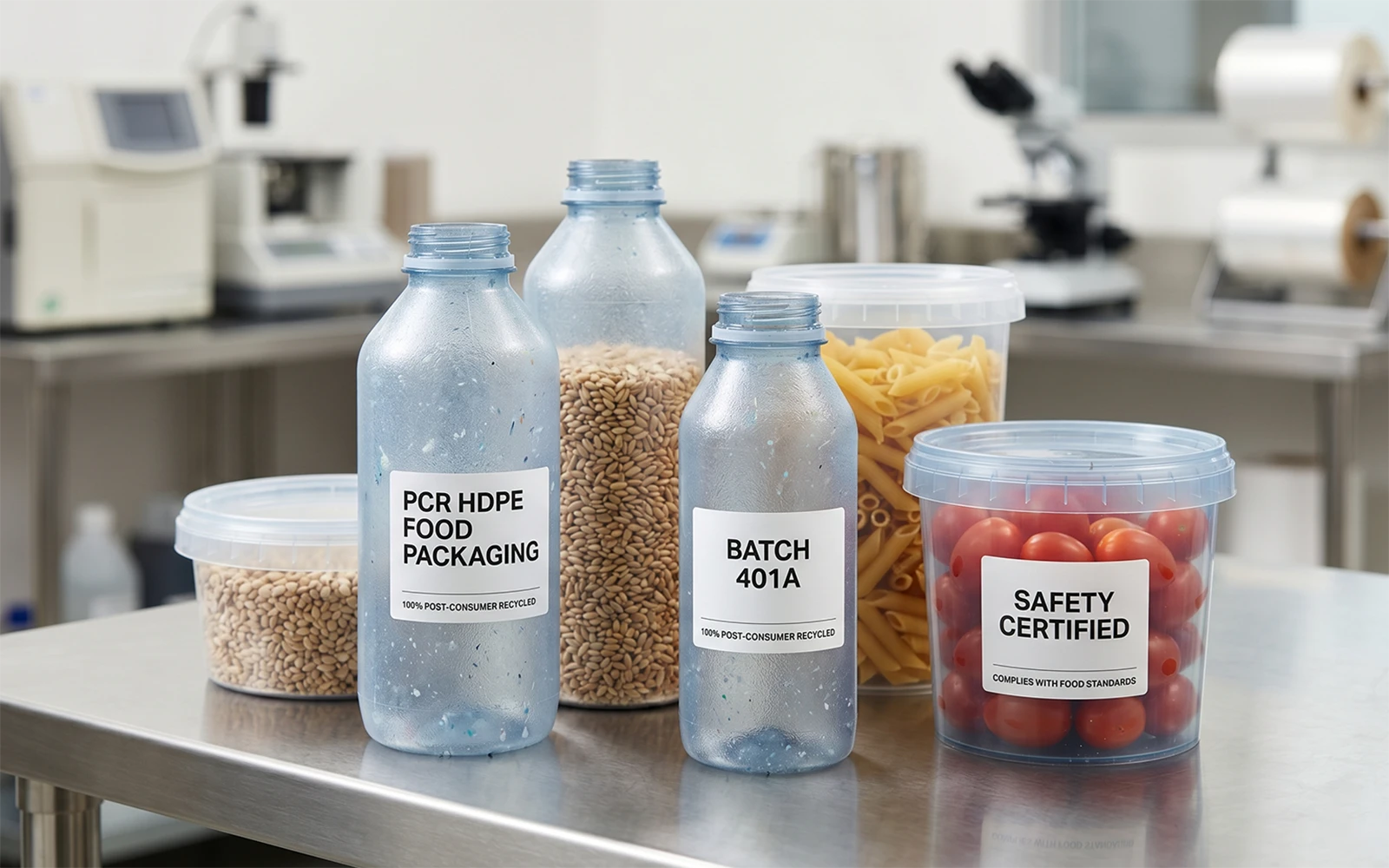
The short answer is yes — but with important strings attached. As food brands and packaging buyers across Europe, North America, and Southeast Asia push toward measurable sustainability targets, recycled HDPE has moved from a niche interest to a mainstream procurement consideration. The question that keeps coming up in purchasing conversations is a fair one: can post-consumer recycled (PCR) HDPE perform safely in direct food contact, or does the recycling process introduce risks that make it unsuitable?
The reality is more practical than either extreme. Recycled HDPE can meet food safety standards, but only when produced under controlled conditions using properly validated recycling processes and backed by the right documentation.
How Food Safety Is Regulated for Recycled HDPE
Food-grade recycled HDPE is not treated the same as virgin food-grade HDPE by regulatory bodies. The FDA evaluates PCR processes on a case-by-case basis, which means there is no blanket approval for “recycled HDPE” as a material category. Each production line and decontamination method must be individually reviewed and cleared.
The FDA Letter of Non-Objection
If a supplier claims their recycled HDPE is suitable for food contact, the first document you should request is the FDA Letter of Non-Objection (LNO) or the equivalent EU documentation. This letter defines three critical parameters:
- The maximum PCR content allowed in the final product
- The temperature range within which the material is considered safe
- The types of food the material is permitted to contact
Without this documentation, a food-grade claim is essentially unverifiable. No reputable supplier will object to sharing it.
How Decontamination Makes PCR HDPE Food-Safe
Standard mechanical recycling — grinding, washing, and re-pelleting — is not sufficient for food contact. The contaminants absorbed by HDPE during its first life cycle (think detergent residues, cosmetic chemicals, and environmental pollutants) remain in the polymer matrix after basic washing. Two technologies bridge this gap:
- Super-clean extrusion. A multi-stage process that applies heat, vacuum, and in some cases chemical agents to strip volatile contaminants at the molecular level. This is currently the industry standard for food-grade HDPE recycling.
- Solid-state polycondensation (SSP). More commonly associated with PET recycling, this process is increasingly being adapted for HDPE. It raises the polymer’s intrinsic viscosity while driving off residual contaminants.
These processes add cost — typically 15–30% more than standard mechanical recycling — which is why food-grade PCR HDPE commands a premium. But they are also what makes the material regulatory-compliant.
The Practical Challenges Buyers Should Know
Even with proper decontamination, recycled HDPE behaves differently from virgin material during processing. If you are sourcing food-grade HDPE packaging from a new supplier, these are the variables that deserve attention:
| Challenge | Impact on Production | Typical Mitigation |
|---|---|---|
| Melt flow index variability | Inconsistent wall thickness in thermoformed or injection-molded parts | Blend PCR with virgin resin; request MFI certification per batch |
| Odor absorption | Residual consumer-product odors migrating into food packaging | Specify deodorization treatment; verify with sensory panel testing |
| Color inconsistency | Visible batch-to-batch variation, especially in natural/translucent grades | Limit PCR to pigmented applications or tighten color tolerance specs |
None of these challenges make recycled HDPE unsafe. They make it harder to process consistently. For most B2B buyers, the practical question is not “is it safe?” but “can my production line handle the variability at my target PCR percentage?”
What Percentage of Recycled Content Is Realistic
For most food contact applications, 25% to 50% PCR content is achievable without compromising mechanical integrity or safety performance. The upper bound depends on several factors:
- Food type. Dry goods and ambient-temperature products tolerate higher PCR ratios than fatty, acidic, or hot-fill applications.
- Processing method. Blow molding generally handles higher PCR content than thin-gauge thermoforming.
- Regulatory jurisdiction. The EU tends to set more conservative PCR limits than the FDA for equivalent applications.
For buyers who are new to recycled HDPE, a staged approach works best. Start with 10% recycled content in a single SKU, run at least three production batches, validate mechanical and sensory quality at each stage, and scale up only when consistency is confirmed. This reduces both financial exposure and operational risk.
What to Ask When Sourcing Food-Grade PCR HDPE
Supplier verification is where most procurement gaps occur. When evaluating a potential supplier, these are the verification steps that carry real weight:
- Request the FDA LNO or EU equivalent and confirm it covers your specific food-contact application and temperature range.
- Ask which decontamination process is used. If the answer is vague or limited to “washing and re-pelleting,” that material is not food-grade.
- Confirm batch traceability — the supplier should be able to trace every lot back to its original recycling run and input material source.
- Review MFI and density data per batch, not just the published typical values. Variability between lots is normal, but it needs to stay within your processing window.
Suppliers like Reliancepak, who integrate manufacturing with direct sourcing and hold food-grade certifications covering both EU and FDA standards, offer a practical advantage here — they control more of the quality chain and can provide the documentation buyers need without back-and-forth delays.
The Bottom Line
Recycled HDPE packaging can meet food safety standards, provided the right decontamination technology is used, the certifications are in place, and the buyer goes in with realistic expectations about material behavior. It is not a drop-in replacement for virgin HDPE in every scenario. But for the majority of food packaging use cases, a 25–50% PCR blend delivers safety, performance, and sustainability without meaningful compromise.
The deciding factor is supplier verification. The market has food-grade recycled HDPE available. But not all recycled HDPE is food-grade. That distinction is everything — and the documentation is how you prove it.
FAQ
Can recycled HDPE be used for direct food contact?
Yes.
Recycled HDPE processed with FDA-approved decontamination technology (such as super-clean extrusion) is permitted for direct food contact. Always verify the supplier holds a valid FDA Letter of Non-Objection for your specific application.
What is the difference between food-grade and non-food-grade recycled HDPE?
Food-grade PCR HDPE undergoes additional decontamination beyond standard mechanical recycling. Non-food-grade material may retain residual contaminants and is not certified for food contact. Always request the FDA LNO or equivalent to confirm the grade.
How much recycled content is realistic for food packaging?
For most applications, 25% to 50% PCR content is feasible. Start with a 10% pilot run, validate quality across multiple batches, check regulatory limits for your region, then scale gradually based on real results.
Does recycled HDPE cost more than virgin HDPE?
Yes.
Food-grade recycled HDPE typically costs 10–25% more than virgin due to additional decontamination processing and certification overhead. Many buyers find the premium is offset by sustainability reporting value and regulatory positioning.