
Recycled Polyethylene Terephthalate, commonly known as rPET, is a high-grade plastic material produced by collecting, cleaning, and reprocessing post-consumer PET waste into new packaging solutions. This material serves as a sustainable alternative to virgin plastic, allowing manufacturers to create a closed-loop system that reduces environmental impact while maintaining the safety standards required for food contact.
Procurement officers and food service distributors face increasing pressure from both regulatory bodies and eco-conscious consumers to transition away from single-use virgin plastics. You likely deal with the challenge of balancing strict food safety compliance with the need for sustainable brand positioning, all while managing fluctuating supply chain costs. This guide provides a technical breakdown of rPET plastic, offering the data and insights necessary to integrate recycled materials into your inventory without compromising on quality or durability.
What defines rPET in the food packaging industry?
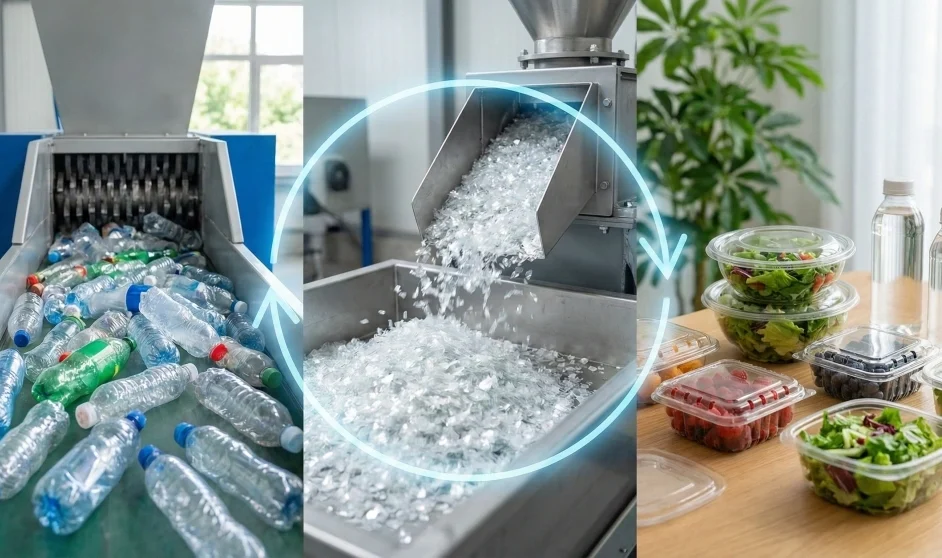
rPET is a polymer created through the mechanical or chemical recycling of existing PET products, primarily clear water and soda bottles, to be used again in manufacturing. In the food packaging sector, this means transforming waste into food-grade containers that meet the same rigorous safety requirements as new plastic.
The mechanical recycling process
The journey from waste to a food-grade tray involves several technical stages designed to eliminate impurities. Here is the deal: the process must be precise to ensure the final resin is free of contaminants that could migrate into food.
- Collection and Sorting: Post-consumer waste is gathered and sorted by material type and color using infrared sensors.
- Grinding and Washing: The plastic is shredded into flakes and subjected to a hot caustic wash to remove labels, adhesives, and residues.
- Decontamination: High-temperature vacuum processes remove volatile organic compounds and ensure the material meets FDA or EU safety standards.
- Pelletizing: The clean flakes are melted and extruded into uniform pellets ready for thermoforming or injection molding.
Applications in modern food service
The versatility of this material allows it to replace virgin plastic in almost every cold-chain application. You might find that the performance characteristics remain nearly identical to traditional PET.
- Produce Trays: Used for berries, salad greens, and delicate fruits where high clarity is a priority for shelf appeal.
- Beverage Bottles: The most common use case, supporting circularity in the water and carbonated soft drink industries.
- Prepared Food Containers: Ideal for deli items, cold salads, and grab-and-go snacks that require a secure, leak-proof seal.
- Lids and Accessories: Providing the necessary tension and fit to match with both plastic and paper-based bowls.
| Processing Stage | Purpose | Outcome |
| Sorting | Remove non-PET materials | High purity base material |
| Cold/Hot Wash | Remove external debris | Clean flakes |
| Solid State Polymerization | Increase viscosity | Food-grade safety compliance |
The transition from raw waste to finished resin requires sophisticated 9-line production capabilities to ensure consistent material flow and safety.
Key Takeaway: rPET is a technically processed recycled polymer that provides a functional, food-safe alternative to virgin plastic for diverse packaging needs.
Is rPET packaging always 100% recycled material?
rPET packaging can contain anywhere from 10% to 100% recycled content, depending on the specific requirements for clarity, strength, and price. While 100% rPET is technically achievable, many manufacturers use a blend of recycled and virgin materials to balance performance with cost-efficiency.
Understanding the blend ratio
Determining the right percentage of recycled content is a strategic decision for your supply chain. Look at it this way: the higher the recycled content, the more the carbon footprint is reduced, but the aesthetic properties may change.
- 100% rPET: Offers the maximum environmental benefit and satisfies the strictest sustainability mandates.
- 50% – 70% Blend: A common middle ground that maintains high clarity while significantly reducing the use of virgin resin.
- 30% Blend: Often used to meet minimum regulatory requirements in regions like the UK or EU while keeping costs stable.
Certification and safety verification
When sourcing rPET, the percentage of recycled content must be verified by third-party certifications to avoid “greenwashing” claims. This is a common concern for procurement managers who need to prove compliance to their own clients.
- FDA/EFSA Approval: Ensures the recycling process effectively removes contaminants, making the material safe for direct food contact.
- GRS (Global Recycled Standard): Tracks and verifies the content of recycled materials in the final product.
- SCS Global Services: Provides certification for recycled content percentages to ensure transparency in the labeling.
| Recycled Content | Clarity Level | Market Application |
| 100% | Slight grey/blue tint | Eco-premium brands |
| 50% | High clarity | Standard retail packaging |
| 25% | Near-perfect clarity | High-end visual displays |
The choice between 100% recycled content and a blend depends on your brand’s sustainability targets and the visual expectations of your end-users.
Key Takeaway: While 100% rPET is available, many B2B buyers utilize customized blends to achieve a balance between environmental goals and product aesthetics.
How does rPET compare to virgin PET performance?
rPET maintains the same fundamental physical properties as virgin PET, including high impact resistance, excellent moisture barriers, and superior transparency. In most food packaging applications, the end-user will not notice a functional difference between a recycled tray and a virgin one.
Physical durability and barrier properties
The molecular structure of PET remains stable even after the recycling process. The fact is, rPET provides the same protection for food products, ensuring shelf-life is not compromised.
- Impact Strength: Both materials are highly resistant to cracking or breaking during transit, which is critical for bulk distribution.
- Gas Barrier: rPET effectively blocks oxygen and CO2, preserving the freshness of fruits, vegetables, and carbonated liquids.
- Moisture Resistance: Prevents the absorption of humidity, keeping dry goods crisp and preventing leaks in wet food applications.
Aesthetic differences and color consistency
While performance remains high, there are subtle visual variations that you should be aware of. This is where the deal changes: virgin PET is perfectly colorless, while high-percentage rPET may have a slight tint.
- Visual Tint: High concentrations of recycled material can result in a very faint yellow, blue, or grey hue.
- Inclusion Specks: Occasionally, tiny specks may be visible in the plastic, which are remnants of the recycling process that do not affect safety.
- Customization: Professional manufacturers can use food-safe additives to neutralize tints and provide the clear look your customers expect.
| Feature | Virgin PET | rPET (Recycled) |
| Food Safety | Certified | Certified (if food-grade) |
| Recyclability | 100% | 100% |
| Transparency | Crystal Clear | Near-Clear to Slight Tint |
| Carbon Footprint | High | Low |
The technical performance of rPET ensures that transitioning to sustainable materials does not result in higher product loss or customer complaints due to packaging failure.
Key Takeaway: rPET offers nearly identical functional performance to virgin plastic, making it a reliable drop-in replacement for food-grade applications.
Why does rPET packaging cost more than virgin plastic?
The higher cost of rPET packaging is primarily driven by the complex logistics of collection, the energy-intensive cleaning process, and the high demand for food-grade recycled resin. Unlike virgin plastic, which is tied to the price of crude oil, rPET costs are dictated by the efficiency of recycling infrastructure.
The complexity of the supply chain
Producing recycled resin involves more manual and technical steps than manufacturing virgin plastic from oil. Think about it: every bottle must be diverted from a landfill, transported, and processed before it even reaches the factory.
- Collection Costs: Intensive labor and logistics are required to gather post-consumer waste from various locations.
- Sorting Efficiency: Advanced technology is needed to separate PET from other plastics like PVC or HDPE to prevent contamination.
- Decontamination Energy: The high-vacuum and heat treatments required to achieve food-grade status add to the overall utility costs.
Market demand and availability
As global brands commit to sustainability, the demand for high-quality rPET often exceeds the available supply. Here is the reality: when supply is tight, prices for certified food-grade flakes increase.
- Corporate Mandates: Large beverage and food companies are buying up massive quantities of rPET resin, driving up the market price.
- Regulatory Taxes: Many countries are implementing plastic taxes on virgin material, which indirectly increases the competitive value and price of recycled alternatives.
- Limited Infrastructure: Not all regions have the 9-line production capacity or advanced recycling facilities to produce food-safe rPET, creating regional price variations.
| Cost Driver | Virgin PET | rPET |
| Raw Material | Crude Oil / Natural Gas | Post-consumer Waste |
| Processing | Chemical Polymerization | Mechanical/Chemical Recycling |
| Price Stability | Tied to Oil Market | Tied to Collection Rates |
While the initial price per unit may be higher, the long-term value lies in brand loyalty, regulatory compliance, and the avoidance of virgin plastic taxes.
Key Takeaway: The price premium for rPET is an investment in a specialized supply chain that ensures safety and fulfills environmental mandates.
How to source reliable rPET food containers in bulk?
Sourcing rPET containers requires finding a supplier that combines large-scale manufacturing capacity with strict food-grade certifications. For a procurement manager, the focus must be on finding a partner that offers factory-direct pricing and stable lead times to maintain inventory levels.
Verifying manufacturer credentials
A reliable supplier should operate as an integrated trade and factory entity to ensure full control over the quality of the recycled resin. The fact is, you cannot afford to have a gap between the sample quality and the bulk order.
- Facility Audits: Ensure the factory has dedicated lines for rPET to prevent cross-contamination with non-food-grade plastics.
- Certification Access: Request current FDA, EU, or GRS certificates before placing large-scale orders.
- Sample Testing: Always utilize free sample programs to test the clarity, thickness, and seal integrity of the rPET containers in your specific environment.
One-stop procurement strategies
To optimize costs, look for suppliers that can provide a full range of rPET and associated sustainable products under one roof. This simplifies logistics and reduces the risk of communication errors.
- Product Variety: Select a partner that offers everything from rPET trays to paper bags and cups to consolidate your shipping.
- Customization Services: Ensure the manufacturer can adjust the recycled content percentage and dimensions to meet your specific food-service needs.
- Stable Delivery: Prioritize factories with multiple production lines that can guarantee fast delivery even during periods of high resin demand.
| Sourcing Factor | Why it Matters | Buyer Action |
| Factory-Direct | Lower wholesale margins | Skip the middleman |
| Certification | Legal compliance | Verify EU/FDA documents |
| Sample Program | Quality assurance | Request and test physical units |
By focusing on integrated manufacturers who provide transparent data and certified quality, you can secure a stable supply of rPET packaging that meets your performance and sustainability goals.
Key Takeaway: Reliable rPET sourcing depends on choosing a partner with high-volume production lines and verified food-safe certifications.
Summary
Transitioning to rPET packaging is a strategic move that aligns your business with global sustainability trends while maintaining the high standards of food safety your customers demand. Reliancepak provides the technical expertise and 9-line production capacity necessary to supply high-quality rPET containers, trays, and lids that fit your specific requirements. We suggest contacting our team to discuss your customized packaging needs or to request a free sample of our food-grade rPET solutions.
The packaging industry is moving toward a circular economy where waste is viewed as a resource, and rPET stands as the most viable path forward for food-safe plastic applications.
Frequently Asked Questions
Can rPET be recycled again after use?
Yes. rPET is a highly recyclable material that can go through the recycling loop multiple times, although some virgin resin may be added in subsequent cycles to maintain structural integrity. This recyclability supports the circular economy by keeping plastic out of landfills and oceans.
Is rPET safe for hot food applications?
No. Standard rPET, like virgin PET, has a relatively low heat distortion temperature and is primarily designed for cold or room-temperature food storage. If your application requires high-heat resistance, you might consider C-PET or specialized paper-based alternatives.
How can I tell if a container is made from rPET?
Most rPET containers will feature the standard #1 recycling symbol, often accompanied by a “Post-Consumer Recycled” (PCR) label or a specific percentage mark. Many brands also include a slight blue or grey tint as a visual cue to consumers that the packaging is sustainable.
Does rPET packaging have a shelf life?
No. The material itself is highly stable and does not degrade under normal storage conditions in a warehouse or on a retail shelf. As long as the containers are kept in a cool, dry place away from direct UV light, they will maintain their physical properties indefinitely.
Can I get custom sizes for rPET food trays?
Yes. Integrated manufacturers with professional customization services can create molds for specific dimensions, depths, and compartment configurations. This allows you to tailor the packaging to your specific product, such as pre-cut vegetables or specialized pastry assortments.