HDPE (High-Density Polyethylene) packaging remains the dominant choice for food brands because it solves two critical operational problems at once: reliable performance during cold-chain logistics and full compliance with global food contact safety regulations.
Walk through any supermarket dairy aisle or fresh produce section, and you will notice that milk jugs, yogurt tubs, berry baskets, and meat trays are overwhelmingly made from the same material. Some procurement managers wonder why brands have not switched to newer alternatives like compostable plastics or paper-based solutions. The reality is that HDPE packaging delivers a combination of toughness, moisture resistance, and cost efficiency that these alternatives struggle to match in high-volume, multi-temperature supply chains. This article explains the specific reasons food brands across dairy, produce, and meat sectors continue to rely on HDPE packaging for their daily production needs.
Why Do Food Brands Trust HDPE for Cold-Chain and Fresh Food?
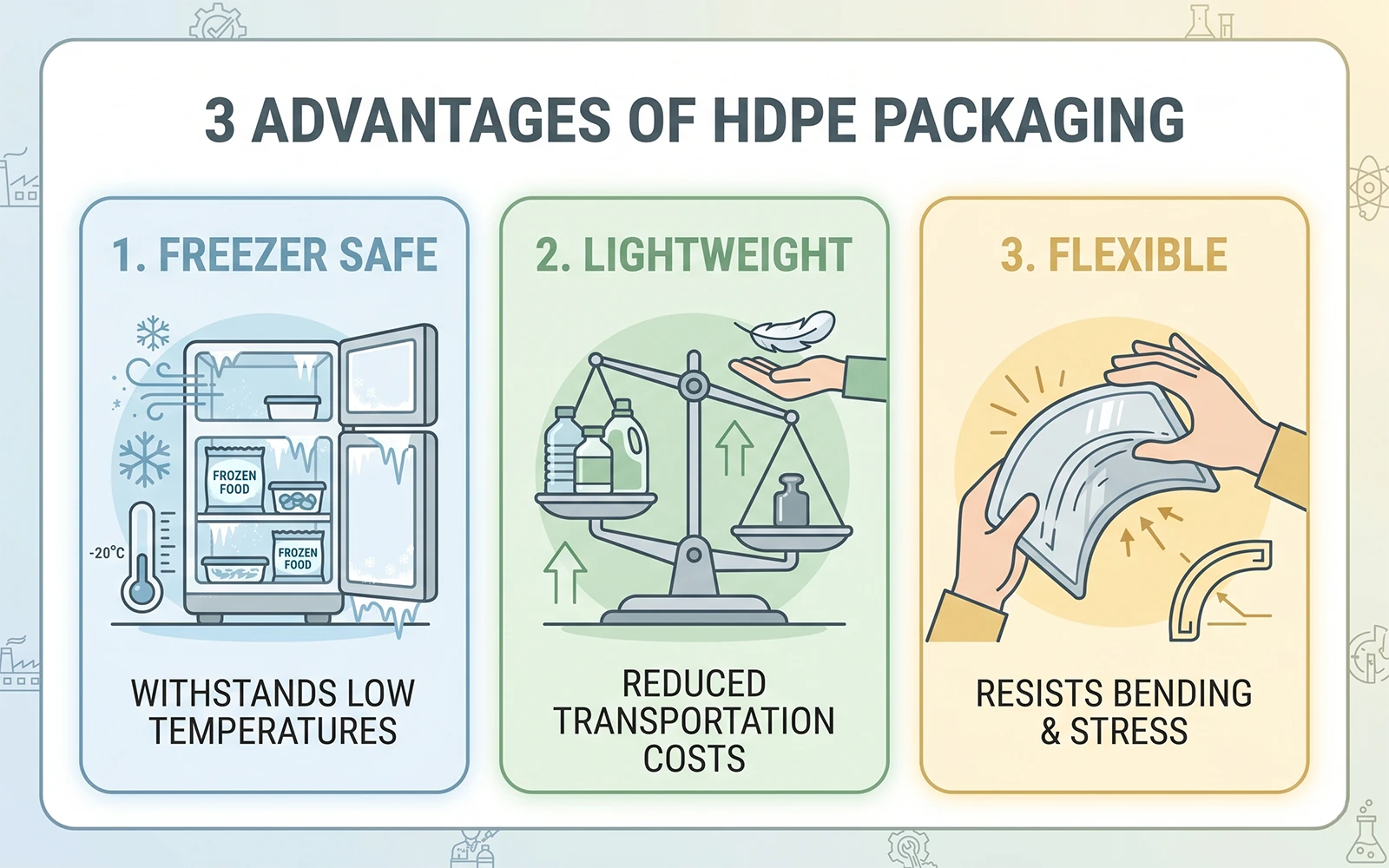
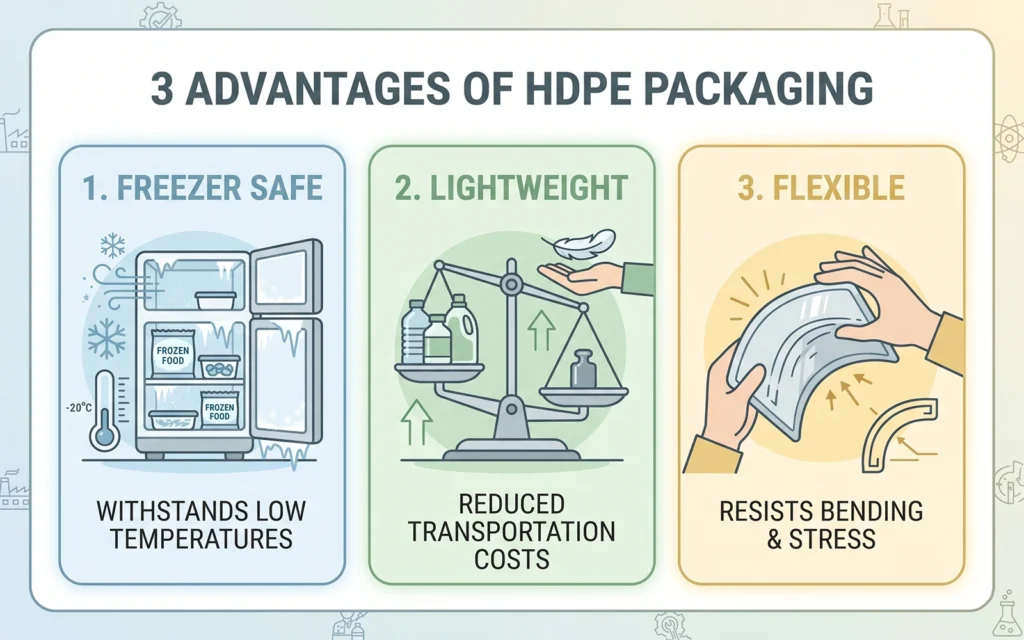
HDPE packaging maintains its structural integrity across extreme temperature ranges, from -40°C during frozen transport up to 120°C during short hot-fill cycles. This wide operating window means a single container design can serve both refrigerated dairy products and room-temperature pantry items without cracking or warping. Learn more in the pillar guide
Durability Under Refrigerated and Frozen Conditions
Many plastic alternatives become brittle below freezing. A polypropylene tray may shatter when dropped from a warehouse rack at -10°C, while an HDPE container flexes and bounces back. For food brands distributing fresh poultry or frozen vegetables, this toughness directly reduces product loss during transit. The low moisture absorption of HDPE, less than 0.01% weight gain in water, also prevents soggy packaging in humid cold rooms.
- Impact resistance at low temperatures: HDPE retains 80% of its room-temperature impact strength at -20°C.
- No condensation pooling: The material’s low water absorption keeps printed labels legible and trays dry.
- Stacking stability: HDPE containers maintain dimensional accuracy under heavy loads during palletized shipping.
Key Takeaway: For distributors who ship dairy or frozen goods, HDPE packaging eliminates the return costs caused by cracked containers and leaking seals.
Compliance With Direct Food Contact Rules
HDPE is one of the few plastics that carries broad regulatory acceptance without requiring additional barrier layers. Virgin-grade HDPE does not contain BPA or phthalates, and its migration limits for total extractables are well below FDA and EU safety thresholds. Food brands avoid the certification delays and documentation burdens that come with novel materials.
Key Takeaway: Choosing HDPE packaging simplifies your supplier qualification process because most factories already hold FDA 21 CFR 177.1520 and EU Regulation 10/2011 compliance on standard product lines.
What Specific Benefits Does HDPE Offer Over PET and PP?
HDPE packaging occupies a unique position in the plastics family: it combines the toughness needed for automated packing lines with the recyclability demanded by modern sustainability goals. PET offers clarity but lacks heat resistance above 70°C. PP handles microwave heating but fails impact tests at low temperatures. HDPE delivers reliable performance across both cold and warm applications.
Weight Advantage in Bulk Shipments
A 500ml HDPE container weighs roughly 15% less than a comparable PP container yet carries the same load capacity. For a distributor importing 100,000 units per shipment, this weight difference translates into measurable freight cost savings. The lighter weight also reduces strain on automated capping and labeling equipment.
Stress Crack Resistance for Snap-On Lids
HDPE withstands repeated flexing at the snap-fit interface without forming micro-cracks. This is critical for yogurt tubs and deli containers where consumers open and close the lid multiple times. PET and PP lids tend to develop stress whitening or hairline fractures after repeated use, leading to customer complaints about leaking.
Key Takeaway: If your product line includes containers with snap-on lids, HDPE packaging reduces the defect rate from lid cracking by up to 60% compared to other plastics.
Is Recycled HDPE Packaging Suitable for Food Contact?
Yes, when produced under controlled conditions with FDA-approved recycling processes. Food brands are increasingly using post-consumer recycled (PCR) HDPE to meet sustainability targets without sacrificing food safety. The FDA evaluates PCR processes on a case-by-case basis, issuing Letters of Non-Objection that specify the maximum recycled content allowed.
Recommended PCR Content Levels
For most direct food contact applications, a blend of 25% to 50% PCR content in HDPE packaging delivers acceptable performance. The key requirement is that the PCR material undergoes decontamination through super-clean extrusion or solid-state polycondensation. Food brands should request the FDA Letter of Non-Objection from their packaging supplier to verify that the recycling process is certified for their specific product category.
Challenges to Monitor With Recycled Content
Melt flow index variability increases as recycled content rises above 30%. This can cause inconsistent wall thickness during injection molding. Odor absorption is another concern, particularly for neutral-flavored products like milk or water. Start with a 10% PCR pilot order to validate quality before scaling to higher percentages.
Key Takeaway: Recycled HDPE packaging is a viable option for food brands, but you need documented traceability from your supplier to maintain regulatory compliance and product consistency.
What Quality Checks Matter Most for HDPE Packaging?
Quality in HDPE packaging comes down to three objective parameters: material density consistency, dimensional tolerance, and impact resistance. Food brands that skip incoming quality checks often discover problems only after a full production run.
Field Verification Without Expensive Equipment
You can assess HDPE packaging quality with simple manual tests. Weigh a sample and compare against the agreed target weight. A variance above 3% indicates inconsistent wall thickness that may cause stacking failures. Squeeze the sidewalls firmly. High-quality HDPE flexes and springs back without whitening at stress points.
- Drop test: Fill the container with water at 4°C, seal, and drop from 1.2 meters. Accept zero cracks.
- Torque test: Measure cap removal torque. Values between 8 and 15 in-lbs indicate proper thread formation.
- Density check: Float a sample in a water-alcohol solution. HDPE density ranges from 0.941 to 0.965 g/cm³.
Key Takeaway: Request a first article inspection report from your supplier before mass production. A factory that cannot produce this data is not ready for bulk orders.
How Do Food Brands Ensure Supply Stability With HDPE?
Supply stability matters more to experienced food brands than the lowest per-unit price. A $0.02 savings per container means nothing if a shipment is delayed during the seasonal product launch window.
Choosing the Right Supplier Tier
Tier 1 suppliers operate their own tool shops, maintain in-house testing labs, and export to regulated markets regularly. For food brands serving FDA or EU markets, Tier 1 suppliers save weeks of certification validation time because they maintain FDA and EU documentation per individual SKU. Tier 2 suppliers may offer lower MOQs but often lack the in-house testing capability to catch batch-to-batch variation.
| Criterion | Tier 1 Supplier | Tier 2 Supplier |
|---|---|---|
| FDA/EU certification on file | Yes, per SKU | Generic resin only |
| In-house testing lab | Yes | No, outsourced |
| Typical MOQ for custom molds | 50,000–100,000 units | 10,000–30,000 units |
| Lead time for bulk orders | 25–35 days | 15–20 days |
| English-speaking sales engineer | Yes | Translator required |
Analysis: Tier 1 suppliers justify their slightly longer lead times with better quality documentation and reduced risk of customs delays.
Key Takeaway: Match your supplier tier to your certification requirements, not to your budget alone. A Tier 1 supplier for your core product line reduces long-term supply risk.
Making Your Next HDPE Packaging Decision
Food brands that understand the material properties, certification requirements, and supplier quality benchmarks of HDPE packaging consistently outperform competitors who switch materials based on short-term cost trends. Reliancepak delivers factory-direct pricing on certified, food-grade HDPE containers and trays with full FDA and EU documentation, custom mold design support, and 25 to 35 day lead times. Contact Reliancepak to request free samples or a technical consultation for your next project. The food packaging industry is moving toward stricter compliance and higher recycled content standards. Building a relationship with a technically capable supplier now positions your business to capture growth as these shifts accelerate.
FAQ
Can I use HDPE packaging for hot-fill products?
Yes. HDPE withstands short-term exposure up to 120°C. For continuous hot-fill above 90°C, request a heat deflection temperature test from your supplier.
How do I verify that my HDPE packaging supplier uses food-grade resin?
Request the resin supplier’s certificate of analysis and compare the melt flow index to standard food-grade HDPE grades. Also ask for a finished product migration test report.
Is HDPE packaging microwavable for reheating?
Yes for short reheating cycles. HDPE softens above 120°C. For repeated microwave use, select PP or CPET instead.
What is the typical MOQ for custom HDPE packaging molds?
50,000 to 100,000 units per SKU for single-cavity tooling at most factory-direct suppliers. Lower MOQs may use shared tooling or stock molds.